
Business research used to be a project with a start date and a deadline. AI is turning it into a continuous process — one that surfaces what matters before you think to look for it.
Business research has always been expensive — not necessarily in money, but in time. Producing a useful picture of a market, a competitor set, or a prospect landscape required sustained attention from someone who knew where to look, what to look for, and how to synthesise what they found into something actionable. In large organisations, that someone was an analyst or a research function. In small organisations, it was whoever had the most time that week — which usually meant it did not happen as thoroughly as it should have, or as often.
The result was a familiar pattern in small business strategy: decisions made on research that was too old, too incomplete, or too superficial to be fully trusted. The market analysis that shaped last year’s strategy was conducted eighteen months ago. The competitive landscape assessment that informed the pitch was produced from a morning’s worth of searches. The prospect research that preceded the important meeting was whatever the business development lead could pull together between two other calls.
Stop building consolidations in spreadsheets.
BrizoConsol automates multi-entity consolidation — setup in minutes, reports the same day.
AI is changing the economics of business research in a way that is more significant than most commentary acknowledges. It is not simply making research faster — it is making continuous, comprehensive research viable for organisations that previously could not afford the staff hours required to conduct it consistently.
What Business Research Looked Like Before
Traditional business research was episodic. It happened before a major strategic decision, before a significant pitch, before a new market entry. Between those moments, the organisation’s picture of its competitive environment was static — shaped by the last research cycle and updated only by information that happened to come through existing channels. A competitor’s pricing change might be noticed by a client mention or a chance encounter at an industry event. A target company’s leadership change would only become visible when someone thought to check LinkedIn. A new market entrant would surface only when they appeared in a prospect conversation or a search result.
The episodic nature of research was not a choice — it was a constraint. Research takes time, and the time required to research continuously was not available in most small organisations. The research that did happen was thorough within its scope but narrow in frequency. The gaps between research cycles were filled by assumption and by the slow degradation of an increasingly stale picture of the market.
Research conducted once a quarter describes a market that is updating every day. The gap between the two is where opportunities expire and risks compound unnoticed.
The Three Ways AI Has Changed the Research Process
Speed of synthesis. The most immediately visible change is the compression of the time required to synthesise a research landscape from hours to minutes. A competitive analysis that previously required an afternoon of structured reading, note-taking, and synthesis can now be completed in a fraction of the time. AI systems can process and synthesise far more source material than a human researcher working at normal speed, and they can do it without the attention fatigue that makes human research less reliable over long sessions. The effect is not just efficiency — it is the practical elimination of depth as a trade-off against breadth.
Continuity of monitoring. The second and more structural change is the shift from episodic to continuous research. AI systems can monitor a defined competitive or market landscape continuously — tracking company developments, leadership changes, financial signals, product announcements, regulatory filings, and public signals of strategic intent — and surface changes as they occur rather than waiting for the next research cycle. The market picture is no longer a snapshot produced at a point in time. It is a continuously updated view that reflects current conditions.
Specificity of output. The third change is the shift from general research output to specific actionable intelligence. Traditional research produced briefs, reports, and summaries — synthesised information that a decision-maker then had to read, interpret, and convert into a specific action or decision. AI-driven research can produce conclusions rather than information — not “here is what we found about the competitive landscape” but “this specific competitor has changed their pricing model in a way that affects two of your active deals, and here is which ones.”

What This Means for Market Analysis Specifically
Market analysis has historically been the category of research most dependent on specialist resources. A thorough market analysis for a professional services firm entering a new segment required interviews, secondary research, financial data, competitive mapping, and the analytical capacity to synthesise all of it into a coherent strategic picture. The investment required placed genuine market analysis beyond the practical reach of most small businesses, who substituted instinct and anecdotal observation for the structured process.
AI changes this access equation materially. The data sources required for market analysis — company filings, news flows, financial databases, industry publications, job posting data as a proxy for strategic intent, web signal data as a proxy for buying readiness — are now processable at a scale and speed that makes continuous market monitoring viable without a research analyst. The analysis that previously required a specialist with access to expensive data sources can now be produced by an AI system working from publicly available and commercially accessible data.
For accounting practices and professional services firms assessing their target market, this means the ability to identify which companies in a target segment are showing signs of organisational change — leadership transitions, entity restructuring, geographic expansion, acquisition activity — that typically precede an increase in demand for the services those firms provide. The ability to monitor the competitive environment continuously rather than assessing it annually. The ability to understand the market conditions affecting a specific client before a review meeting rather than relying on what the client volunteers during it.
The Quality and Reliability Dimension
A candid assessment of AI-driven business research has to address the quality and reliability question directly, because the limitations are real and they matter for how the output should be used.
AI research systems are highly effective at processing and synthesising structured, publicly available information. They are less reliable at making nuanced judgments about the significance of what they find — distinguishing a genuine strategic signal from a noise event, assessing whether a competitor’s announcement represents a real capability shift or a marketing positioning change, inferring the internal strategic logic behind a series of observable decisions. These are judgments that currently require human expertise applied to the AI’s output, rather than being delegatable to the AI itself.
The practical implication is that AI-assisted market analysis is most valuable when it is used as a first layer that surfaces the right things for a human expert to assess, rather than as a final layer that produces conclusions without further review. The AI handles the monitoring, the synthesis, and the initial pattern identification. The expert handles the interpretation of significance and the conversion of findings into strategic judgments. This division of labour produces better outcomes than either the AI or the expert working alone.
Prospect Research and Business Development Intelligence
The category of business research most immediately transformed by AI for small professional services firms is prospect and relationship research — the intelligence required to identify the right companies to approach, understand their current situation and needs, and time outreach to maximise the likelihood of a productive conversation.
Traditional prospect research was among the most time-consuming categories of business development activity. Understanding a target company well enough to approach it with a relevant value proposition required reviewing financial statements, reading recent news, assessing organisational structure, identifying key decision-makers and their backgrounds, and synthesising all of this into a picture of the company’s current situation and likely needs. For a practice director doing business development alongside client management responsibilities, the time required to do this properly for each target company was prohibitive.
AI compresses this research to a fraction of the previous time requirement while simultaneously improving its depth. A comprehensive prospect brief can be produced in minutes rather than hours. And when that research is embedded in a continuous monitoring layer rather than conducted on-demand before each outreach, it arrives at the moment of relevance rather than requiring the practice director to remember to conduct it.
What Good AI-Assisted Research Looks Like in Practice
The organisations that are getting the most value from AI-assisted business research share a common approach. The starting point is defining the research universe precisely. AI research produces better output when the scope is clearly defined — which companies, which signals, which changes, which relationships are worth monitoring. The precision of the definition determines the relevance of the monitoring.
The second element is integrating the research output into the operational workflow rather than treating it as a separate research function. The most effective AI-assisted research does not produce reports that then need to be read, translated, and acted on — it surfaces specific actionable items directly in the context where decisions are made. A target company’s leadership change surfaces as an outreach prompt, not as a footnote in a monthly research digest. A client’s expansion into a new jurisdiction surfaces as a service opportunity, not as background information in a quarterly competitive review.
The third element is maintaining the human judgment layer. The practice director or business development professional who uses AI research effectively is not using it as a substitute for their own knowledge of the market and their relationships within it — they are using it as a tool that ensures their knowledge and relationships are applied at the right moment to the right company, rather than being deployed based on whatever happens to be in the front of mind on any given day.
Where BrizoMarket Fits
BrizoMarket is BrizoSystem’s market intelligence platform for professional services firms and lean business development teams in Singapore and the region. It is built specifically around the research and market analysis challenge that small accounting practices and professional services firms face: the need for continuous, specific, actionable market intelligence without the headcount required to produce it through a traditional research process.
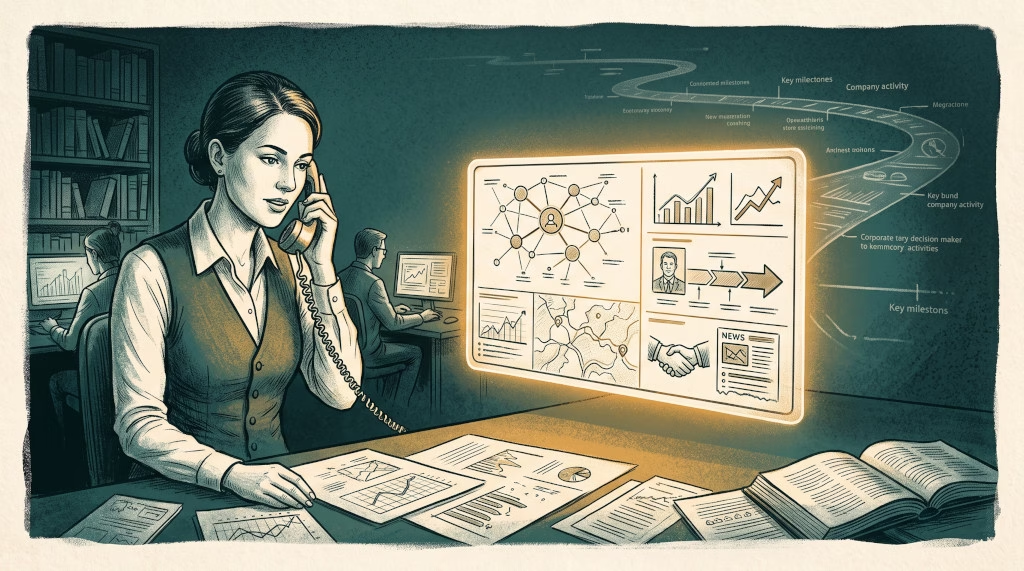
The product monitors a defined universe of companies continuously — tracking the organisational, financial, and strategic signals that indicate a company is at a moment when the services of the practice are likely to be relevant. It surfaces those moments as specific, actionable intelligence rather than as research briefs requiring further interpretation. The practice director receives a notification that a target company has added a new subsidiary across a new jurisdiction, not a weekly market report that mentions the company in a list of sector developments.
AI is redefining what business research and market analysis are capable of producing, and who can access that capability. For small professional services firms that have historically made do with episodic, understaffed, and underinformed research, the access change is the significant story. The market intelligence that used to require a research analyst and an enterprise data subscription is now accessible in a purpose-built product designed for the specific firms that need it most — and priced for the organisations that have historically been priced out of it.