For many finance teams, reporting still happens in cycles. Management receives a monthly pack. Variances are reviewed weeks after they occur. Problems are only discovered after the period has closed. But modern businesses move faster than that — and the delay between something going wrong and finance noticing it is where value is lost.
Finance teams increasingly need to know not just what happened last month, but what is happening now. They need a way to monitor the overall health of the business continuously, identify risks earlier, and focus attention on the areas that matter most. This is the purpose of BrizoConsol’s Pulse Health Scores and Real-Time KPI Monitoring.
Why Traditional Reporting Is No Longer Enough
Traditional reporting is designed around periodic review. Teams prepare reports at month-end, distribute them to management, and then investigate issues that have already happened. The problem is that by the time a report is reviewed, revenue shortfalls may already be significant, costs may have drifted beyond budget, cash flow pressure may be building, or one entity may be underperforming while the rest of the group masks the issue at consolidated level.
Automate NCI calculations across all your entities.
BrizoConsol handles non-controlling interest automatically — no manual adjustments required.
Consolidated financial statements remain essential for statutory compliance and management accountability — but they are backward-looking by design. They tell you where the business has been. For active management, finance teams also need earlier signals: indicators that show when performance is beginning to deteriorate, before the month closes and the opportunity to act has passed.
What Are Pulse Health Scores?
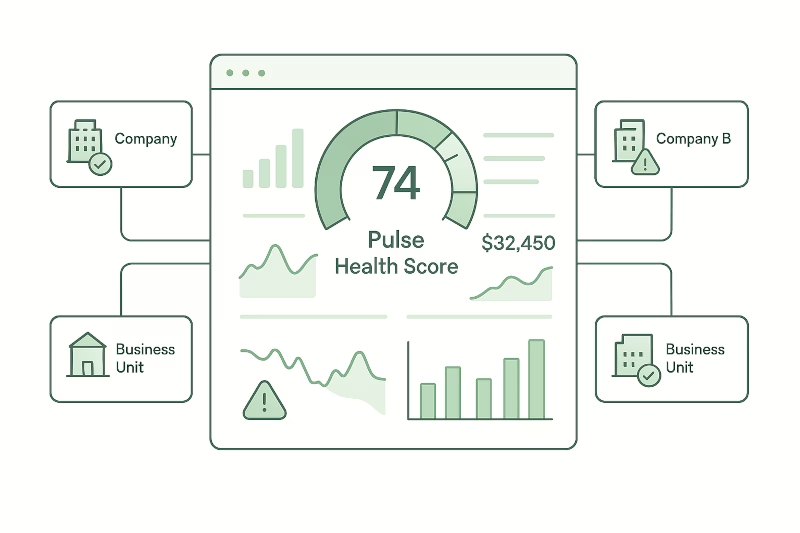
A pulse health score is a single composite indicator that summarises the overall condition of an entity, a virtual group, or the group as a whole. Instead of requiring users to review dozens of reports and metrics individually, BrizoConsol combines multiple KPI trends into one easy-to-interpret score.
The score draws from a configurable set of performance measures:
- Revenue growth versus prior period and versus budget
- Gross margin movement
- Operating expense trend
- Cash flow position
- Working capital ratios (current ratio, debtor days, creditor days)
- Budget versus actual variance on key P&L lines
Each measure is scored against its configured target or threshold, and the individual scores are combined — with weights that finance teams can configure to reflect the priorities of their business — into an overall health score. When performance is within expected ranges, the score remains healthy. When one or more indicators begin to deteriorate, the score declines and signals where attention is needed.
How a pulse health score is constructed — illustrative For a UK subsidiary, the finance team has configured five KPI components:
Revenue vs budget: Tracking at 97% — score: 88/100
Gross margin: 34.2% vs 35.0% target — score: 75/100
Operating expenses: On budget — score: 95/100
Cash position: Above minimum threshold — score: 100/100
Debtor days: 48 days vs 42-day target — score: 60/100
Weighted composite health score: 83/100
The score is healthy overall, but the debtor days and gross margin components are flagging for review. Management sees the 83 score, notices it’s down from 91 last month, and investigates the debtor days position — identifying three overdue accounts that had slipped past the AR team.
The purpose is not to replace detailed reporting. It acts as an early warning layer. When a health score changes, users can drill deeper into the underlying KPIs and reports to understand the reason. Pulse health scores create a bridge between high-level management oversight and detailed financial analysis.
Real-Time KPI Monitoring
Alongside pulse health scores, BrizoConsol supports monitoring of individual KPIs as soon as new data is available. “Real-time” in the context of a consolidation platform means that as soon as BrizoConsol syncs from the connected accounting systems — Xero, QuickBooks, MYOB, Zoho Books — the KPI dashboard updates to reflect the latest available data. For groups that sync daily or on-demand, this means KPIs are current within hours of entity data being updated, not weeks after month-end.
Financial KPIs that can be monitored include:
- Revenue and sales growth (group and entity level)
- Gross margin percentage
- EBITDA
- Operating expense trends
- Cash balances
- Debtor and creditor days
- Budget versus actual variance
- Forecast performance
If one subsidiary experiences a sharp decline in sales or if costs suddenly rise above expected levels, the KPI dashboard reflects this at the next data sync — not at month-end close. Finance teams can investigate and respond while there is still time to act.
Monitoring Across Multiple Entities
One of the most significant challenges in group reporting is that performance issues are often hidden inside consolidated numbers. A group may appear healthy overall while one individual entity is underperforming significantly. A small issue in several entities may combine into a larger group-wide risk that only becomes visible after the period closes.
BrizoConsol’s pulse health scores can be viewed at group level, by entity, by virtual group (business division or geographic region), or by reporting segment. This creates transparency at each level. When group health declines, finance teams can immediately identify whether the issue is concentrated in one subsidiary, spread across a region, or driven by a specific cost category — rather than relying only on top-level consolidated numbers.
Early Warning Through Thresholds and Alerts
The real value of KPI monitoring comes from identifying problems early — before they are visible in the month-end close. BrizoConsol allows finance teams to define thresholds for important metrics: gross margin below a defined floor, expenses exceeding budget by more than a set percentage, cash balance dropping below a target, intercompany mismatches exceeding the defined tolerance.
When these thresholds are breached, the system flags the KPI for attention — combining with the pulse health score to create a practical early warning system. Finance teams don’t need to manually search for problems; the system highlights where action may be required. This is especially valuable for growing groups where management cannot realistically monitor every detail manually across a large entity set.
How This Changes the Role of Finance
Historically, finance teams have spent most of their time preparing reports. Data was gathered, validated, consolidated, and formatted before management could review it — and by the time the process was complete, much of the value had shifted from decision-making to explanation of what had already happened.
Real-time KPI monitoring and pulse health scores shift this dynamic. Instead of spending most capacity on producing backward-looking reports, finance teams can spend more time interpreting trends, understanding causes, and advising the business on what to do next. Finance moves from a reactive role to a proactive one — identifying when revenue is beginning to slow or when an entity is consistently missing forecast, and supporting management action while there is still a period left to act.
BrizoConsol’s Pulse Health Scores give finance teams a single composite view of business performance at group, entity, and virtual group level — with configurable KPI thresholds and alerts that surface issues before the month closes. Learn more or see it in action →