
For thirty years, business software has waited to be told what to do. That relationship is about to reverse — and the organisations that understand it first will have a significant advantage.
Every piece of business software in existence today was built around the same core assumption: the user initiates. The user opens the application, navigates to the right screen, runs the right query, reads the output, and then — if the timing is right and the interpretation is correct — acts on what they find.
This is not a design flaw. It is a reflection of the technical constraints that existed when the software paradigm was established. Storage was limited, processing was expensive, and the idea of a system that monitored conditions continuously and surfaced conclusions automatically was beyond what the infrastructure could support at reasonable cost.
Stop building consolidations in spreadsheets.
BrizoConsol automates multi-entity consolidation — setup in minutes, reports the same day.
Those constraints no longer exist. And the software category that replaces the reactive model is already being built.
The Reactive Model and What It Costs
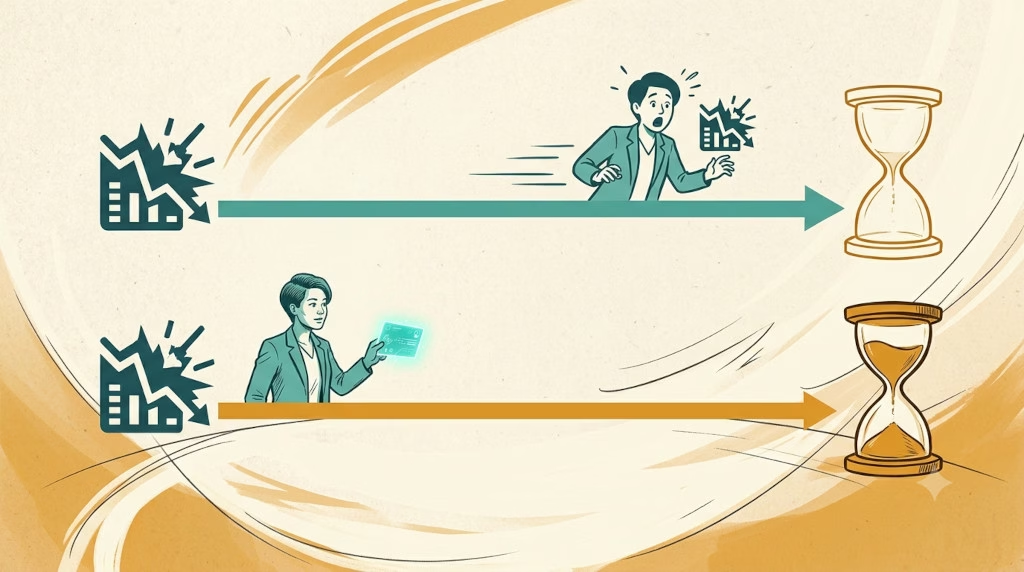
Reactive software is software that waits. It waits for you to log in. It waits for you to choose a report. It waits for you to notice that a metric has moved. It waits for you to remember to check a pipeline that you have not looked at in two weeks. It is infinitely patient and entirely passive — and that passivity has a cost that most organisations have never fully accounted for.
The cost is measured in missed moments. The sales opportunity that was warm for a window of four days before the prospect moved on to a competitor. The client relationship that showed signs of disengagement for six weeks before anyone noticed. The intercompany balance that had been drifting out of alignment for a quarter before it was caught in a period-end review. Each of these is a moment where earlier information would have produced a better outcome — and in each case, the information existed. It just was not surfaced to the right person at the right time.
Reactive software cannot fix this. Its architecture is built around the assumption that users will seek information out. When they do not — because they are busy, because they did not know what to look for, because the window between the signal and the need to act was shorter than the organisation’s review cadence — the moment passes.
The information was always there. What was missing was a system that understood when it mattered.
What Proactive Software Actually Means
Proactive software does not wait to be asked. It monitors conditions continuously, identifies the moment when a condition has changed in a way that warrants attention, and delivers a specific, actionable conclusion to the right person before they have thought to ask for it.
This is not the same as notifications or alerts in the conventional sense. Most alert systems in current software are just reactive software with an extra layer — they send a notification when a metric crosses a threshold you defined in advance. But defining the right thresholds requires knowing what to monitor, which requires the analytical judgment the software should be providing in the first place. The alert fires when the number drops below twenty percent. It does not tell you that the number has been declining for six weeks, that three similar accounts showed the same pattern before churning, and that the account manager’s last contact was nineteen days ago.
Proactive software does not ask you to configure what to watch for. It watches for the patterns that matter — learned from the domain, from historical data, from the accumulated understanding of what precedes a consequential event — and surfaces the interpretation, not just the raw signal.
Why Now Is the Inflection Point
The shift from reactive to proactive software is not a new idea. What is new is that the three conditions required to build proactive software at viable cost have all arrived simultaneously.
Continuous monitoring is now cheap. Cloud infrastructure has made it economically viable to run monitoring processes against live business data at a frequency that would have been prohibitively expensive five years ago. A proactive software product can now check conditions across thousands of accounts, contacts, or transactions every hour without incurring the kind of infrastructure cost that once made such systems the exclusive domain of large enterprises.
AI can perform interpretation at scale. The gap between a raw data point and an actionable conclusion has always required human judgment to cross. AI — specifically the combination of machine learning models and large language models — has closed that gap for the class of interpretive tasks that business software needs to perform. Identifying that a client relationship is at risk, that a sales signal is present, that a consolidation entry requires attention — these are pattern-recognition problems that current AI handles with enough reliability to act on.
Users now expect software to come to them. The consumer software experience of the last decade — where applications learn preferences, surface relevant content unprompted, and notify users of things they would want to know — has reset expectations for what software should do. Business users no longer accept the premise that they must go looking for insight. The expectation is that insight finds them. Proactive software meets that expectation; reactive software increasingly fails it.
The Organisations That Will Benefit Most
Proactive software will be valuable across every category of organisation, but it will produce the most significant advantage in places where three conditions are present: decisions happen on compressed timescales, the people making decisions have limited bandwidth for proactive monitoring, and the cost of a missed or delayed decision is material.
Professional services firms fit this precisely. A partner at an accounting practice managing twenty active client relationships does not have the capacity to proactively monitor the health of each one on a daily basis. Their attention is allocated to the work in front of them. A proactive system that identifies which of those relationships is showing early warning signs — before the partner receives a difficult call — changes the dynamics of client management fundamentally. The partner is no longer reacting to problems. They are addressing conditions before they become problems.
Lean business development teams are a second clear beneficiary. The window in which a buying signal is actionable is often measured in days. A team that is notified the moment a target company enters a relevant trigger event — a leadership change, a funding announcement, an expansion into a new market — has a structural advantage over one that discovers the same information during a weekly CRM review. Proactive software converts that structural advantage into a consistent operational practice.
Finance and consolidation teams are a third. The period close is a time-constrained, high-consequence process in which errors discovered late are significantly more expensive to resolve than errors caught early. A proactive system that monitors intercompany balances throughout the period, flags discrepancies as they emerge, and surfaces the specific adjustments required before the close begins is not just a convenience — it is a risk management tool.
The Design Challenge Incumbents Will Not Solve Easily
Existing software vendors understand that proactive capability is becoming an expectation. The response from most incumbents has been to add it as a layer on top of existing reactive architectures — AI copilots, smart notifications, recommendation engines that sit alongside the conventional product.
These additions are not worthless. But they share a fundamental constraint: they are designed to assist a user who is already in the product, already engaged, already looking. A proactive layer that only activates when someone has logged in and navigated to the right screen is not truly proactive. It is reactive with a suggestion attached.
Genuine proactive software requires a different architecture from the ground up — one where the primary output of the product is not a screen the user navigates to, but a conclusion the product delivers. The user interface becomes secondary to the intelligence layer. The product’s job is not to present data but to act on it on the user’s behalf, within the boundaries the user has defined.
Building this on top of a product designed around a different model is genuinely difficult. It is not impossible, but it requires architectural decisions that contradict the assumptions baked into most existing platforms. This is why proactive capability is more likely to be built well by new products than retrofitted well into old ones.

What Proactive Software Looks Like in Daily Practice
The experience of using proactive software is qualitatively different from the experience of using reactive software, even when the underlying data and the ultimate decisions are the same.
With reactive software, the start of a working day involves a series of deliberate acts of information gathering. Log into the CRM. Check the pipeline. Review last week’s close numbers. Open the consolidation tool. Run the intercompany report. Each of these is a small investment of time and attention, and each is predicated on remembering to make it.
With proactive software, the start of a working day involves reading a brief. The system has already done the monitoring, already performed the interpretation, already ranked the items by urgency and relevance. The first thing the user sees is not a set of tools to use — it is a set of conclusions to act on. Three clients require attention this week. One consolidation entry needs review before the close. A target company in your pipeline showed two buying signals in the last forty-eight hours.
The shift is not merely one of convenience. It changes the relationship between the user and the information. In the reactive model, insight depends on the user’s discipline and availability. In the proactive model, it depends on the system’s reliability. And reliability, unlike human discipline, does not degrade under pressure, does not take holidays, and does not forget to check the numbers during a busy period-end week.
Where BrizoSystem Is Positioned
Both of BrizoSystem’s current products are built around the proactive model — not as a feature, but as the core design principle.
BrizoConsol monitors consolidation data throughout the accounting period rather than waiting for the period-end close to surface discrepancies. Intercompany imbalances, elimination entries that require attention, currency translation anomalies — these are flagged as they arise, not when the accountant runs the consolidation report. The team arrives at the close with the work already largely done, rather than discovering what needs to be done under deadline pressure.
BrizoMarket monitors market conditions continuously on behalf of the business development team, surfacing the specific companies, contacts, and moments that warrant action — without requiring the team to run searches, review feeds, or schedule manual pipeline reviews. The intelligence comes to the team. The team acts on it.
In both cases, the product’s value is not in what it shows you when you open it. It is in what it tells you before you thought to look. That is what proactive software is. And it is the direction that business software, as a whole, is heading.