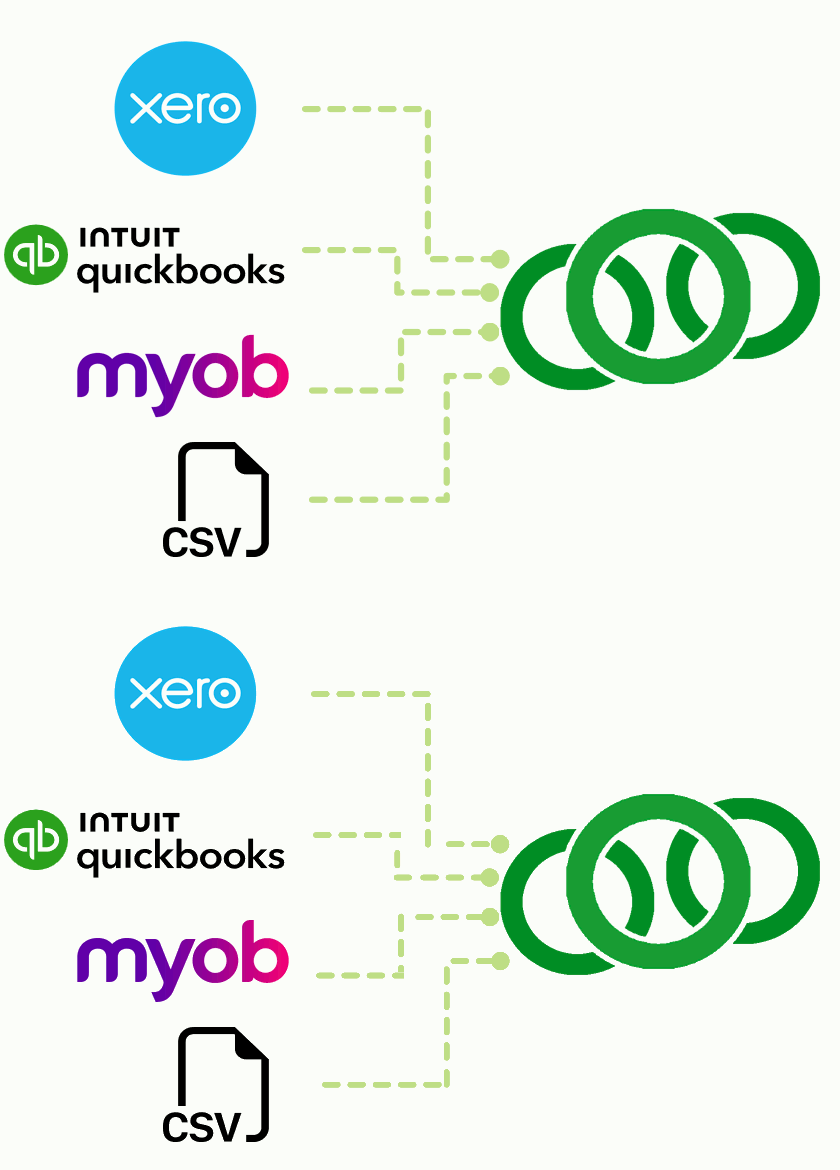
The financial reporting cycle has three stages: data in, consolidation, reporting out. Most attention goes to the middle stage — how the consolidation is done, how long the close takes, how errors are introduced in the adjustments. The input stage — getting data out of accounting systems and into a usable form — gets less attention. It shouldn’t. The costs that originate at the input stage compound through everything that follows, and they’re almost entirely invisible on any budget line.
This post covers the specific costs that arise from manually exporting financial data from accounting systems — Xero, QuickBooks, MYOB, Zoho Books — for use in consolidation and reporting. These are distinct from the consolidation process costs and the reporting output costs covered in the other posts in this series. They are the costs before any of that work begins.
Hidden Cost 1
Monthly Repetition — The Same Work, Every Month, From Scratch
Automate NCI calculations across all your entities.
BrizoConsol handles non-controlling interest automatically — no manual adjustments required.
Manual data exports from accounting systems are a fully repetitive task. Every month, the same person logs into the same systems, navigates to the same reports, selects the same date range, exports to the same format, saves to the same folder structure, and starts again with the next entity. Nothing is learned, nothing is saved, nothing carries forward. The month-two export takes exactly as long as the month-one export.
For a five-entity group, each entity requiring a trial balance export plus a P&L check: forty minutes per entity is a reasonable estimate, including logging in, locating the right report, selecting the correct period, exporting, verifying the totals, and filing. That’s over three hours of fully repetitive, zero-analytical-value work before the consolidation has even started — every single month, twelve months a year.
The monthly export time — illustrative estimate 5 entities × 40 minutes per export = 3h 20min per month = 40 hours per year. At a fully-loaded senior accountant cost of $70/hour: $2,800 per year in compensation for work that could be eliminated entirely by a direct API connection. This doesn’t include the time spent reformatting the exports into a consistent structure, which adds another 1-2 hours per month.
Hidden Cost 2
Format Fragmentation — Every System Exports Differently
Xero, QuickBooks, MYOB, and Zoho Books each produce exports in different formats, with different column structures, different account code formats, different handling of multi-currency figures, and different treatment of comparative periods. A Xero trial balance CSV looks nothing like a QuickBooks trial balance export. A group with three entities on different platforms has three fundamentally different data structures to reconcile into one before any consolidation can happen.
The reconciliation step — normalising three different formats into a consistent input for the consolidation model — is itself a fragile manual process. A column shift in one export, a new account code format after a system update, a change to how QuickBooks handles opening balance entries: any of these breaks the downstream formulas silently. The consolidation model continues to run, producing numbers that are slightly wrong because the input normalisation failed in a way that wasn’t immediately visible.
The silent format break Xero releases a minor update that changes how account codes are formatted in the trial balance export — a leading zero is dropped from certain account codes. The consolidation model’s VLOOKUP matching fails on those codes silently: they don’t return an error, they just return blank. Eight accounts with the affected format don’t map to any group line. Their balances are missing from the consolidated P&L. The balance sheet balances because the missing amounts are absorbed into retained earnings. The error isn’t caught until someone questions why admin costs look unusually low.
Hidden Cost 3
Timing Inconsistency — Exports from Different Moments in Time
In a multi-entity group, different entities submit exports at different points in the close cycle. Entity A submits on the 5th. Entity B submits on the 8th. Entity C submits on the 12th. Each export captures the state of that entity’s accounting system at the moment of export — which is a different moment for each entity.
Any transaction posted between the 5th and the 12th appears in entities that exported later but not in those that exported earlier. For intercompany transactions — where both sides of the entry need to be captured for elimination to work — this timing difference is particularly damaging. Entity A may have posted its side of an intercompany transaction on the 7th; Entity B’s export from the 4th doesn’t include its side. The elimination mismatches, and the close is delayed while the discrepancy is traced and resolved.
💡 The fix most groups don’t implement: A locked export date — all entities extract data for the same period cutoff at the same time, after a declared “books closed” point. This eliminates timing inconsistency but requires discipline: entities cannot post adjustments after the export date without a formal re-extraction process. In practice, most groups tolerate timing inconsistency because enforcing the discipline is harder than dealing with the mismatches it produces.
Hidden Cost 4
Stale Data During a Long Close Cycle
When a close cycle takes ten to twelve working days — not unusual for a manual multi-entity consolidation — the data extracted on day one is already twelve days old by day twelve. Any transaction posted in those twelve days is not in the consolidation. If those transactions are material — a large customer payment, a significant supplier invoice, a month-end accrual posted late — the closed figures don’t reflect the actual period-end position.
The standard response is to re-extract from the earliest entities if late-posted transactions are material. Each re-extraction adds time, resets the normalisation step, and risks introducing new format issues. The temptation to accept stale data rather than redo the extraction is real — which means the consolidated figures presented to the board may not reflect the actual financial position at the period end date.
Hidden Cost 5
The Wrong Export Type — Management Reports vs Trial Balance
Accounting systems offer multiple export types: P&L reports, balance sheet reports, aged receivables, transaction lists, trial balances. For consolidation, the trial balance is the correct input — a complete, account-level extract of every account’s debit and credit balance for the period. A P&L report or balance sheet report is a pre-formatted summary that has already applied groupings, netting, and presentation logic that may not match the group’s reporting structure.
Finance teams new to consolidation often export formatted management reports rather than trial balances, because the management report looks like what they’re trying to produce. The problem: a formatted P&L report doesn’t give account-level granularity, which means the COA mapping step can’t be done, intercompany account identification is harder, and any account that falls outside the report’s preset structure is silently excluded.
Why this matters for intercompany elimination To eliminate an intercompany management fee, you need to identify the specific accounts in each entity that carry the income and expense. A formatted P&L export that groups all “management and admin” costs into one line doesn’t tell you which accounts the intercompany fee sits in. The trial balance does. Using the wrong export type means the elimination either can’t be done at the account level, or requires going back to the accounting system and extracting additional detail — adding time to a close that’s already running late.
Hidden Cost 6
No Audit Trail for the Data Extraction Itself
When data is manually extracted from accounting systems, there is no automated record of what was extracted, when, by whom, or whether any adjustments were made to the export before it entered the consolidation model. The audit trail for the close process starts at the consolidation model — it doesn’t extend back to the source system.
When an auditor asks “what is the source data for this balance?” the answer requires tracing back through email timestamps, file creation dates, and folder histories to reconstruct which export the figure came from. For prior periods — where a question arises twelve months after the fact — this reconstruction may be impossible if files have been overwritten or archived inconsistently.
A direct API integration between the accounting system and the consolidation platform maintains a timestamped, system-generated record of every data pull: which entity, which period, which accounts, what values, at what time. The audit trail starts at the source, not at the point where someone opened a CSV and began reformatting it.
What Direct Integration Changes
A direct API connection between accounting systems and the consolidation platform eliminates the repetition cost entirely — data is pulled on a schedule or on demand, in a consistent format, at a defined cutoff point, with a complete extraction log. The format normalisation step disappears because the integration layer handles it. The timing inconsistency problem is solved by pulling all entities simultaneously to the same cutoff. The stale data problem is addressed by pulling fresh data at any point in the close cycle without restarting the normalisation process.
What it doesn’t eliminate: the need for a clean close in each entity’s accounting system. Direct integration pulls whatever is in the accounting system at the time of the pull — if the entity’s books aren’t closed, the data isn’t clean. The discipline of closing entity books before the group extraction runs is still required. The integration makes the extraction itself costless; it doesn’t make the entity close automatic.
BrizoConsol connects directly to Xero, QuickBooks, MYOB, and Zoho Books — pulling trial balance data on demand, in a consistent format, with a full extraction log. No CSV exports, no format normalisation, no timing inconsistency from staggered manual pulls. Learn more or see it in action →