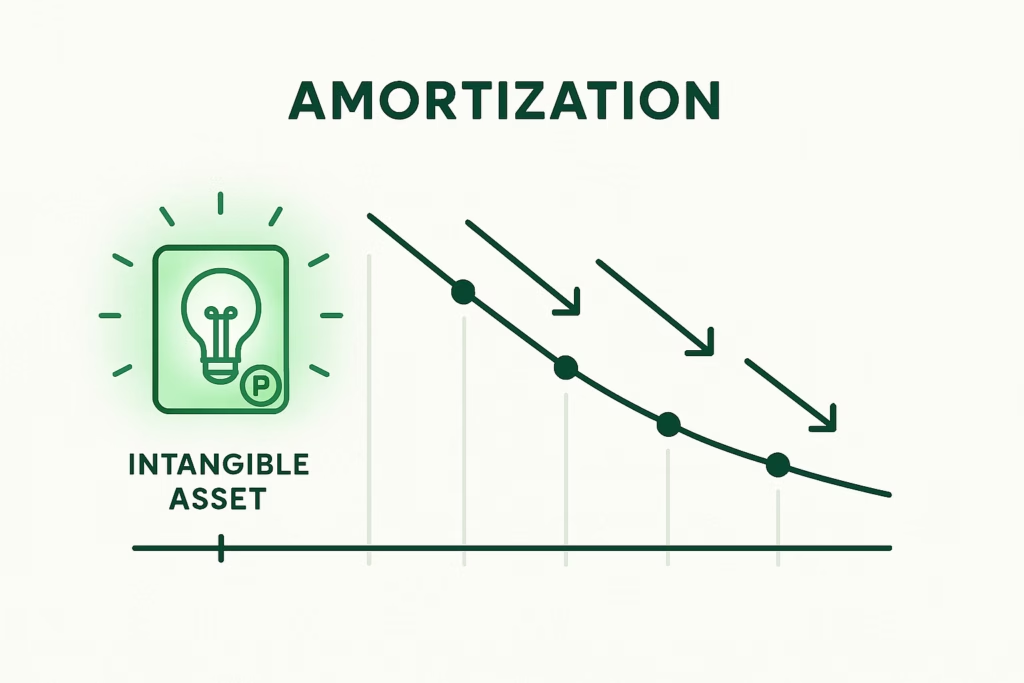
Amortization is the systematic allocation of an intangible asset’s cost over its useful life — the period during which the asset is expected to generate economic benefits. It works on the same matching principle as depreciation: the cost of an asset should be recognised as an expense in the periods that benefit from it, not entirely at the point of acquisition. For intangible assets with finite useful lives, amortization ensures that cost is spread appropriately. For those with indefinite useful lives, no amortization is charged — impairment testing replaces it.
What Can Be Recognised as an Intangible Asset
Before amortization applies, the asset must meet the IAS 38 recognition criteria. An intangible asset must be:
- Identifiable: either separable (can be sold, licensed, or transferred separately from the business) or arising from contractual or legal rights
- Controlled: the entity has the power to obtain future economic benefits and restrict others from obtaining them
- Probable future economic benefits: the asset will generate revenue, cost savings, or other benefits
- Reliably measurable cost
A common point of confusion: internally generated intangibles are generally not recognised under IAS 38. Internally generated brands, customer lists, and goodwill cannot be capitalised even if they clearly have value — IAS 38 prohibits it because the cost cannot be reliably distinguished from the cost of developing the business as a whole. The exception is development costs, which can be capitalised when specific criteria are met (technical feasibility, intention to complete, ability to use or sell, probable future benefits, adequate resources, and reliable measurement).
Stop building consolidations in spreadsheets.
BrizoConsol automates multi-entity consolidation — setup in minutes, reports the same day.
Finite vs Indefinite Useful Life
The first assessment for any intangible asset is whether its useful life is finite or indefinite. “Indefinite” means there is no foreseeable limit on the period over which the asset is expected to generate net cash inflows — it does not mean the asset will last forever.
| Asset type | Typical life classification | Amortization treatment |
|---|---|---|
| Patent | Finite (shorter of legal life and expected benefit period) | Amortised over useful life |
| Software licence (time-limited) | Finite (licence term) | Amortised over licence term |
| Customer relationships (acquired in M&A) | Finite (expected retention period) | Amortised over estimated useful life |
| Technology/IP (acquired in M&A) | Finite (estimated technological life) | Amortised over useful life |
| Brand name with active maintenance and no foreseeable end | Indefinite | Not amortised; tested annually for impairment |
| Goodwill | Indefinite (IFRS) / Finite option (US GAAP private) | Not amortised under IFRS; impairment-only |
Indefinite useful life is reassessed at each reporting date. If conditions change — for example, a brand that was indefinite-life loses its market position and a foreseeable end of benefit period becomes apparent — the classification changes to finite and amortization begins.
Amortization Methods
IAS 38 requires the amortization method to reflect the pattern in which the asset’s economic benefits are consumed. Where that pattern cannot be determined reliably, the straight-line method is used.
Straight-line: Equal charge each period. Most commonly used for intangibles because the pattern of consumption is often unknown or assumed to be even. Annual amortization = (Cost − Residual value) / Useful life.
Units of production: Charge based on actual use rather than time. Appropriate where the benefit is directly tied to output — for example, a patent protecting a manufacturing process might be amortised based on units produced under the patent rather than years elapsed.
🚩 Revenue-based amortization — a restricted method: A 2014 amendment to IAS 38 (and IFRS 15 guidance) clarified that revenue is generally not an appropriate basis for amortization. Revenue reflects factors beyond the consumption of the economic benefits of the asset (including price changes and sales volumes that are unrelated to usage of the intangible). Revenue-based amortization is only permitted in the very narrow circumstance where revenue and the consumption of the asset’s economic benefits are highly correlated. In practice, this restriction means most attempts to amortise customer lists or technology assets based on revenue are not compliant with IAS 38.
Residual value
The residual value of an intangible asset is assumed to be zero unless either: (a) a third party has committed to purchase the asset at the end of its useful life, or (b) there is an active market for the asset and residual value can be determined by reference to market prices. In practice, the residual value of almost all intangible assets is zero — the exceptions are narrow.
Purchase Price Allocation (PPA) Intangibles — The Consolidation Dimension
In a business combination under IFRS 3, the acquiree’s identifiable intangible assets must be recognised at their fair value at acquisition date — even if they were not recognised in the acquiree’s own financial statements. This is where amortization of intangibles becomes most significant in a group consolidation context.
Common PPA intangibles and their typical amortization periods:
| Intangible type | Typical useful life | Basis for estimation |
|---|---|---|
| Customer relationships | 5–15 years | Historical customer churn rate and expected retention period |
| Trade names / brands | Finite (3–20 years) or indefinite | Market position, competitive dynamics, whether the brand will be maintained |
| Core technology / IP | 5–10 years | Product lifecycle, expected technology obsolescence |
| Order backlog | Months to 2 years | Expected fulfilment timeline of contracts in hand at acquisition |
| Non-compete agreements | Duration of non-compete clause | Contractual term |
These PPA intangibles and their amortization exist only in the consolidated accounts — not in the subsidiary’s own statutory financial statements, which continue to be filed on their local accounting basis. The fair value uplift at acquisition and the resulting amortization are consolidation adjustments, tracked in the consolidation working papers and applied each period.
PPA example — customer relationships A group acquires a subsidiary for $5,000,000. As part of the purchase price allocation, the acquired customer relationships are valued at $800,000 (fair value at acquisition date). Estimated useful life: 8 years.
Annual amortization = $800,000 / 8 = $100,000
Each year, the consolidation includes: Dr Amortization Expense $100,000 / Cr Accumulated Amortization – Customer Relationships $100,000
This entry exists only in the group consolidation adjustments — the subsidiary’s own accounts show no such intangible.
The EBITDA Impact of PPA Amortization
Amortization of PPA intangibles is a significant factor in how acquisition-active groups are analysed by investors. Because amortization is below the EBITDA line, groups with large recent acquisitions can show strong EBITDA margins while their reported profit after tax is materially lower — reflecting substantial amortization charges on acquired customer relationships, technology, and trade names.
Analysts commonly exclude PPA amortization from their “adjusted” or “underlying” earnings metrics, arguing that it’s an accounting consequence of M&A activity rather than a cash cost of running the business. This is a reasonable analytical adjustment in many cases — but it requires understanding exactly which amortization relates to PPA intangibles and which relates to ordinary internally developed assets.
For CFOs presenting results to investors, disclosure of PPA amortization as a separate line item in adjusted earnings reconciliations is standard practice for acquisition-active groups. It helps investors understand the difference between reported profit and cash-generative underlying performance.
For groups managing PPA intangibles across acquisitions — tracking useful lives, applying amortization as a consolidation adjustment each period, and ensuring these charges are correctly excluded from EBITDA calculations — BrizoConsol provides the entity-level and group-level reporting framework to manage these balances with a full audit trail. Learn more or see it in action →