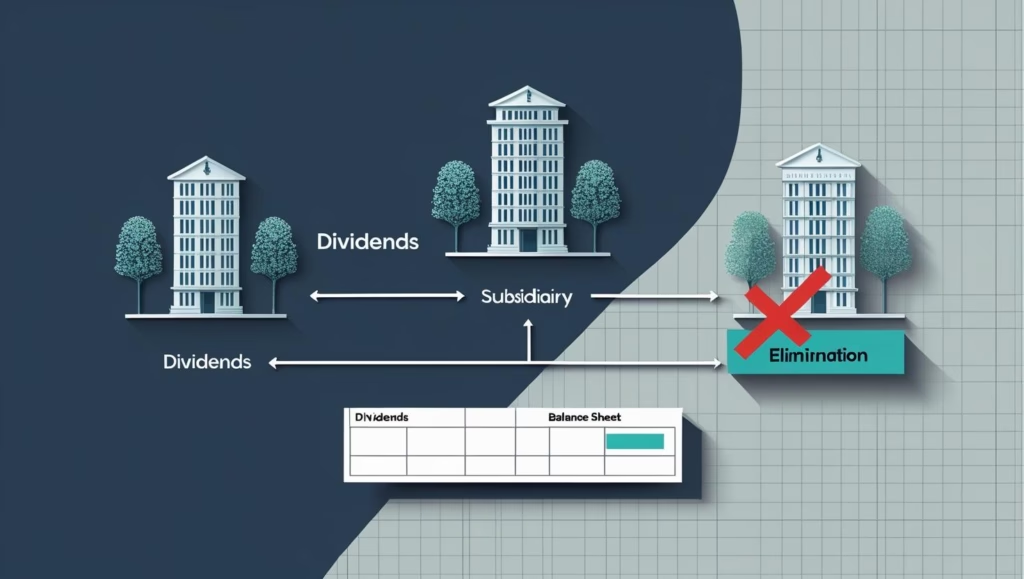
Intercompany dividend elimination is one of the most commonly mishandled adjustments in group financial consolidation. When a subsidiary pays a dividend to its parent or another group entity, both sides record the transaction — but from a consolidated perspective, the money never left the group. If those entries aren’t eliminated, the group’s income and retained earnings will be overstated, and the financial statements won’t present a true and fair view.
This guide explains exactly why these eliminations are required, walks through the journal entries involved, and covers the real-world scenarios that make the process more complex — including partial ownership, tiered group structures, and timing mismatches across reporting periods.
Why Intercompany Dividends Must Be Eliminated
When consolidating financial statements across multiple entities within a group, one essential adjustment is the elimination of intercompany dividends. These are dividends paid by one subsidiary to another entity within the same group—such as a holding company or another subsidiary.
Automate NCI calculations across all your entities.
BrizoConsol handles non-controlling interest automatically — no manual adjustments required.
While dividends are legitimate transactions between companies, they must be eliminated during consolidation because they do not represent external income for the group. Including intercompany dividends would result in overstating the group’s revenue or retained earnings, misrepresenting its actual financial performance and position to shareholders, auditors, and regulators.
In other words, what is income to one group company is an expense—or distribution of profit—from another. From a group perspective, it’s simply a movement of funds within the same economic entity.
What Does the Elimination Involve?
The process of eliminating intercompany dividends depends on the structure of the group and how the dividends are recorded in each company’s financials.
Let’s look at a simple example:
- Subsidiary A declares a dividend of $100,000 to Holding Company B.
- Subsidiary A records a debit to Retained Earnings and a credit to Dividend Payable.
- Holding Company B records a debit to Dividend Receivable (or Bank) and a credit to Dividend Income.
During consolidation, both entries must be eliminated:
- Dividend Income must be removed from the consolidated Profit & Loss statement.
- Dividend Payable/Receivable balances (if they still exist at reporting date) must also be eliminated from the consolidated Balance Sheet.
Consolidation Entry Example:
| Account | Debit | Credit |
|---|---|---|
| Dividend Income (Holding Company) | 100,000 | |
| Retained Earnings (Subsidiary) | 100,000 |
If the dividend has not yet been paid, then the payable/receivable must be removed from the balance sheet:
| Account | Debit | Credit |
|---|---|---|
| Dividend Payable (Subsidiary) | 100,000 | |
| Dividend Receivable (Holding Company) | 100,000 |
Real-Life Scenarios and Complexity
Scenario 1: Partial Ownership and Non-controlling Interest (NCI)
When a parent owns less than 100% of a subsidiary, only the group’s portion of the dividend income needs to be eliminated. The portion that relates to non-controlling interest (NCI) is still valid and should remain.
For example, if the parent owns 80% of Subsidiary C and Subsidiary C pays a $50,000 dividend, only $40,000 (80%) would be eliminated. The remaining $10,000 is attributable to NCI and stays in the consolidated income.
Scenario 2: Tiered Ownership Structures
In more complex group structures with multiple layers (e.g., Subsidiary D pays a dividend to Intermediate Holding E, which is owned by the Ultimate Parent F), elimination must be handled at the correct level. Systems like BrizoSystem allow for this kind of granularity and can apply eliminations accurately across different levels of the hierarchy.
Scenario 3: Timing Differences
A timing mismatch occurs when a dividend is declared in one reporting period but received (and settled) in another. This is common in groups where subsidiaries operate across different countries or month-end cut-off dates don’t align.
Example: Subsidiary G declares a £60,000 dividend on 28 March (within Q1), but Holding Company H doesn’t receive the cash until 5 April (Q2). At the 31 March group reporting date:
- Subsidiary G has recorded: Debit Retained Earnings £60,000 / Credit Dividend Payable £60,000
- Holding Company H has recorded: Debit Dividend Receivable £60,000 / Credit Dividend Income £60,000
At the 31 March consolidation, the Dividend Income and Dividend Receivable/Payable balances must still be eliminated — even though no cash has moved yet:
| Account | Debit | Credit |
|---|---|---|
| Dividend Income (Holding Company H) | £60,000 | |
| Retained Earnings (Subsidiary G) | £60,000 |
| Account | Debit | Credit |
|---|---|---|
| Dividend Payable (Subsidiary G) | £60,000 | |
| Dividend Receivable (Holding Company H) | £60,000 |
The risk here is that if consolidation is done before all intercompany balances are confirmed, the payable and receivable may not match — particularly if exchange rates are involved or the declaration date falls in a different period than the payment date. Finance teams need a clear cut-off policy and a way to flag unmatched intercompany balances before the consolidation is finalised.
Common Mistakes in Intercompany Dividend Elimination
Even experienced finance teams make avoidable errors in this area. The most frequent ones to watch for:
1. Eliminating 100% when NCI exists. In partially owned subsidiaries, eliminating the full dividend income rather than just the parent’s share overstates the adjustment and misrepresents the NCI’s economic interest.
2. Forgetting the balance sheet leg. Teams often eliminate the P&L entry (Dividend Income) but leave the Dividend Receivable/Payable on the consolidated balance sheet. Both legs must be eliminated.
3. Missing cross-currency dividends. When a subsidiary declares a dividend in a different currency from the parent’s reporting currency, exchange rate movements between declaration date and payment date can create a small residual difference. This needs to be treated as a consolidation foreign exchange adjustment, not left as an unexplained variance.
4. Inconsistent cut-off policies. Without a clear group-wide cut-off policy, one entity may record the dividend in March and the other in April — leading to a one-sided elimination that breaks the balance sheet.
Why Systems Like BrizoSystem Help
The three scenarios above illustrate why manual elimination of intercompany dividends is high-risk at scale. In a group with 10 or more entities, dozens of intercompany dividend flows may need to be identified, matched, and eliminated each period — and any missed or incorrectly calculated elimination flows straight through to the consolidated P&L or balance sheet.
BrizoSystem addresses this in several practical ways:
Automatic matching: Intercompany transactions are identified based on counterparty, date, and amount — so finance teams aren’t hunting through entity-level ledgers to find the other side of a dividend entry.
NCI-aware eliminations: For partial ownership structures like Scenario 1, BrizoSystem applies the correct elimination percentage automatically based on the ownership structure defined in the system — so only the group’s share is removed, and the NCI portion is preserved correctly.
Multi-level hierarchy support: For tiered structures like Scenario 2, eliminations can be applied at the correct consolidation level rather than forcing everything through a single top-level adjustment.
Period-end mismatch tracking: For timing differences like Scenario 3, BrizoSystem flags unmatched intercompany payables and receivables before the consolidation run, reducing the risk of unresolved balances slipping through at period close.
The result is a consolidation process that is faster, auditable, and consistent across every reporting cycle — without relying on manual spreadsheet logic that needs to be rebuilt each time.
Getting Intercompany Dividend Elimination Right
Intercompany dividend elimination is not optional — it is a fundamental requirement of consolidated financial reporting under IFRS 10, IAS 27, and ASC 810. Done correctly, it ensures the group’s income statement and balance sheet reflect only genuine external activity, giving shareholders, auditors, and regulators an accurate picture of financial performance.
Done incorrectly — or inconsistently — it inflates income, distorts retained earnings, and creates audit findings that are expensive to unwind.
As group structures grow more complex, with multiple layers of ownership, cross-border dividends, and tight reporting deadlines, getting this right manually becomes increasingly difficult. BrizoSystem is built to handle exactly this kind of complexity — giving finance teams a single, structured environment to manage intercompany eliminations with full traceability and without rebuilding the logic every quarter.
👉 See how BrizoSystem handles intercompany eliminations → or See It in Action to walk through your group structure with our team.