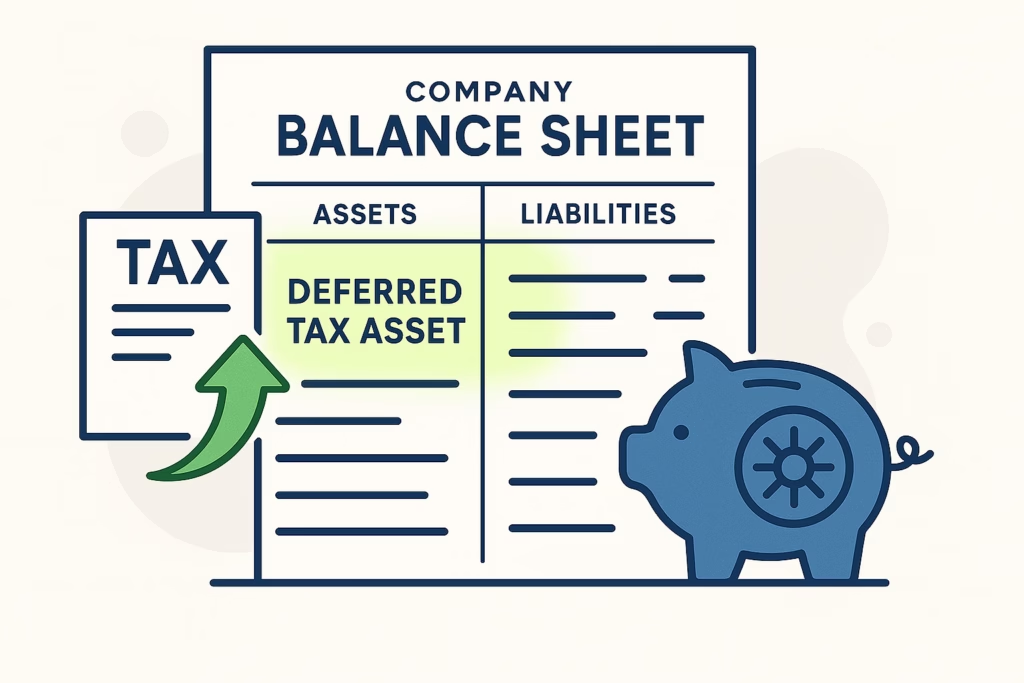
A Deferred Tax Asset (DTA) is a balance sheet asset representing tax that the company has effectively overpaid relative to its accounting results — and will recover in future periods through lower tax payments. Understanding how DTAs arise, when they can be recognised, and how they interact with the group consolidation process is important for finance teams responsible for group tax accounting.
The Temporary Difference Concept
DTAs arise from deductible temporary differences — situations where the carrying amount of a balance sheet item is lower than its tax base, generating future tax deductions. The tax base of an asset is the amount that will be deductible for tax in future periods. The tax base of a liability is its carrying amount less any amounts deductible in future (for many liabilities, this is zero — meaning the full carrying amount generates a future deduction when settled).
| Situation | Accounting | Tax | Temporary difference | Result |
|---|---|---|---|---|
| Warranty provision | Expense recognised when provision raised | Deductible when warranty settled (future) | Liability: carrying > tax base | DTA — future deduction available |
| Tax loss carryforward | Loss recognised in P&L | Deductible against future taxable profits | N/A (no balance sheet item, but available deduction) | DTA — future tax reduction available |
| Doubtful debt provision | Impairment recognised immediately | Deductible when debt written off | Asset: carrying < tax base | DTA — future deduction available |
| Accelerated tax depreciation | Book value > tax value (asset depreciated faster for tax) | Asset fully deducted earlier for tax | Asset: carrying > tax base | DTL — taxable amounts will arise in future |
Common Sources of Deferred Tax Assets
1. Tax loss carryforwards
The most common DTA. A company records a tax loss in the current period that can be carried forward to offset taxable profits in future years. The DTA represents the future tax saving from that loss.
Stop building consolidations in spreadsheets.
BrizoConsol automates multi-entity consolidation — setup in minutes, reports the same day.
Example A company reports an accounting loss of $500,000 in the year. The loss is fully deductible for tax and can be carried forward indefinitely. Tax rate: 20%.
DTA recognised = $500,000 × 20% = $100,000
In the following year, the company makes a taxable profit of $300,000. The loss carryforward of $300,000 is utilised, reducing current tax payable by $60,000. The DTA reduces by $60,000 accordingly.
2. Provisions recognised before they are tax-deductible
Many provisions that are recognised in the financial statements are not immediately deductible for tax — the deduction only arises when the obligation is actually settled in cash. Common examples:
- Warranty provisions: Expensed in the year the sale is made; deductible for tax when the warranty claim is paid.
- Doubtful debt provisions: Recognised as an impairment loss immediately; deductible for tax when the debt is actually written off.
- Employee leave accruals: Accrued as a liability in the financial statements; deductible for tax when the leave is taken.
- Restructuring provisions: Recognised when a constructive obligation exists; deductible for tax when costs are incurred.
Example — warranty provision A manufacturer raises a $200,000 warranty provision in Year 1. The provision is not deductible for tax until claims are settled.
Tax base of the warranty liability = $200,000 − $200,000 = $0 (will be fully deductible when settled).
Carrying amount of the liability = $200,000.
Deductible temporary difference = $200,000.
DTA = $200,000 × 20% = $40,000
Journal entry — DTA recognition
| Account | Debit | Credit |
|---|---|---|
| Deferred Tax Asset | $40,000 | |
| Deferred Tax Income (P&L) | $40,000 |
3. Deductible temporary differences on assets
Where the carrying amount of an asset in the financial statements is lower than its tax base — meaning the tax authority will allow more deductions in future than the accounting value implies — a deductible temporary difference exists. Impaired assets are the most common example: an asset written down for accounting purposes may still carry its original cost for tax purposes, giving a higher tax base than carrying amount.
The Recognition Test — When Can a DTA Be Recognised?
Under IAS 12.24, a DTA is recognised only to the extent it is probable that sufficient future taxable profits will be available to utilise the deductible temporary difference or tax loss carryforward. Probable means more likely than not — greater than 50% — though this is a judgement based on the available evidence.
Evidence that supports DTA recognition includes:
- A history of taxable profits in the relevant jurisdiction
- Budgets and forecasts showing taxable profits within the period the carryforward can be utilised
- Availability of tax planning strategies that would create taxable income
- Reversing taxable temporary differences that will generate taxable income in the same period as the DTA unwinds
🚩 The unrecognised DTA problem: A company with a long history of losses may have accumulated substantial tax loss carryforwards but cannot recognise the full DTA because there is insufficient evidence of future taxable profits. The unrecognised DTA must be disclosed in the notes. If the company returns to profitability, the previously unrecognised DTA is recognised at that point — producing a significant deferred tax income credit that can look unusual without clear disclosure.
DTAs in Group Consolidation
Several consolidation adjustments create or affect DTAs at the group level, in addition to the DTAs that exist in each entity’s own accounts.
DTA on intercompany unrealised profit elimination
When the group eliminates unrealised profit from the consolidation — for example, goods sold by Entity A to Entity B at a profit, still held in Entity B’s inventory at period end — the tax consequence must also be addressed. Entity A has already recognised and paid tax on the intercompany profit in its own jurisdiction. The group eliminates the profit from the consolidated P&L but cannot reverse the tax already paid to the tax authority.
The result is a DTA at group level: the tax paid relates to profit not yet recognised in the consolidated statements. When the goods are subsequently sold externally, the profit is recognised and the DTA is released.
Example — DTA on unrealised profit Entity A sells goods to Entity B at a $50,000 profit. Entity A pays tax on this profit: $50,000 × 20% = $10,000. At period end, all goods remain in Entity B’s inventory — $50,000 unrealised profit eliminated from the consolidated P&L.
Group consolidation: Dr Deferred Tax Asset $10,000 / Cr Tax Expense $10,000
When Entity B sells the goods externally in the following period: the $50,000 profit is recognised in the consolidated P&L, and the DTA of $10,000 is released — matching the tax expense to the period of recognition.
DTA on accounting policy restatements
In mixed-standard groups (where entities report under different frameworks and are restated to the group standard at consolidation), the restatement changes the carrying value of assets and liabilities without changing their tax base. This creates temporary differences — and therefore DTAs or DTLs — in the consolidation that do not exist in any entity’s own accounts.
The most common example: restating a US entity’s LIFO inventory to FIFO for IFRS group reporting. The FIFO carrying value is higher than the LIFO carrying value; the tax base remains at the LIFO amount used in the local tax return. The resulting temporary difference is a DTL (carrying amount exceeds tax base), not a DTA. Any restatement that increases the carrying value of an asset creates a taxable temporary difference and a DTL; any restatement that increases a liability (such as recognising a provision that doesn’t exist in the local accounts) creates a deductible temporary difference and a DTA.
DTA vs DTL — The Summary
| Deferred Tax Asset (DTA) | Deferred Tax Liability (DTL) | |
|---|---|---|
| Arises from | Deductible temporary differences, tax loss carryforwards | Taxable temporary differences |
| Economic substance | Tax overpaid or deductions available in future | Tax underpaid; will be due in future |
| Balance sheet | Asset | Liability |
| P&L impact on recognition | Reduces tax expense (or increases deferred tax income) | Increases tax expense |
| Recognition test | Only when future taxable profits are probable | Recognised for all taxable temporary differences (with limited exceptions) |
💡 Offsetting under IAS 12: DTAs and DTLs must be offset when the entity has a legal right to offset current tax assets and liabilities, and the DTA and DTL relate to taxes levied by the same taxation authority on the same taxable entity (or different entities that intend to settle on a net basis). This means DTAs and DTLs in different jurisdictions cannot be offset — even if the group has a net DTA in one country and a net DTL in another.
For groups managing deferred tax across multiple entities and jurisdictions — including DTA recognition assessments, consolidation-level adjustments for unrealised profits, and tracking across accounting policy restatements — BrizoConsol provides the entity-level and group-level visibility that makes these positions auditable. Learn more or see it in action →