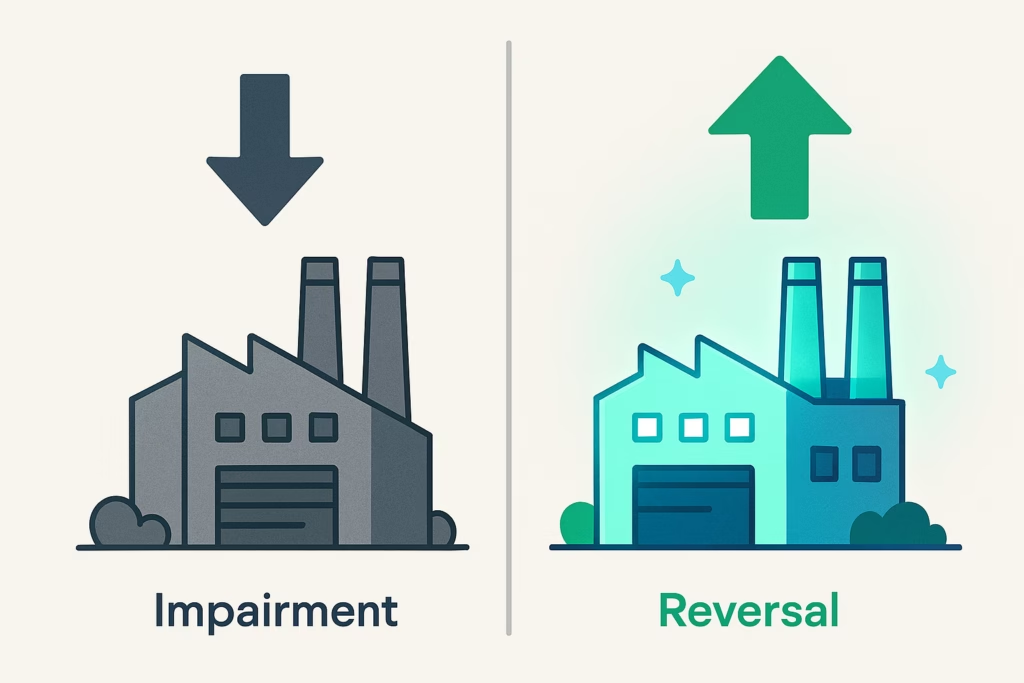
Impairment reversal is the accounting recognition of an asset’s recovery in value following a prior impairment loss — permitted under IFRS when the conditions that caused the original impairment have improved, subject to a ceiling that prevents overstating the asset’s carrying value. Understanding impairment reversal requires understanding the impairment framework it operates within, the ceiling calculation, and the significant exception that applies to goodwill.
The Impairment Framework
An impairment loss is recognised when an asset’s carrying amount — its value in the books after accumulated depreciation and any prior impairments — exceeds its recoverable amount. Under IAS 36, recoverable amount is the higher of:
- Value in use (VIU): the present value of future cash flows expected from continuing to use the asset, discounted at a pre-tax rate reflecting current market assessments of the time value of money and asset-specific risk
- Fair value less costs of disposal (FVLCD): the price a market participant would pay for the asset, less the costs of selling it
When recoverable amount falls below carrying amount, the difference is the impairment loss — recognised immediately in the income statement, reducing the asset’s carrying value on the balance sheet. For a cash-generating unit (CGU) containing goodwill, any impairment loss is allocated first to reduce the goodwill balance, then to reduce the other assets in the CGU pro-rata.
Stop building consolidations in spreadsheets.
BrizoConsol automates multi-entity consolidation — setup in minutes, reports the same day.
When Impairment Reversal Is Permitted
Under IAS 36.110, an entity must assess at each reporting date whether there is any indication that a previously recognised impairment loss may no longer exist or may have decreased. Indicators that conditions have improved include:
- Market value of the asset has increased significantly
- Favourable changes in the technology, market, economic, or legal environment in which the asset operates
- Market interest rates have declined, increasing the VIU calculation
- The asset’s performance has improved, producing better-than-expected cash flows
If any such indicator exists, the entity recalculates the recoverable amount. If the new recoverable amount exceeds the current carrying amount, a reversal may be recognised — but only up to the ceiling.
The Reversal Ceiling — Depreciated Original Cost
The impairment reversal cannot restore the asset to a carrying value higher than what its carrying amount would have been had no impairment been recognised. That means the ceiling is not the original cost — it is the original cost less accumulated depreciation that would have been charged had the impairment never been recognised.
Worked example — reversal ceiling Year 0: Equipment purchased at $1,000,000. Useful life: 10 years, straight-line. Annual depreciation: $100,000.
Year 2 (start): Carrying amount = $800,000. Recoverable amount falls to $500,000. Impairment loss: $300,000.
Post-impairment carrying amount: $500,000.
Remaining life: 8 years. New annual depreciation: $500,000 / 8 = $62,500.
Year 3: Recoverable amount recovers to $750,000.
Current carrying amount: $500,000 − $62,500 = $437,500.
What the carrying amount would have been without the impairment:
$1,000,000 − (3 × $100,000) = $700,000
Maximum reversal: $700,000 − $437,500 = $262,500
Reversal recognised: min($750,000 − $437,500, $262,500) = min($312,500, $262,500) = $262,500
Post-reversal carrying amount: $437,500 + $262,500 = $700,000 (= depreciated original cost ceiling).
Reversal journal entry
| Account | Debit | Credit |
|---|---|---|
| Accumulated Impairment / Asset (net) | $262,500 | |
| Impairment Reversal — Profit or Loss | $262,500 |
The reversal is recognised in profit or loss — the same line where the original impairment loss was recorded. Going forward, depreciation is recalculated on the revised carrying amount over the remaining useful life.
The depreciation recalculation after reversal: Post-reversal carrying amount of $700,000 over the remaining 7 years = $100,000/year — which is back to the original annual depreciation rate. This is logical: the reversal effectively restores the asset to where it would have been had no impairment occurred.
The Goodwill Exception — Permanent Impairment
Goodwill impairment cannot be reversed under IAS 36.124. This is an absolute prohibition, not a practical limitation. The reasoning: after a goodwill impairment loss is recognised, any subsequent increase in the recoverable amount of the CGU is likely to represent an increase in internally generated goodwill — which cannot be recognised as an asset under IAS 38. Reversing the goodwill impairment would be equivalent to recognising internally generated goodwill through the back door.
This exception has a significant practical consequence for group consolidations: where a subsidiary’s goodwill has been impaired, that impairment is permanent and accumulates over time. It cannot be reversed even if the subsidiary’s business recovers strongly. The only way goodwill that has been impaired leaves the balance sheet is through disposal of the relevant CGU.
🚩 Common misapplication: A subsidiary’s trade name or customer relationship intangible asset has been impaired in a prior year. The subsidiary’s performance has recovered significantly. The finance team reverses the impairment against retained earnings rather than through the income statement. Under IAS 36, impairment reversals must be recognised in profit or loss (for assets carried at cost) — not directly in equity. The only exception is assets carried under the revaluation model (IAS 16 or IAS 38), where the reversal goes to OCI to the extent it reverses a prior revaluation decrease.
IFRS vs US GAAP — A Significant Difference
IFRS and US GAAP diverge significantly on impairment reversals:
| IFRS (IAS 36) | US GAAP | |
|---|---|---|
| PP&E | Reversal permitted up to depreciated original cost | Reversal prohibited once impaired |
| Intangible assets | Reversal permitted (not goodwill) | Reversal prohibited |
| Goodwill | Reversal prohibited | Reversal prohibited |
| Financial assets | IFRS 9 expected credit loss model allows credit loss recovery | CECL model (ASC 326) allows credit loss recovery |
| Held-for-sale assets | Impairment reversals permitted up to cumulative loss | Reversal permitted only for subsequent increases in FVLCD |
The prohibition on reversals under US GAAP means that a US-based entity that has recognised an impairment loss on PP&E cannot reverse it even if the asset’s recoverable amount subsequently exceeds carrying value. IFRS entities can — and must assess whether to — reverse prior impairments at each reporting date when indicators of improvement exist.
Consolidation Implications
For group finance teams, impairment reversals create specific consolidation considerations:
Mixed-standard groups: Where an IFRS subsidiary has reversed an impairment and the group reports under US GAAP (or vice versa), the reversal must be adjusted out in the consolidation to align the entity’s figures to the group’s accounting policy. An IFRS subsidiary’s impairment reversal recognised in its statutory accounts cannot flow through to a US GAAP consolidated P&L without adjustment.
NCI in partially-owned subsidiaries: Where a subsidiary with a prior impairment is partially owned, any reversal affects the subsidiary’s net assets — and therefore the NCI’s share of equity. The reversal must be split between the group’s share and the NCI’s share in the consolidated statements, consistent with how the original impairment was allocated between the parent and minority interests.
Goodwill tracking at group level: The prohibition on goodwill impairment reversal means the group must maintain the impaired goodwill balance indefinitely for each CGU. As the group structure changes — new acquisitions, reorganisations, changes in CGU definitions — tracking which goodwill has been impaired, at what level, and against which CGU requires clear documentation in the consolidation working papers.
For groups managing impairment testing, reversal tracking, and goodwill allocation across multiple entities and CGUs, BrizoConsol provides the entity-level and group-level reporting visibility needed to monitor asset carrying values, NCI allocations, and consolidation adjustments period to period. Learn more or see it in action →