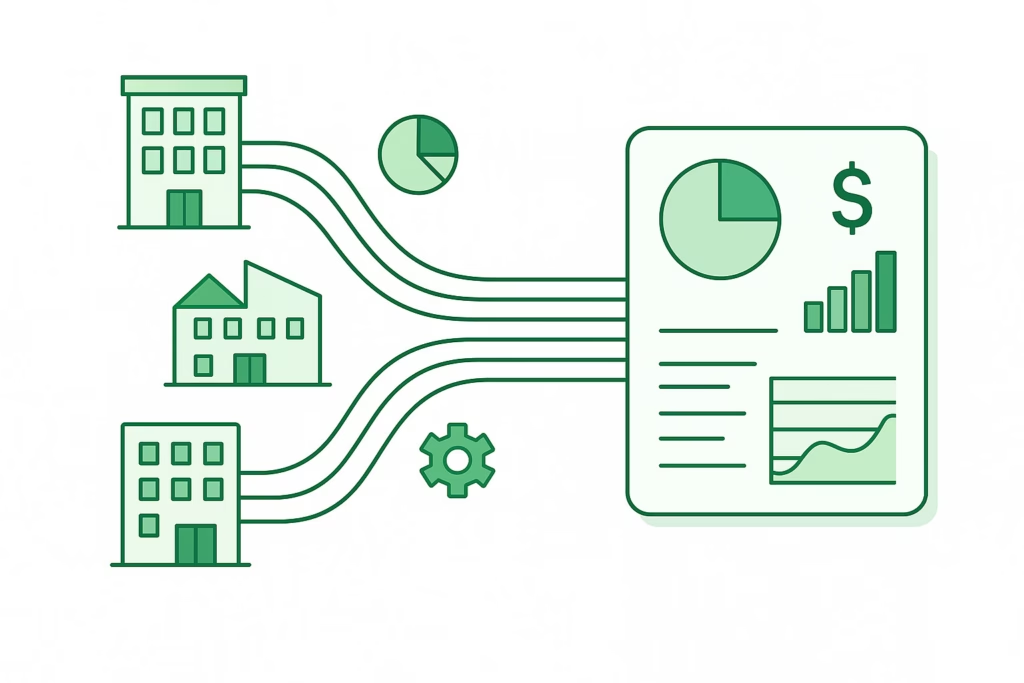
Mid-sized companies occupy an awkward position in the consolidation software market. Enterprise consolidation platforms — OneStream, Oracle Hyperion, SAP BPC — are built for groups with hundreds of entities, dedicated implementation teams, and 12-18 month deployment timelines. The cost structures and complexity levels of these products are calibrated for companies far larger than the typical mid-sized group. Spreadsheets, on the other hand, are where most mid-sized groups start — and where many stay until the model breaks irreparably during a year-end audit or a CFO change.
The gap between “Excel that’s struggling” and “enterprise system that’s overkill” is exactly where most mid-sized companies sit when they need to make a consolidation tool decision. Understanding that gap — what characterises it, what changes when you’re in it, and what the right response looks like — is the starting point for making a good decision.
The Three Phases of Consolidation Complexity
Most mid-sized groups move through three phases as they grow, and the transition between phases is when the consolidation process either adapts or starts failing:
Automate NCI calculations across all your entities.
BrizoConsol handles non-controlling interest automatically — no manual adjustments required.
Phase 1 — Excel works
2–4 entities, same currency, limited intercompany trading
At this stage, the consolidation is genuinely manageable in a well-built spreadsheet. There are few entity pairs, the intercompany activity is predictable and small, all entities report in the same currency, and the same person who built the model can run it every month. The risk is low and the overhead is proportionate.
Phase 2 — Excel is struggling
5–12 entities, multiple currencies, intercompany trading growing
This is the mid-sized company’s consolidation problem. The entity count has grown to a point where the intercompany reconciliation matrix is complex (10 entities = 45 entity pairs). Foreign currency entities have been added, requiring exchange rate management that the original model wasn’t designed for. Intercompany trading has grown enough that mismatches now appear regularly. The model is being maintained by someone who didn’t build it, under time pressure every month. The close is getting longer. Revised reports are going out more often. Trust in the numbers is eroding.
Phase 3 — Excel is failing
10+ entities or material complexity events (acquisition, audit pressure, leadership change)
Something specific breaks: an audit uncovers unexplained intercompany differences, a CFO departure exposes the model’s single-person dependency, an acquisition adds a new currency and the model can’t accommodate it cleanly, or the year-end close takes three weeks because nobody is fully confident in the output. At this point the cost of the spreadsheet approach is visible and concrete, not just theoretical.
What Makes Mid-Sized Companies Specifically Different
The mid-sized consolidation problem has specific characteristics that distinguish it from both the small-company problem and the large-enterprise problem:
| Characteristic | Small company | Mid-sized company | Large enterprise |
|---|---|---|---|
| Entity count | 1–4 | 5–30 | 50+ |
| Finance team size | 1–2 people | 3–10 people | Large dedicated team |
| Currency complexity | Single currency | 2–6 currencies | Many currencies |
| Intercompany activity | Minimal or none | Material and growing | Extensive and structured |
| Appropriate tool | Accounting software reports | Dedicated consolidation platform | Enterprise CPM system |
| Implementation tolerance | Days | Weeks to months | Months to years |
The mid-sized company doesn’t have the homogeneous single-currency simplicity of the small company or the dedicated implementation resources of the large enterprise. It has real complexity — intercompany trading, foreign currencies, NCI, sometimes different accounting platforms across entities — and a lean finance team that needs to close the books reliably every month without a six-month implementation project.
The Five Tipping Point Signals
Most mid-sized companies know intuitively when the spreadsheet process has become unsustainable. The specific signals that confirm it:
- The close takes more than five working days — and most of that time is data assembly and mismatch investigation, not analysis.
- Only one person fully understands the consolidation model — and when they’re unavailable, the close either stalls or produces output the team isn’t confident in.
- The board receives revised reports after the initial distribution — not occasionally, but as a pattern. The first version is no longer reliably the final version.
- Intercompany mismatches are expected every period — they’re not investigated to root cause because “there’s always something”; they’re patched and carried forward.
- Audit preparation is a separate project — pulling together elimination schedules, exchange rate sources, and adjustment documentation for the auditors takes more than a day and involves significant reconstruction of decisions made months earlier.
Any one of these signals is a concern. More than two appearing together regularly indicates a consolidation process operating at or beyond its reliable capacity.
What the Right Tool Actually Provides
A consolidation tool designed for mid-sized companies doesn’t need the configuration depth of an enterprise CPM system. It needs to solve the specific problems that Phase 2 and Phase 3 companies face:
- Direct API connections to the accounting systems already in use (Xero, QuickBooks, MYOB, Zoho Books) — not requiring a data warehouse or middleware layer
- A group chart of accounts that entity accounts map to once and reuse every period
- Automated intercompany matching before the close runs, not after
- Centrally published exchange rates applied to all entities simultaneously
- Elimination logic stored and applied consistently without manual re-entry each month
- Drill-down from group totals to entity and account detail
- Implementation measured in weeks, not months
The goal isn’t to replicate what an enterprise system provides for a Fortune 500 group. It’s to give a 5-15 entity mid-sized company the consolidation infrastructure that makes its close reliable, its audit defensible, and its management reporting trustworthy — without requiring a dedicated implementation team or a six-figure annual licence.
BrizoConsol is built specifically for mid-sized multi-entity groups — direct API connections to Xero, QuickBooks, MYOB, and Zoho Books, group COA mapping, automated intercompany matching, centrally applied FX rates, and elimination logic in a single platform. Implementation in weeks, not months. Learn more or see it in action →