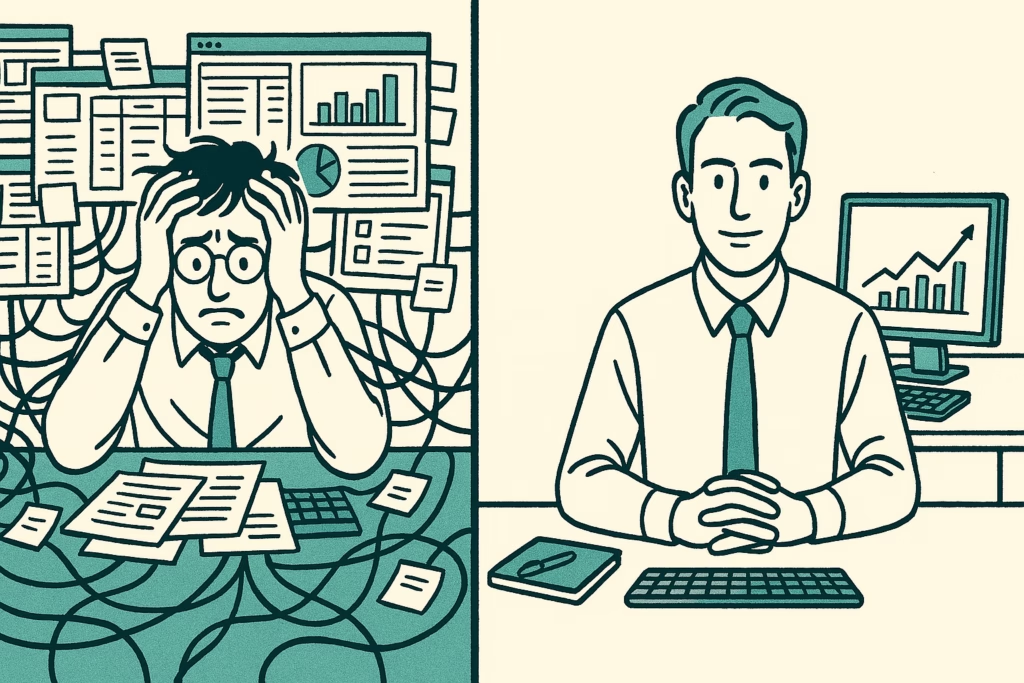
The tools built to save accountants time are now eating it. Here’s how it happened — and what it should look like instead.
There is a specific kind of frustration that every accountant managing multi-entity clients knows well. You open your consolidation software, and before you can do anything useful, you have to navigate a menu of menus, configure a setting that has nothing to do with your task, and dismiss a tooltip that was last relevant in 2019.
The software was supposed to save time. Somewhere along the way, it became the thing you need to be saved from.
Stop building consolidations in spreadsheets.
BrizoConsol automates multi-entity consolidation — setup in minutes, reports the same day.
This is not an accident. It is the predictable result of how most business software is built, funded, and grown — and understanding the pattern is the first step toward demanding something better.
The Feature Factory Problem

Most enterprise software companies operate what product teams call a “feature factory.” Every quarter, product roadmaps are filled not by asking what problem needs solving, but by asking what can we ship. Sales teams promise features to close deals. Competitors release something shiny. A loud enterprise client submits a request. Features accumulate.
Each individual addition might be justifiable. But no one is keeping score of the total. No one is asking whether the 47th menu item makes the product better or just larger. Complexity, unlike bugs, is rarely logged as a defect.
The best interfaces are not the ones with the most features. They are the ones where you only ever see the feature you actually need.
The accounting software market is particularly vulnerable to this. The underlying workflows — consolidations, eliminations, intercompany reconciliations, group reporting — are already complex by nature. When you layer marketing-driven complexity on top of genuinely hard problems, you get something that requires a certification course just to use.
The Incentive Structure Nobody Talks About
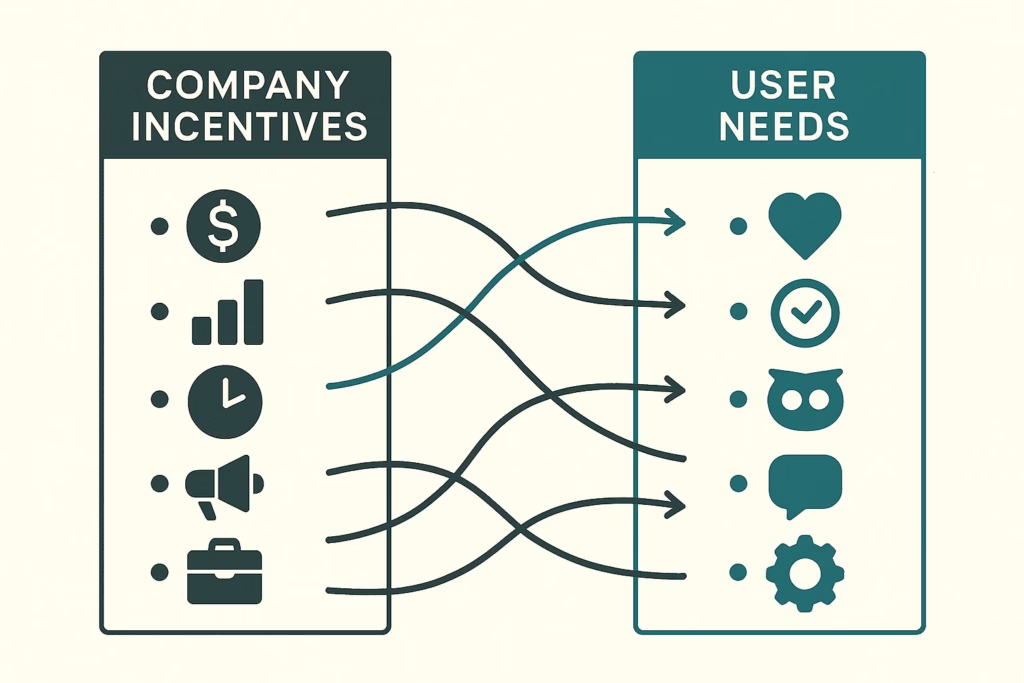
The feature factory does not persist because product teams lack taste. It persists because the incentives are entirely misaligned with simplicity.
- Complexity justifies price. Enterprise software is often priced on the perception of depth. A product that looks complicated feels more valuable to procurement. Buyers are conditioned to equate feature count with capability.
- Features are sellable; clarity is not. A sales team can demonstrate a new automation module in a pitch deck. They cannot easily demonstrate “we removed twelve confusing steps from your monthly close.” Simplicity does not slide well.
- Removing features is politically dangerous. Someone in the organisation fought to build every feature that exists. Proposing its removal is a direct confrontation with that history. Most product managers choose addition over conflict.
- Churn is blamed on everything except complexity. When users abandon a product, exit surveys often cite cost or missing features. Rarely do they articulate “it took too long to understand.” Complexity hides in plain sight, attributed to training gaps or change management failures instead.
- The people building it stop seeing it clearly. After eighteen months building a product, complexity becomes invisible to the team. The five-step process to generate a consolidated P&L feels obvious. It is not obvious to the partner at an accounting firm opening the product for the first time.
The Hidden Cost Sitting in Your Billing
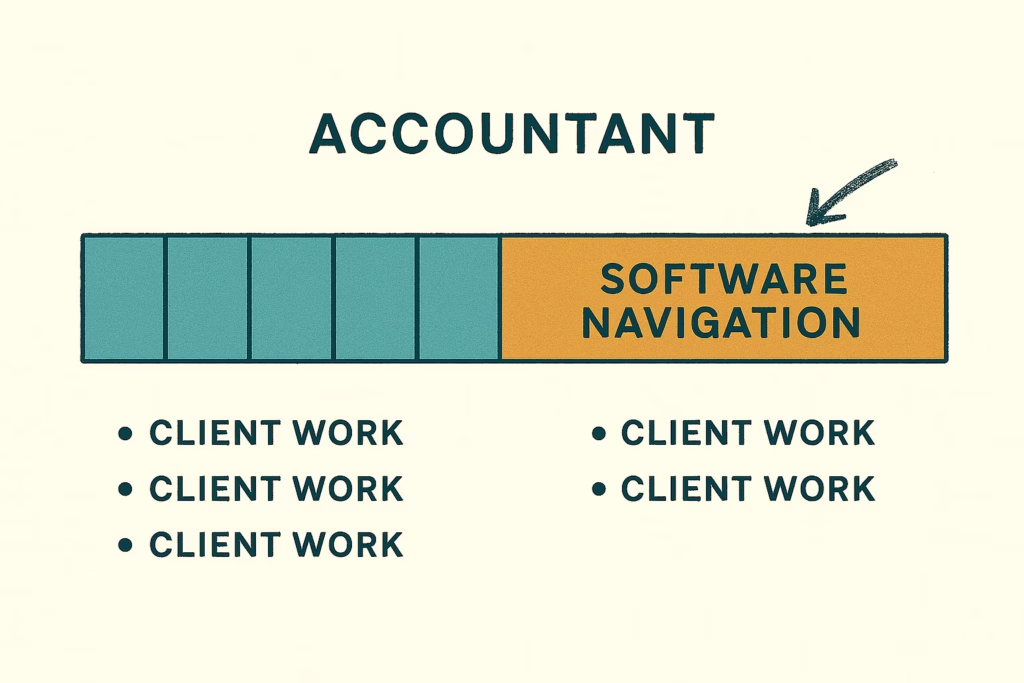
Time lost to complex software is one of the most invisible line items in an accounting practice. It does not appear on an invoice. It does not show up in a utilisation report. It shows up as a partner working until 9pm during group reporting season, as junior staff making errors because the workflow had too many steps to internalise, as clients waiting longer than they should for deliverables.
- 37% of software users report completing less than half of what they intended in a session due to interface friction.
- 4.5× more likely to abandon a workflow mid-task when the next step requires navigating a submenu.
- 2–3 hrs average weekly time lost per accountant to software navigation rather than actual accounting work.
- 68% of accounting firms cite software training time as a top operational cost when onboarding new staff.
What Complexity Actually Looks Like in Practice
For accounting firms managing multi-entity clients, the patterns are consistent enough to be almost predictable:
The setup maze. Connecting entities, mapping intercompany accounts, configuring elimination rules — these tasks should take an hour in a well-designed system. In many platforms, they take days. Consultants are called. Documentation is hunted. Tickets are raised.
The workflow that branches unexpectedly. You are halfway through a consolidation run and the system asks you to complete a configuration step you didn’t know was prerequisite. You navigate away. You lose your place. You start over.
The export problem. After all the work, the output does not match what the client expects. Formatting is off. Currency presentation differs from what was agreed. You export to Excel, manually fix it, and wonder what you paid for.
The training cliff. New staff cannot use the platform without weeks of internal training. Senior partners become the only people who truly know the system. That knowledge becomes a bottleneck. The software that was meant to scale the practice has instead created a dependency on one or two people.
Complexity is not a feature. It is technical debt that gets paid back in human hours.
The Alternative: Opinionated Software
The antidote to complexity is not necessarily simplicity in the sense of fewer features. It is opinionatedness. Software that makes clear choices about how work should flow, rather than providing infinite configurability that leaves users to construct their own workflow from scratch.
Good financial software for group reporting should know that accountants need to see consolidated financials in a standard format. It should know that intercompany eliminations follow rules that can be automated. It should know that the output of consolidation is not just numbers — it is a story of how a group of companies performed, which needs to be communicated clearly to partners and clients.
When software knows these things — when it is built around a deep understanding of how accounting actually works — it can make decisions on your behalf. Not to limit you, but to remove the decisions that were never yours to make in the first place.
Three Markers of Software That Respects Your Time
You can describe what it does in one sentence. If the answer to “what does this software do?” requires a slide deck, the product has a clarity problem. Clear software has a clear purpose.
A new user can complete a core task on day one. The benchmark for a well-designed financial consolidation tool is not whether an expert can eventually master it. It is whether a capable accountant can complete a consolidation run without consulting support documentation.
The output looks like work you are proud of. Good software produces outputs that represent the practice well — formatted correctly, presented clearly, easy to explain to a client. If the last step of every workflow is “tidy this up in Excel,” the software has not finished its job.
What BrizoSystem Was Built Around

BrizoConsol, BrizoSystem’s multi-entity consolidation platform, was built with a single audience in mind: accounting firms in Singapore and the region managing group structures for their clients. Not theoretically. Specifically.
That specificity is intentional. It allows the product to make decisions. To not ask you to configure things that have sensible defaults. To understand that IFRS and Singapore FRS have particular requirements for NCI, goodwill, and intercompany eliminations — and to handle them correctly without requiring you to build the logic yourself.
The standard we hold ourselves to: a senior accountant who has never used BrizoConsol should be able to run a consolidation for a three-entity group in their first session. Not after training. Not after reading a guide. In their first session.
If they cannot, it is our problem to fix — not theirs to work around.
That is what software that respects its users looks like. And it is the standard that the category deserves — and that accounting firms should be demanding.