Most group finance teams run into the same problem eventually.
The legal structure of the business — the holding company, its subsidiaries, the ownership percentages — reflects how the group was built, not necessarily how it should be managed. A regional CFO wants to see APAC performance as a single view. A board wants to assess the manufacturing division independently from distribution. A partner managing the client portfolio wants to produce a consolidated pack for the operational businesses, separate from the investment holding entities.
Legal entity structure answers the compliance question. It does not always answer the management question. And for most consolidation tools, those two questions are treated as the same thing.
Automate NCI calculations across all your entities.
BrizoConsol handles non-controlling interest automatically — no manual adjustments required.
BrizoConsol handles them separately — and that distinction is what this post is about.
The Foundation: What Consolidation in BrizoConsol Actually Handles
Before covering what makes BrizoConsol different, it is worth being precise about what the consolidation engine handles by default, because the baseline matters.
Common Chart of Accounts. Subsidiaries rarely use identical account structures. One entity might classify a cost as “Staff Costs,” another as “Personnel Expenses.” BrizoConsol’s Common Chart of Accounts (CCOA) resolves this at the mapping layer — each entity’s accounts are mapped to a shared CCOA, which is what drives consolidated reporting. The result is that group financials reflect consistent classifications across all entities, without requiring anyone to manually reformat data before consolidation runs.
Multi-currency translation. For groups with entities operating in different currencies, BrizoConsol applies exchange rates automatically — average rates for P&L, closing rates for balance sheet, in line with standard consolidation practice. A Singapore-based group with subsidiaries in Australia, the UK, and the US can consolidate into SGD without manual rate adjustments or FX worksheet gymnastics. The currency translation adjustment (CTA) is handled within the system.
Intercompany eliminations. Intercompany transactions — loans between entities, management fees, internal sales — need to be eliminated before the group view is meaningful. BrizoConsol supports eliminations at both group and subsidiary level, giving the consolidation preparer flexibility in how they approach the elimination process depending on the client’s structure and the nature of the transactions involved.
Drill-down from consolidated to source. Consolidated figures are only trustworthy if you can verify what sits underneath them. BrizoConsol allows users to drill from any consolidated number down to the individual transactions that make up that figure — useful for review, useful for audit queries, and useful for explaining movements to stakeholders who want more than a summary.
These features handle the compliance and accuracy side of consolidation. They are what you need to produce group financial statements that are technically correct. But they are not what makes BrizoConsol worth discussing at the management reporting level.
Virtual Groups: Consolidation Across a Different Dimension
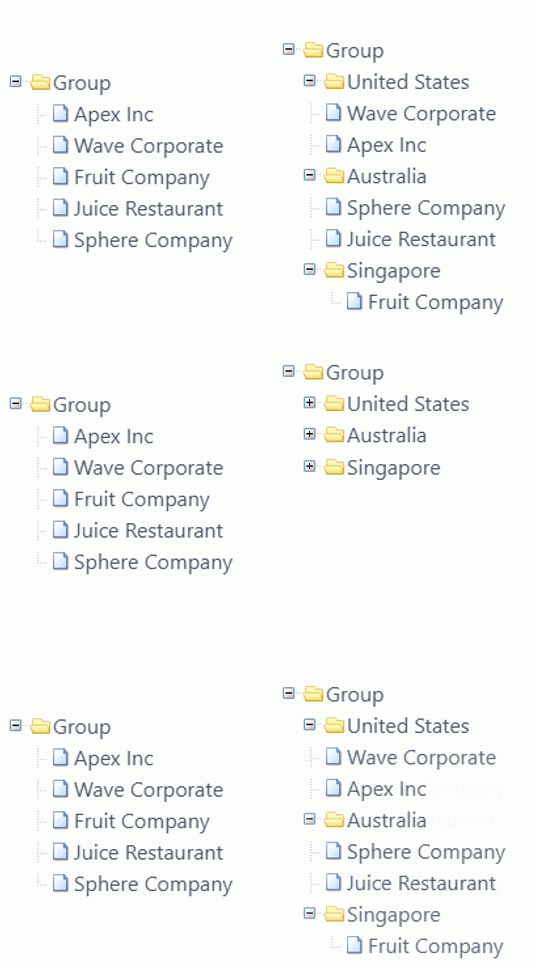
Every consolidation tool can consolidate by legal structure. BrizoConsol can also consolidate by whatever structure matters for how the business is actually managed.
Virtual Groups is the feature that makes this possible. It allows you to define custom groupings of entities — based on geography, business function, product line, strategic classification, or any other dimension — and generate consolidated financials for those groups, using the same underlying data that feeds the legal entity consolidation.
No separate data import. No duplicate chart of accounts mapping. No parallel process. The entities are already in BrizoConsol. Virtual Groups simply gives you a different lens through which to aggregate them.
What This Looks Like in Practice
Take a group with the following structure:
A Singapore holding company with subsidiaries in Australia, New Zealand, the United Kingdom, and the United States. The legal consolidation produces a single group P&L and balance sheet — which is what the auditors and regulators need.
But the CFO needs three additional views:
By geography. An APAC view that consolidates Singapore, Australia, and New Zealand — useful for regional performance reporting and comparison against EMEA (UK) and Americas (US).
By function. The Australian and New Zealand entities are primarily distribution businesses. The UK entity runs R&D. The US entity handles sales and marketing. The CFO wants to see how the distribution businesses are performing relative to the enabling functions — without having to extract data and rebuild the analysis in a spreadsheet every quarter.
By strategic classification. Some entities are in high-growth markets where short-term profitability is intentionally sacrificed for market share. Others are in mature, cash-generative markets. Grouping them separately produces a cleaner picture of where the business is investing versus where it is harvesting.
With Virtual Groups configured in BrizoConsol, the finance team generates all four views — legal group consolidation plus the three management groupings — from the same data, on the same platform, without maintaining separate workbooks for each cut.
Why This Matters for Accounting Firms
For accounting firms managing a portfolio of multi-entity clients, Virtual Groups serves a specific practical function: it lets you produce management-ready reporting for each client without being constrained by how their legal structure happens to be organised.
A client might have built their group through acquisition, with entities that reflect historical deal structures rather than current operational logic. Another might have a holding company that owns both operating businesses and investment assets that should never appear in the same management view. Virtual Groups lets the reporting reflect the operational reality rather than the legal history.
It also means that as a client’s business evolves — new acquisitions, restructured divisions, geographic expansion — the management reporting structure can be updated independently of the legal consolidation. The two do not need to move in lockstep.
Getting Started
If you are currently managing a multi-entity client portfolio and producing management views by manually slicing and aggregating from a single consolidated output, Virtual Groups is the feature that eliminates that work.
BrizoConsol is available on a free trial. If you would prefer to see how Virtual Groups and the broader consolidation workflow operates with a structure similar to your own, book a demo and we will walk through it with you.
BrizoConsol is a multi-entity financial consolidation platform built for accounting firms and finance teams managing group structures. It supports IFRS, UK GAAP, and US GAAP consolidation with native integrations to Xero, QuickBooks, MYOB, and Zoho Books.