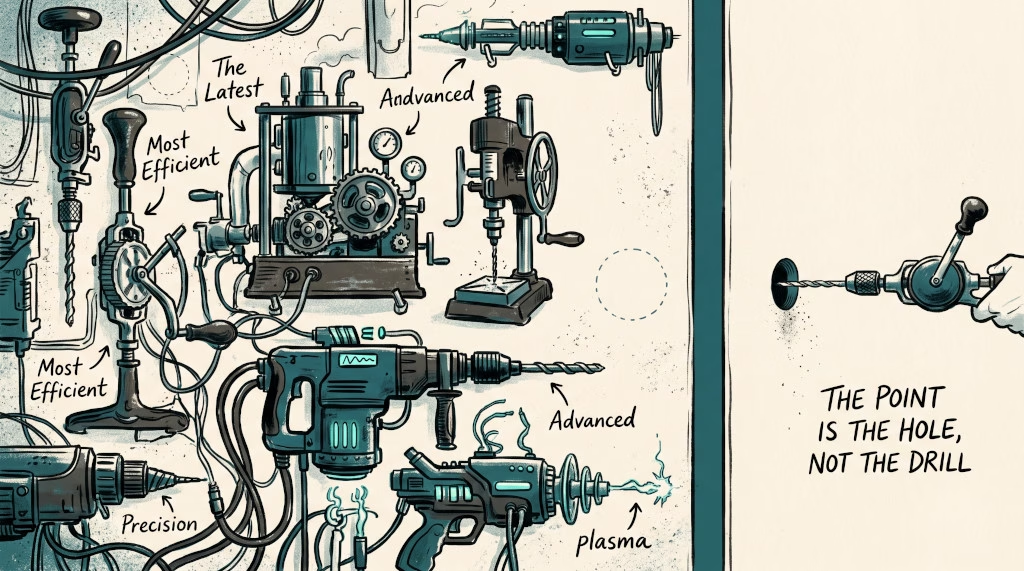
Most software grows by addition. The products that endure grow by subtraction — removing everything that stands between the user and the thing they actually need to do.
There is a moment in the development of almost every software product where the team stops asking “what problem are we solving?” and starts asking “what should we build next?” It is a subtle shift, and it rarely feels like a wrong turn when it happens. The backlog is full of reasonable requests. The roadmap is full of plausible additions. Each item on it seems justifiable when considered individually. Collectively, they point the product in a direction that has nothing to do with the problem it was originally built to solve.
This is not a failure of ambition. It is a failure of discipline — the specific discipline required to hold a product to the problem it set out to address, to resist the pressure to expand scope in response to every request, and to make the distinction between additions that serve the user’s actual need and additions that serve the product team’s need to feel like they are building something.
Stop building consolidations in spreadsheets.
BrizoConsol automates multi-entity consolidation — setup in minutes, reports the same day.
The products that people return to without being reminded — the ones that earn quiet loyalty rather than grudging dependency — are almost always the ones that solved a specific problem so completely that there was nothing left to work around. They did not do more. They did the right thing thoroughly.
Why Features Accumulate Without Solving Problems
Understanding how products drift from problem-solving to feature-accumulating requires understanding the incentive structure that governs most product development processes.
Sales teams close deals by demonstrating capability. Every feature is demonstrable. The absence of a problem — the reduction of friction, the elimination of a step, the removal of a configuration option that should have been a default — is not demonstrable in a product demo. It is felt over time by the person using the product, but it cannot be shown in a thirty-minute call. The incentive structure of the sales process therefore consistently pushes toward addition, because addition is visible and absence is not.
User feedback, channelled through support tickets and feature requests, reflects the symptoms of problems rather than the problems themselves. A user who asks for a new export format is expressing a symptom — that the current output does not match what they need. The problem might be that the output format was designed for a different use case. Solving the problem would mean redesigning the output for the user’s actual use case. Adding the new export format is faster, and it closes the ticket, so it gets added. The underlying problem remains.
Competitive pressure produces a third force toward accumulation. When a competitor releases a feature, the response in most product teams is to match it — not because the feature solves a problem the team’s users have, but because not having it becomes a point of competitive comparison. Features get added to close competitive gaps rather than to close user problems, and the product grows without meaningfully becoming better at what it set out to do.
A feature request is a symptom report. The user is telling you something is wrong. They are rarely in a position to tell you what is actually wrong — that is the product team’s job to find out.
What Solving a Real Problem Actually Means
The phrase “solving a real problem” is used so frequently in product circles that it has lost its specificity. It is worth being precise about what it means in practice, because the precision is what distinguishes products that genuinely do it from products that merely claim to.
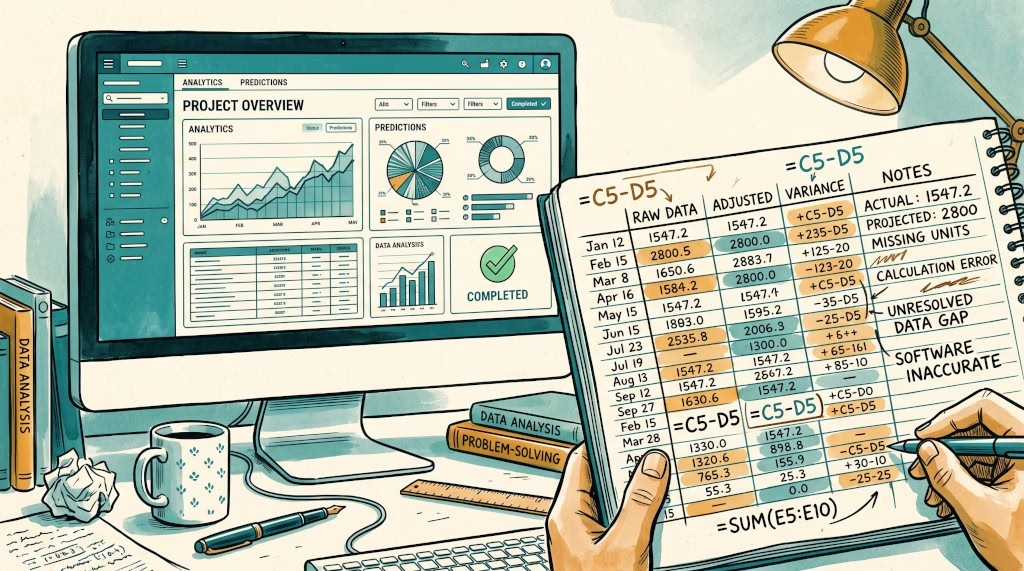
Solving a real problem means that after the user has used the product for its intended purpose, the problem that existed before is gone — not mitigated, not reduced, not addressed through a workaround — gone. The user does not need to finish the job in Excel. They do not need to cross-reference the output against a separate system. They do not need to remember to check a setting before running the process. The product handled it, correctly, without requiring the user to carry the knowledge of the exception or the maintenance of the workaround.
This is a higher bar than it sounds. It requires the product team to understand the problem with enough precision that they know what “done” looks like from the user’s perspective — not from the perspective of the team that built the feature, but from the perspective of the person whose working day the feature is supposed to improve. It requires following the user’s workflow all the way to the output they actually need to produce, not stopping at the point where the product’s direct involvement ends.
It also requires accepting that solving a problem completely is harder and slower than adding a feature partially. A feature that addresses eighty percent of the problem can be shipped quickly. The remaining twenty percent — the edge cases, the output formatting, the integration with the adjacent workflow step — takes as long as the first eighty, and it is less satisfying to build because it produces no new capability, only the completion of a capability that already partially existed. The discipline to finish is as important as the discipline to start.
The Discipline of Problem-First Development
Building products around problems rather than features requires a set of practices that are straightforward to describe and genuinely difficult to maintain under the pressures of a product development cycle.
State the problem before the solution. Every item that enters the product roadmap should be preceded by a clear statement of the problem it solves — not the feature it adds, but the user situation it changes. “Allow users to export in CSV format” is a feature. “Accountants currently cannot share consolidation data with clients who use Excel-based templates without a manual reformatting step” is a problem. The feature may be the right solution. But starting with the feature prevents the team from asking whether there is a better solution to the stated problem.
Define what done looks like from the user’s perspective. Before building anything, the team should be able to describe specifically what the user’s experience will be after the problem is solved — not what the product will do, but what the user will no longer have to do. If the team cannot describe this precisely, the problem is not understood well enough to solve.
Follow the workflow to its natural end. The temptation in product development is to build the part that is most interesting to build and leave the last mile to the user. The last mile is where most of the frustration lives. An accounting tool that produces a technically correct output but requires reformatting before it can be delivered to the client has not solved the accountant’s problem — it has solved the calculation problem and left the presentation problem untouched.
Measure whether the problem actually went away. The most rigorous test of whether a problem has been solved is to check whether the workaround that preceded the feature has been abandoned. If users are still maintaining a spreadsheet alongside the product, if they are still performing the manual step the feature was meant to eliminate, the problem has not been solved. The workaround is the honest diagnostic. Its persistence is the product’s feedback.
How to Know If You Are Solving the Right Problem
The hardest part of problem-first product development is not the discipline required to build this way — it is the work required to identify which problems are actually worth solving. Not all problems are equal. Not all problems experienced by users are the problems that, if solved, would change how those users work.
The problems worth solving share a common profile. They are problems that occur repeatedly, in the same part of the workflow, for the same reason. They are problems that require the user to maintain a workaround — a spreadsheet, a manual step, a recurring check — that consumes time and attention every time the workflow runs. They are problems whose resolution would change the output of the workflow, not just the experience of producing it. And they are problems where the user’s current approach is genuinely inferior to what the product could provide — not just different, but worse in ways that matter to the quality of the work.
The problems not worth solving are the ones that represent edge cases or personal preferences that do not generalise, the problems whose solution would require the product to expand into an adjacent domain it is not designed for, and the problems that are real but minor — friction that is genuine but insufficient to change anyone’s working pattern if removed.
Knowing the difference requires proximity to the user’s actual work — not to their stated preferences, but to the workflow itself, observed directly or reconstructed with enough detail to identify what is actually causing the friction. Generic problems produce generic solutions. Precise problems produce precise solutions that actually change how work gets done.

The Compounding Advantage of Problem-Focused Products
Products built around problem-solving rather than feature accumulation have a compounding advantage that becomes more significant over time. It does not show up immediately — in the first six months, the feature-rich competitor may look more impressive in a side-by-side comparison. But it shows up consistently at the point that actually matters: in whether users return to the product because it makes their work better, or whether they use it because switching costs make leaving inconvenient.
A product that solves the core problem completely accumulates fewer support requests, because the sources of friction that generate support requests have been eliminated rather than worked around. A product with a precisely defined scope is easier to improve — each new version can go deeper into the problem rather than wider into adjacent territory. A product whose value is felt in the quality of the work it enables, rather than in the volume of capabilities it offers, creates the kind of genuine advocacy that no marketing budget can manufacture.
Users who experienced a product solving a real problem for them talk about it differently than users who experienced a product with a lot of features. The former talk about what they no longer have to do. The latter talk about what the product can do. The distinction reveals the difference between a product that changed how someone works and a product that expanded what they theoretically have access to. Only the former produces durable retention.
How This Shapes How We Build at BrizoSystem
The problem-first principle is the governing constraint at BrizoSystem — not as a stated value, but as a practical filter applied to every product decision.
When BrizoConsol was scoped, the problem was stated precisely: accounting firms managing group structures for SME clients spend a disproportionate amount of their close cycle discovering what needs to be done, constructing eliminations manually, and reformatting outputs for presentation. The product was designed to remove each of those steps specifically. The benchmark was not “does the consolidation calculation work?” It was “does the accountant’s close take materially less time and produce a better deliverable than before?”
When features are proposed for BrizoConsol, the filter is the same: does this solve a specific problem that currently exists in the accounting firm’s workflow, and if implemented completely, would the user’s workaround for that problem disappear? Features that pass this test get built. Features that add capability without eliminating friction do not.
The same discipline applies to BrizoMarket. The problem being solved is not “give business development teams access to more market data.” It is “business development professionals at small firms spend time they do not have monitoring market conditions manually, and as a result they miss the moments that matter most.” The product’s job is to make those moments impossible to miss — not to add monitoring capability, but to eliminate the monitoring burden entirely.
Solving real problems is slower than shipping features. It requires more precise problem statements, more rigorous definitions of done, and the discipline to finish the last mile of a workflow even when the interesting engineering is complete. But it is the only approach that produces the thing the user actually needed — and the only approach that produces a product worth returning to.