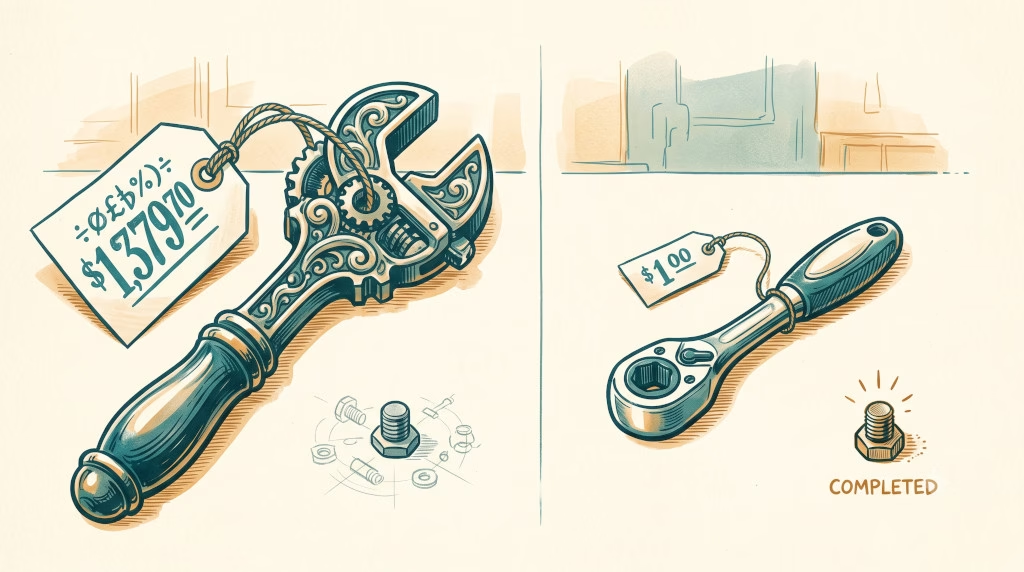
Price is not a reliable proxy for fit. For most small businesses, the most expensive option is also the least well-suited — and the gap between what they pay and what they get is widening.
There is a durable assumption in business software procurement that price signals quality — that a more expensive platform is more capable, more reliable, and more appropriate for serious professional use than an affordable alternative. This assumption has never been universally true, but it has been true often enough, for long enough, that it has shaped procurement behaviour across industries for decades.
It is less true now than it has ever been. The conditions that once produced a reliable correlation between price and capability — high infrastructure costs, expensive engineering talent, significant distribution overhead — have changed materially. The cost of building and deploying capable software has declined. The market for specialist tools has matured. And the gap between what enterprise software delivers to small businesses and what those businesses actually need has become wide enough to be quantifiable.
Stop building consolidations in spreadsheets.
BrizoConsol automates multi-entity consolidation — setup in minutes, reports the same day.
The argument for expensive enterprise software in a small business context is not that it is better. It is that it is familiar, defensible, and carries the reputational weight that makes it the safe choice in a procurement process. That is a different argument — and it is one that does not survive a rigorous assessment of what the business actually gets for the premium it pays.
What Enterprise Pricing Actually Covers
Understanding why enterprise software is expensive is the first step toward understanding why that expense often does not translate into value for smaller organisations.
Enterprise software pricing covers several things that are entirely legitimate costs for the vendor: the engineering investment required to build software that scales to thousands of concurrent users, the global support infrastructure required to serve enterprise clients across time zones, the compliance certifications required to operate in regulated industries and markets, and the sales and implementation capacity required to close and deploy large enterprise contracts. These are real costs, and for the large enterprise client that needs all of these capabilities, the pricing reflects genuine value.
For the small accounting firm with twelve staff, or the lean business development team of four, these costs are still embedded in the price — but the capabilities they cover are largely irrelevant. The firm does not need software that scales to thousands of users. It does not need a global support team available at 3am. It does not need the compliance infrastructure required to operate in fifty jurisdictions. It is paying for capabilities it will never use, in order to access the specific workflow support it needs — which is available, often at superior quality, from a purpose-built tool at a fraction of the cost.
Enterprise software charges for scale you do not need, compliance you do not require, and support infrastructure you will rarely use. The affordable alternative charges for the workflow you actually have.
Where Affordable Software Has the Structural Advantage
The performance advantage of affordable, purpose-built software over expensive enterprise alternatives is not accidental. It is structural — a direct consequence of the different design mandates that govern each category.
An enterprise suite module for financial consolidation is built to serve organisations ranging from a fifty-person professional services firm to a multinational corporation with three hundred subsidiaries across forty currencies. The design decisions it makes must accommodate that entire range. The result is a module that is technically capable of handling the small firm’s three-entity consolidation but is architected for a use case ten times more complex, and imposes that complexity on the small firm through its interface, its configuration requirements, and its output format.
An affordable, purpose-built consolidation tool for small accounting practices makes none of those compromises. Its entire design mandate is the specific workflow of a firm managing group structures for SME clients — the entity counts, the accounting standards, the client deliverable format, the integration points with the accounting systems those clients use. Every default is calibrated for that use case. The result is a tool that not only costs less but performs better at the specific job, because the specific job is the only job it was designed to do.
The Total Cost of Ownership Gap
The price comparison between affordable and enterprise software is usually framed as a licence fee comparison. That framing understates the gap significantly.
Total cost of ownership for enterprise software includes the licence fee, the implementation cost, the ongoing administration and maintenance cost, the training cost for new staff, and the productivity cost of a tool that is harder to use than the task requires. For small businesses, where implementation is typically handled by internal staff rather than a dedicated project team, these costs are not marginal. They are the dominant component of the total cost — often three to five times the licence fee over a three-year period.
Affordable, purpose-built software does not carry most of these additional costs. The implementation is a setup, not a project. The maintenance is handled by the vendor at the product level, not by the customer at the configuration level. The training overhead is low because the product is designed to be learned through use rather than through structured instruction. When the total cost of ownership is calculated honestly, affordable software that is well-suited to the use case is frequently cheaper at the five-year mark than enterprise software at a lower list price.

The Quality Argument for Domain-Specific Tools
The case for affordable software is not only economic. In specific domains, purpose-built affordable tools produce demonstrably better outputs than the corresponding enterprise module — not because they are more technically sophisticated, but because they are more precisely calibrated to the workflow.
Consider the consolidation workflow. An enterprise ERP consolidation module produces a consolidated financial statement that is technically accurate. But the output is formatted for the ERP’s internal data model, not for the accounting firm’s client deliverable. The accountant exports it, reformats it in Excel, adjusts the presentation to match what the client expects, and delivers it. The technical accuracy is correct. The workflow is not complete.
A purpose-built consolidation tool designed for accounting practices produces a consolidated financial statement that is technically accurate and formatted for presentation — structured in the way the client expects to receive it, ready to deliver without a reformatting step. The accounting knowledge embedded in both products is equivalent. The workflow coverage is not. The affordable, purpose-built tool completes the job. The expensive enterprise module completes the calculation and leaves the job to the accountant.
The Adoption Rate Advantage
Software that is not used does not create value regardless of its cost. Enterprise software adoption in small business contexts follows a predictable pattern: initial enthusiasm gives way to partial adoption as the complexity of the tool becomes clear. Partial adoption stabilises into a long-term equilibrium where the tool is used for the subset of its capabilities that the team has learned and the rest of the licence goes unused.
Affordable, purpose-built software that is well-designed for its specific use case has higher adoption rates for a structural reason: there is less to adopt. The tool covers the specific workflow and nothing else. There are no unused modules, no underutilised features, no capabilities that were purchased in procurement and forgotten in operation. The team learns the tool because the tool is the size of the job.
Full adoption of an affordable tool that covers the core workflow is more valuable than partial adoption of an enterprise suite that theoretically covers everything. The value of software is not what it could do — it is what the team actually does with it.

How to Evaluate Without the Price Heuristic
Removing price as a proxy for quality requires replacing it with evaluation criteria that are directly relevant to what the business needs the software to do.
First-session task completion. Can the person who will use this software daily complete the core task it is meant to support in their first session, without documentation or support? This is the most direct test of whether the tool is calibrated to the user’s actual workflow. Enterprise software typically fails this test for small business users. Purpose-built software designed for the specific workflow typically passes it.
Output quality without post-processing. Does the tool produce the output the business actually needs, in the format it needs it, without a manual step at the end? If the answer requires an Excel step or a formatting adjustment, the tool has not completed the workflow. A more expensive tool that requires post-processing is delivering less value than a more affordable tool that does not.
Total cost over three years, not licence fee. What does it cost to implement, maintain, train new staff on, and operate this tool over a three-year period — including internal time, not just external fees? This calculation consistently changes the comparison. The implementation overhead that is invisible in the licence fee comparison becomes the dominant cost component when the full picture is assessed.
Adoption rate at twelve months. What percentage of the tool’s licensed capability is the team actually using at twelve months? A tool where the answer is thirty percent is delivering thirty percent of its stated value at one hundred percent of its stated cost. A tool where the answer is ninety percent — because the tool is the size of the job — is delivering proportionally more regardless of its price point.
What BrizoSystem Was Built Around
BrizoSystem’s products are built with a specific and deliberate positioning on this spectrum: affordable, purpose-built, and designed to outperform the enterprise module at the specific workflow that matters to the user — not to compete with the enterprise suite on breadth.
BrizoConsol is priced for accounting practices and in-house finance teams, not for enterprise IT budgets. It does not require an implementation project, a configuration workshop, or a specialist to operate. It connects to the accounting systems already in use, produces consolidated financials in a presentation-ready format, and completes the group reporting workflow without a post-processing step. Against the consolidation module of an enterprise ERP, it is more affordable, faster to deploy, easier to use, and produces better output for the specific use case it was built for.
BrizoMarket is priced for lean business development teams and practice directors, not for enterprise sales operations with dedicated RevOps functions. It requires no configuration of monitoring parameters or signal logic. Against the market intelligence capabilities of an enterprise CRM or BI platform, it is more affordable, requires no setup, and produces more actionable output for the specific use case — because the specific use case is the only use case it was designed for.
Price is not irrelevant to software value. But for small businesses evaluating the tools available to support their specific workflows, price is a poor proxy for performance. The question is not what the tool costs relative to the alternatives. It is what it delivers relative to what you need — and on that measure, the affordable tool built for your workflow will outperform the expensive suite built for someone else’s organisation far more often than the price premium suggests it should.