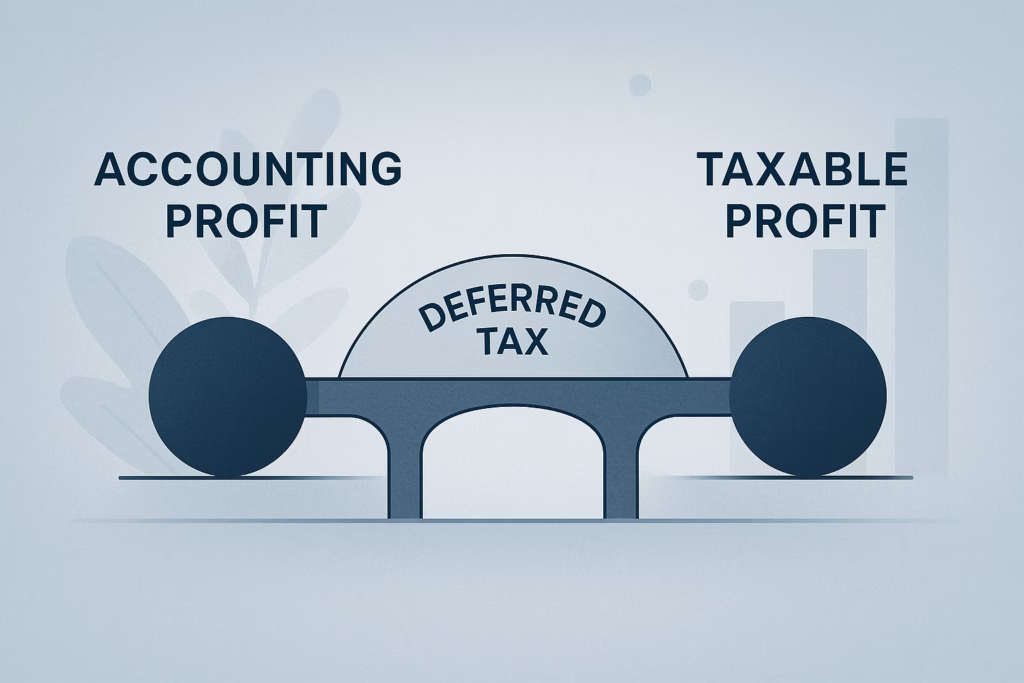
Each entity in a group calculates its own deferred tax position — based on the temporary differences between its accounting carrying values and tax bases. These entity-level deferred taxes are aggregated into the consolidation. But the consolidation process itself also creates new deferred tax balances: temporary differences that don’t exist in any individual entity’s accounts but arise from the adjustments applied to produce the group financial statements.
This post covers those consolidation-level deferred taxes specifically — the ones that arise from intercompany profit elimination, acquisition fair value adjustments, and the group’s investment in subsidiaries. These are the deferred tax balances most likely to be missed or mishandled in a manual consolidation, and the ones auditors scrutinise most closely.
Scenario 1: Deferred Tax on Unrealised Intercompany Profits
When the group eliminates an unrealised intercompany profit — goods sold by Entity A to Entity B still held in Entity B’s inventory at period end — the group’s inventory is written down to the original cost. But Entity A has already paid tax on its profit in its own jurisdiction. The tax authority does not reverse that tax payment because the group has eliminated the profit for accounting purposes.
Automate NCI calculations across all your entities.
BrizoConsol handles non-controlling interest automatically — no manual adjustments required.
The result: the group has paid tax on a profit it has not yet recognised in its consolidated statements. This is a deferred tax asset — the future deductibility when Entity B eventually sells the goods externally.
Worked example Entity A (UK, 25% tax) sells goods to Entity B (Singapore, 17% tax) at a $60,000 profit. All goods remain in Entity B’s inventory at period end.
Step 1 — intercompany profit elimination:
Dr COGS $60,000 / Cr Inventory $60,000 (removes unrealised profit from group inventory)
Step 2 — deferred tax recognition:
DTA = $60,000 × 17% (Entity B’s rate) = $10,200
Dr Deferred Tax Asset $10,200 / Cr Tax Expense $10,200
💡 Use the purchasing entity’s tax rate, not the seller’s. The temporary difference reverses when Entity B sells the goods externally — at which point Entity B’s taxable income increases (it records external revenue against the intercompany cost base). The deferred tax benefit will be realised in Entity B’s jurisdiction, so Entity B’s rate applies. In the example above, Entity A’s 25% rate is irrelevant to the consolidation DTA calculation.
When Entity B sells the goods externally in the following period, the temporary difference reverses: the group recognises the full external margin, and the DTA is released — matching the tax benefit to the period of recognition.
Scenario 2: Deferred Tax on Acquisition Fair Value Adjustments (IFRS 3)
When a subsidiary is acquired, IFRS 3 requires its identifiable assets and liabilities to be measured at fair value at the acquisition date. Where the fair value differs from the tax base — which typically remains at the subsidiary’s pre-acquisition book value — a temporary difference arises at the consolidation level.
Example — PP&E fair value uplift At acquisition, the target’s PP&E has:
Book value (= tax base): $500,000
Fair value at acquisition: $700,000
Fair value uplift: $200,000
Tax rate in the subsidiary’s jurisdiction: 25%
The uplift creates a taxable temporary difference (fair value > tax base) → DTL of $50,000 ($200,000 × 25%)
This DTL reduces the fair value of net assets acquired:
Net assets at fair value: $X
Less: DTL on fair value uplift: ($50,000)
Net identifiable assets (adjusted): $X − $50,000
Goodwill = Purchase consideration − (Net identifiable assets adjusted)
The DTL is recognised in the consolidation at acquisition and carried forward. Each period, as the uplifted PP&E depreciates, the depreciation charged in the group accounts exceeds the depreciation charged in the subsidiary’s own accounts (because the group carries the asset at a higher value). This excess depreciation reverses the DTL over the remaining useful life of the asset.
📌 Goodwill exception under IAS 12.15: The deferred tax arising from the initial recognition of goodwill itself is specifically excluded from IAS 12. No DTL is recognised for the goodwill balance, even though goodwill has no tax base in most jurisdictions (creating a permanent difference). This is an exception to the normal rule that taxable temporary differences give rise to DTLs.
Where a subsidiary is partly owned, the DTL on fair value adjustments is split between the group and the NCI in proportion to their ownership percentages — consistent with how the fair value adjustments are allocated between parent and minority at acquisition.
Scenario 3: Outside Basis Differences — Undistributed Subsidiary Profits
A group’s investment in a subsidiary on the consolidated balance sheet (its share of net assets) typically differs from the tax base of that investment — because the group carries the investment at its share of cumulative net assets (increasing as the subsidiary earns profits) while the tax base may be the original cost of acquisition or a different amount.
This “outside basis difference” creates a taxable temporary difference (carrying amount of investment > tax base). Under normal IAS 12 rules, this would require recognition of a DTL for the group’s share of the subsidiary’s undistributed profits.
However, IAS 12.39 provides an exception: no DTL is recognised for outside basis differences where:
- The parent is able to control the timing of the reversal of the temporary difference, and
- It is probable that the temporary difference will not reverse in the foreseeable future
In practice, most parent companies with wholly-owned subsidiaries meet both conditions: they control dividend policy (can choose not to pay dividends) and intend to hold the investment long-term. The exception means groups do not need to recognise DTLs for all of their subsidiaries’ accumulated retained earnings — which would produce enormous deferred tax liabilities for most groups.
💡 Where the exception does NOT apply: If the group has decided to sell a subsidiary, the outside basis difference will reverse — the sale triggers taxation on the gain. Once the decision to sell is made and the reversal is probable, a DTL must be recognised for the expected tax on disposal. This is a common source of last-minute deferred tax adjustments when M&A activity is in progress.
Applying the Correct Tax Rate — Mixed Jurisdiction Groups
Where group entities operate in different jurisdictions with different tax rates, the consolidation deferred tax calculation must apply each jurisdiction’s rate to the relevant temporary difference — not a blended group rate.
| Temporary difference | Tax rate to apply |
|---|---|
| Unrealised profit in inventory | Purchasing entity’s jurisdiction rate |
| Fair value uplift on acquired PP&E | Subsidiary’s jurisdiction rate |
| Outside basis difference (undistributed profits) | Rate applicable on distribution or disposal (may be dividend withholding rate or capital gains rate) |
| Intercompany loan (net investment exception) | No deferred tax — differences go to OCI (CTA), not temporary differences for IAS 12 purposes |
DTAs and DTLs in different jurisdictions cannot be offset against each other, even if the group has a net DTA position in one country and a net DTL in another. Offsetting is only permitted within the same taxable entity and same tax authority.
The Deferred Tax Register
Managing consolidation-level deferred taxes across multiple entities, multiple scenarios, and multiple periods requires a structured register — a working paper that tracks every temporary difference by entity, the tax rate applied, the balance at the start of the period, movements in the period (new differences arising, existing differences reversing), and the closing balance.
The register serves as both the calculation source and the primary audit evidence. Auditors reviewing deferred tax in a consolidation will expect to trace every balance to the register, confirm the tax rate used for each jurisdiction, and verify that the recognition criteria (probable future profits for DTAs) have been assessed at both entity and group level.
For groups managing consolidation-level deferred taxes across multiple jurisdictions and scenarios — unrealised profit elimination, acquisition fair value adjustments, outside basis differences — BrizoConsol provides the entity-level and group-level reporting framework needed to track these balances with a full audit trail period to period. Learn more or see it in action →