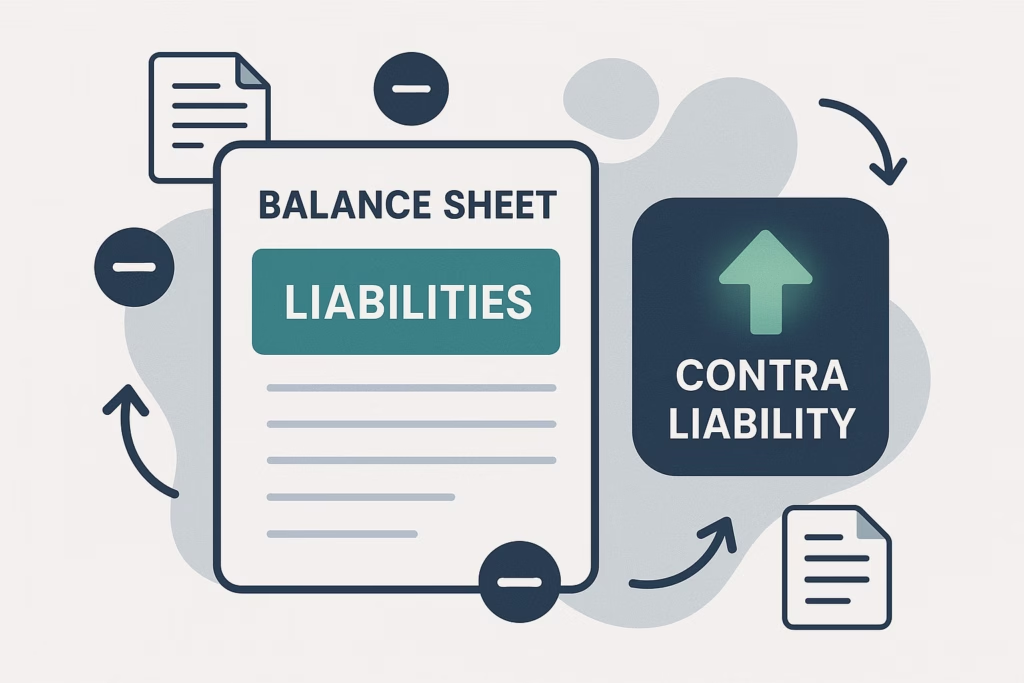
A contra liability account carries a debit balance — the opposite of a normal liability, which carries a credit balance. Rather than representing an amount the company owes, it reduces the carrying value of a related liability on the balance sheet, presenting a net figure that more accurately reflects the true economic obligation. Contra liability accounts are most commonly encountered in the context of debt instruments: bonds issued at a discount, and debt issuance costs that reduce the carrying amount of the related borrowing.
How Contra Liability Accounts Work
In the normal balance sheet presentation, a liability appears at its gross amount. A contra liability is shown directly beneath the gross liability and subtracted to arrive at the carrying amount — the net figure that represents the obligation’s current economic value.
The analogy is to contra asset accounts: just as accumulated depreciation reduces the gross carrying value of property, plant and equipment to its net book value, a contra liability reduces the gross liability to its amortised cost.
Stop building consolidations in spreadsheets.
BrizoConsol automates multi-entity consolidation — setup in minutes, reports the same day.
| Account type | Normal balance | Contra account balance | Net effect |
|---|---|---|---|
| Asset (e.g., PP&E) | Debit | Credit (accumulated depreciation) | Reduces asset to net book value |
| Liability (e.g., bonds payable) | Credit | Debit (discount on bonds) | Reduces liability to carrying amount |
| Equity (e.g., share capital) | Credit | Debit (treasury stock) | Reduces equity to net amount |
Example 1: Discount on Bonds Payable
When a company issues bonds at a price below their face value — which occurs when the coupon rate is lower than the prevailing market interest rate — the difference is recorded as a Discount on Bonds Payable: a contra liability that reduces the bonds payable balance to the actual proceeds received.
Journal entry at issuance — $1,000,000 bond issued at $950,000
| Account | Debit | Credit |
|---|---|---|
| Cash | $950,000 | |
| Discount on Bonds Payable (contra liability) | $50,000 | |
| Bonds Payable | $1,000,000 |
Balance sheet presentation at issuance:
Bonds Payable $1,000,000
Less: Discount on Bonds Payable ($50,000)
Net carrying amount $950,000
Amortising the discount — effective interest method
The discount is not written off immediately. Under the effective interest method (required by IFRS 9 and US GAAP ASC 835), the discount is amortised over the life of the bond. Each period, the interest expense is calculated on the carrying amount at the effective rate — not the coupon rate. The difference between the interest expense and the coupon cash paid reduces the discount balance, increasing the carrying amount toward face value.
Amortisation schedule — 3-year bond, 5% coupon, 6.32% effective rate (implied by $950,000 proceeds on $1,000,000 face)
| Year | Opening CV | Interest expense (6.32%) | Coupon paid (5%) | Discount amortised | Closing CV |
|---|---|---|---|---|---|
| 1 | 950,000 | 60,040 | 50,000 | 10,040 | 960,040 |
| 2 | 960,040 | 60,675 | 50,000 | 10,675 | 970,715 |
| 3 | 970,715 | 29,285* | 50,000 | 29,285 | 1,000,000 |
* adjusted for rounding to arrive at face value
By maturity, the carrying amount equals the face value — the discount has been fully amortised. Each year’s amortisation entry is: Dr Discount on Bonds Payable (reduces contra liability) / Cr Interest Expense — combined with the cash coupon payment.
💡 Bond issued at a premium: If a bond is issued above face value (when the coupon rate exceeds the market rate), the difference is recorded as a Premium on Bonds Payable — a credit balance that adds to the liability rather than reducing it. This is not a contra account; it is an adjunct account. The premium is amortised over the bond’s life, reducing interest expense each period and reducing the carrying amount toward face value.
Example 2: Debt Issuance Costs
When a company raises debt — whether bonds, term loans, or revolving credit facilities — it typically incurs costs: underwriting fees, legal fees, arrangement fees, and registration costs. Under both IFRS 9 and US GAAP (ASC 835-30), these costs are presented as a direct deduction from the carrying amount of the related liability — a contra liability. They are not capitalised as an asset.
Journal entry — $20,000 of debt issuance costs on a $1,000,000 loan
| Account | Debit | Credit |
|---|---|---|
| Unamortised Debt Issuance Costs (contra liability) | $20,000 | |
| Cash | $20,000 |
Balance sheet: the loan is shown at $1,000,000 less $20,000 = $980,000 net carrying amount. The $20,000 is amortised over the loan’s life using the effective interest method, increasing the effective interest rate recognised each period. By maturity, the full $20,000 has been charged to interest expense and the carrying amount equals the loan’s face value.
📌 Historical note: Prior to the update to ASC 835 (effective 2016 for public companies), US GAAP required debt issuance costs to be capitalised as an asset (“deferred financing costs” or “deferred charges”). The current treatment — presented as a contra liability — aligns US GAAP with the long-standing IFRS treatment. Any entity still presenting debt issuance costs as an asset is applying outdated GAAP.
Example 3: Unamortised Loan Premium
Where a group entity acquires debt at a premium — for example, through acquiring a subsidiary whose liabilities are remeasured at fair value on consolidation under IFRS 3 — the acquired debt may be carried above its face amount. The excess is recorded as an unamortised loan premium that reduces interest expense over the remaining life of the debt as it amortises.
This is an adjunct liability (adds to the carrying amount) rather than a contra liability (reduces it) — but the presentation and mechanics are mirror images of the bond discount treatment, and both require the effective interest method for amortisation.
Why Contra Liability Accounts Matter in Consolidation
For group finance teams, contra liability accounts require specific attention in consolidation because eliminations must address the gross liability and its contra account together — not just the net carrying amount.
If a parent company has issued bonds to external investors and one of its subsidiaries has purchased those bonds as an investment, the consolidation must eliminate:
- The bonds payable (gross) in the parent
- The discount or premium on bonds (contra liability) in the parent
- The bond investment (asset) in the subsidiary — at amortised cost, which should equal the parent’s carrying amount
- Any intercompany interest income and expense
A mismatch in carrying amounts — for example, if the parent and subsidiary have applied slightly different amortisation schedules — produces a residual in the consolidation that must be investigated and resolved before the balance sheet closes cleanly.
For groups that have acquired subsidiaries with debt measured at fair value under IFRS 3 (purchase price allocation), the acquired debt may carry a premium or discount at acquisition that needs to be tracked separately and amortised correctly in the consolidation adjustments — not just in the subsidiary’s own accounts.
For groups managing debt instruments, acquisition fair value adjustments, and consolidation eliminations across multiple entities, BrizoConsol provides the entity-level and group-level visibility to track carrying amounts, amortisation, and the full audit trail for each balance sheet position. Learn more or see it in action →