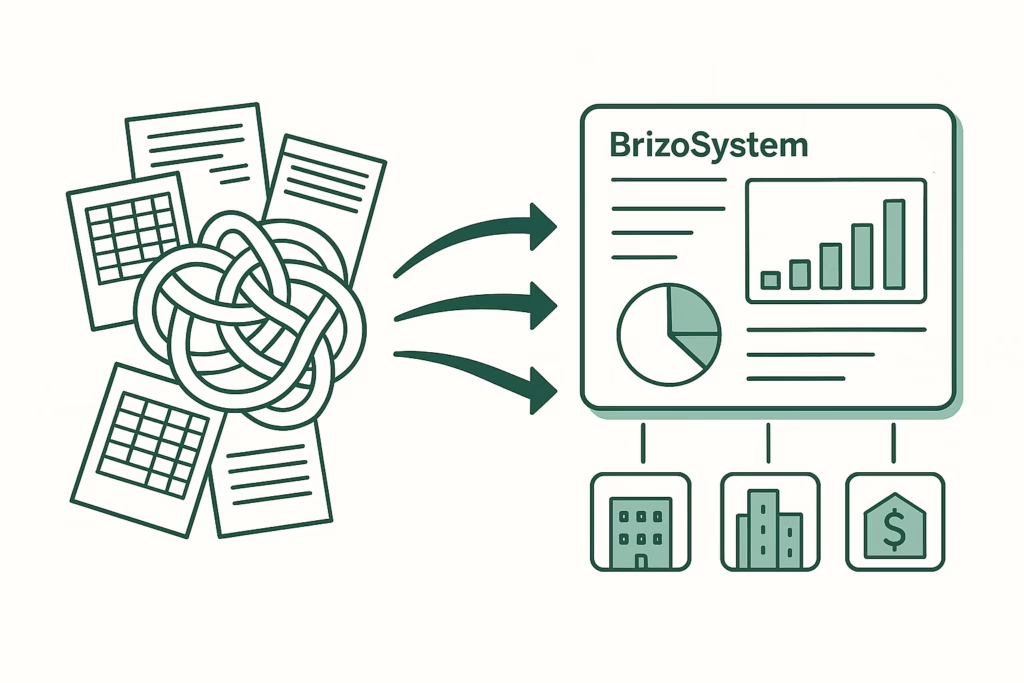
Financial consolidation is one of the most technically demanding processes the finance team runs. Done well, it produces a single accurate picture of the group’s financial position that management can rely on and auditors can verify. Done manually at scale, it produces something else entirely: a monthly race against the close deadline, where every hour is spent reconciling mismatches, chasing entity submissions, rebuilding broken spreadsheets, and answering questions about why the numbers look different from last month — questions that can’t be answered confidently because the process that produced the numbers isn’t fully transparent.
The problem isn’t data. The problem is the process. And the process can be redesigned.
How Complexity Accumulates
Most consolidation problems don’t appear on day one. A two-entity group with a simple structure and no intercompany trading can run a consolidation in Excel with reasonable confidence. The chaos sets in incrementally: a new subsidiary is added, then a foreign currency entity, then intercompany trading begins, then someone leaves and the model is rebuilt slightly differently, then more entities are added on top. At each step, the existing process absorbs the new complexity by growing more intricate — more sheets, more formulas, more manual steps, more single points of failure.
Automate NCI calculations across all your entities.
BrizoConsol handles non-controlling interest automatically — no manual adjustments required.
By the time the group has five or more entities trading with each other in multiple currencies, the manual model is no longer a consolidation tool. It’s a maintenance liability.
The specific failure points that appear at this stage follow a predictable pattern:
- COA inconsistency: Each entity uses different account names for the same transaction type. Mapping them to a common group structure requires manual judgment at every close, and any new account added in any entity falls into a catch-all until someone updates the mapping.
- Intercompany mismatch accumulation: In a group with ten entities, there are 45 possible entity pairs. Each pair may have multiple transaction types. At period end, some of those transactions are recorded on different dates, at different rates, or with different references. Each mismatch requires investigation and resolution before the elimination can proceed.
- Rate application inconsistency: Without a published group rate table, each entity pulls its own exchange rate. Two entities recording the same intercompany transaction in different currencies end up with translated amounts that don’t match, producing a residual that looks like a data error but is actually a process gap.
- Version drift: The consolidation model is typically maintained by one person. When that person is unavailable, or when the model needs to be changed for a structural event (new entity, disposal, change in ownership), the person who makes the change may not understand all of the dependencies. The model works — until it doesn’t, in a way that’s difficult to diagnose.
The Real Cost Is Not the Close — It’s What the Close Prevents
The direct cost of a slow, manual close is measurable: days of finance team time each month, spent on mechanical tasks that add no analytical value. But the indirect cost is larger: the analysis, forecasting, and business advisory work that doesn’t happen because the team’s capacity is consumed by the close machine.
A finance team that spends ten days closing the books has ten fewer days to model the impact of a potential acquisition, build a revised cash flow forecast, analyse where margins are compressing, or prepare the board for a difficult conversation about performance. The consolidation close is a tax on the finance team’s strategic contribution — and the higher the complexity of the manual process, the higher the tax rate.
💡 The threshold question for any finance leader: What would your team do with the close time if they got it back? If the answer is “meaningful work” — analysis, forecasting, business partnering — then the consolidation process is worth redesigning. If the answer is “I’m not sure,” that’s a different conversation about team capacity and deployment.
What a Structured Consolidation Process Looks Like
The shift from manual to structured consolidation isn’t primarily about software — it’s about process design. Software enables the process; the process determines what’s possible. The four structural changes that convert a chaotic close into a reliable one:
A single group chart of accounts, maintained centrally
Entity accounts are mapped to a group COA once, and the mapping is maintained centrally. New accounts in any entity trigger a mapping review before the next close, not after. Reports always present consistent group lines regardless of how each entity codes locally. This is the foundation — without it, every other step requires more judgment and more manual intervention than it should.
Intercompany matching before elimination
Elimination entries are only posted against confirmed, matched intercompany balances. Unmatched balances are flagged before the close, not discovered after. The matching uses counterparty codes and transaction references — not just amounts — so partial settlements and batch-vs-line-item differences surface early.
Centrally published exchange rates
One rate table, published before the close begins, applied consistently to all entities and all intercompany transactions. Rate inconsistency — one of the most common sources of unexplained residuals — is eliminated at the source rather than investigated at period end.
Audit trail by design
Every elimination entry, every COA mapping decision, every rate applied has a documented source. When an auditor asks why a specific consolidated revenue figure differs from the sum of entity revenues, the answer is visible in the elimination schedule — not reconstructed from memory or email chains.
The Before and After
Manual close process
Export trial balances from each entity system manually. Paste into consolidation model. Rebuild charts that broke when data changed. Identify intercompany mismatches by cross-referencing entity schedules. Investigate timing differences by email. Apply exchange rates from individual entity systems (different sources, different dates). Post elimination entries against unmatched balances. Distribute static PDF. Receive a revision request. Repeat.
Structured close process
Trial balances pulled automatically from connected entity systems. COA mapping applied automatically — unmapped accounts flagged for review. Intercompany matching runs before close; unmatched balances visible immediately. Single group rate table applied to all entities. Elimination entries posted against confirmed matched balances. Audit trail complete. Reports available on close completion. Revision requests answered with drill-down, not reconstruction.
The output in both cases is a set of consolidated financial statements. The difference is in confidence, auditability, and the time the finance team spent producing them.
BrizoConsol — Built for This
BrizoConsol connects directly to entity accounting systems — Xero, QuickBooks, MYOB, Zoho Books — pulling trial balance data automatically at each close. Account mapping, intercompany matching, exchange rate application, elimination logic, and report generation all run within a single consolidation environment, with full drill-down from any group line to the entity account behind it.
For groups that have been running their consolidation in Excel and have absorbed the complexity through increasingly intricate workarounds, the transition to a structured platform is as much about process clarity as about software. The platform enforces the structure that makes consolidation reliable — and that structure is what produces the clarity that allows the finance team to do more than run the close.
If your consolidation close is consuming more time and confidence than it should, BrizoConsol is worth looking at. Learn more or see it in action →