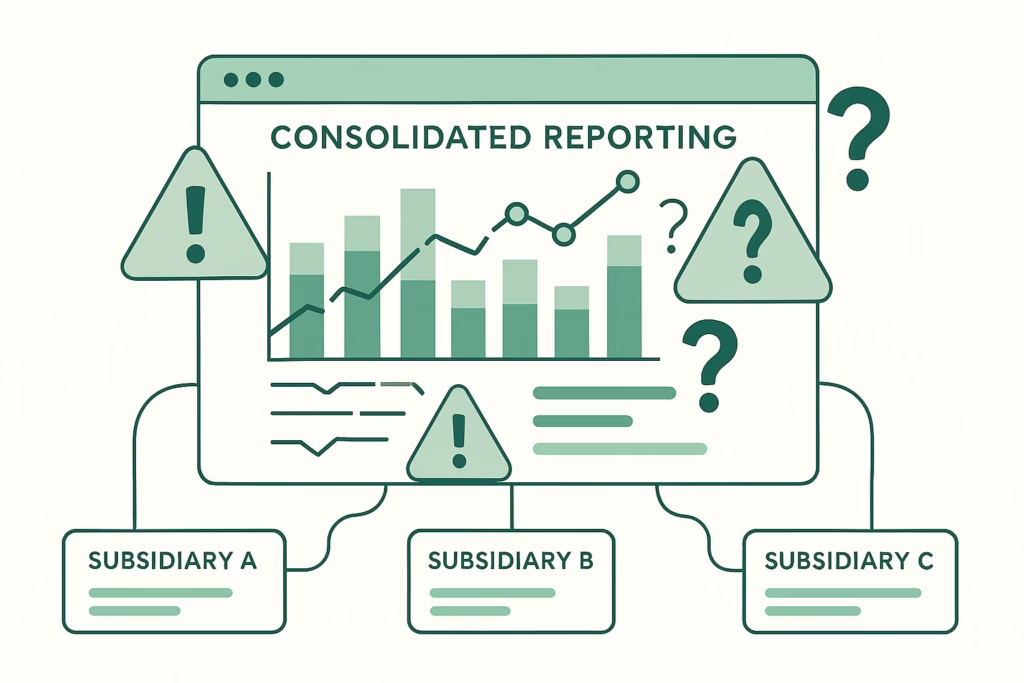
A consolidated report that looks clean is not the same as one that is reliable. The difference matters more than it sounds: leadership makes resource allocation decisions, banking relationships are maintained, and auditors sign off all on the basis that the group numbers are trustworthy. When they aren’t — when the clean surface conceals structural problems in the consolidation process — the consequences range from delayed closes and audit overruns to genuinely wrong strategic decisions made on misleading data.
The five signals below are not about obvious errors. They’re about patterns in how a consolidation behaves that reveal underlying process problems — problems that are often patched each month rather than fixed, because patching keeps the close moving and fixing requires stopping to redesign something.
Signal 1
Intercompany balances never fully reconcile — and the residuals are accepted
Automate NCI calculations across all your entities.
BrizoConsol handles non-controlling interest automatically — no manual adjustments required.
Every group with intercompany transactions will encounter mismatches. That’s expected. What’s not expected is accepting them as a permanent feature — posting a monthly “plug” entry to clear the difference and moving on without understanding what caused it.
What this looks like in practice Month after month, the intercompany receivables and payables don’t fully eliminate. A $3,000–$8,000 residual appears after the elimination run. The team posts a rounding adjustment or a suspense entry to balance the books. The residual varies by amount and by entity pair each month but is never investigated to root cause. It’s just “how it is.”
That residual is diagnostic information. It represents either a process problem (different cut-off dates, inconsistent FX rates, missing counterparty references) or a recording error — both of which affect the accuracy of the consolidated statements. When residuals are routinely accepted, the team has implicitly agreed that the elimination process doesn’t fully work, and the consolidated balance sheet carries unexplained balances that no one can account for.
What it reveals: No structured intercompany matching process. Eliminations are being posted before balances are confirmed as matched, which guarantees residuals will recur.
Signal 2
The close process depends on one person who “knows the model”
If the consolidated financial statements can only be produced by one person — or if any team member asked to run the close without that person would not know where to start — the reporting process is fragile in a way that doesn’t show up in the numbers themselves.
What this looks like in practice The senior accountant who built the consolidation model in 2021 has since left and been replaced. The new person runs the model but doesn’t fully understand the logic — specifically, why certain journal entries are posted in a particular order, and which formulas are critical vs decorative. When a new entity is added, they make a change to the model that accidentally breaks a formula in a sheet three tabs away. The error isn’t discovered until the auditor asks a question the team can’t answer.
Person-dependent processes are also silent sources of error. When someone is the only person who understands the model, they are also the only person who might notice when something is wrong. If their knowledge becomes outdated — through organisational change, process drift, or simple human error — there is no independent check.
What it reveals: The consolidation logic lives in the model builder’s head, not in a documented, system-driven process. The next time that person is unavailable or makes a mistake, the close stalls or produces wrong output.
Signal 3
Report versions keep changing after initial distribution
A board or management team that receives three versions of the monthly management accounts — “v1”, “v1-revised”, “v1-final” — across a week-long period is not just inconvenienced. They are receiving a visible signal that the team doesn’t know when the numbers are right.
What this looks like in practice The management pack is distributed on day 5 of the close. On day 6, a subsidiary controller emails to say they forgot to post a large revenue accrual and can the numbers be updated? On day 7, an FX rate error is found in one entity’s trial balance. On day 8, the board chair asks why the group revenue figure doesn’t match what the Singapore entity’s controller quoted at a meeting. A revised pack is issued on day 9.
Each revision compounds the problem. The first revision suggests the initial was unreliable. The second suggests the first revision was incomplete. By the time a “final” version is issued, the audience has lost confidence in all of them. The reputational cost of repeated revisions is larger than the time cost of producing them.
What it reveals: Data validation and intercompany matching are happening after distribution rather than before. The close process doesn’t have a defined “ready to distribute” gate that the data must pass before the report is sent.
Signal 4
The finance team can’t explain what drove a movement
A finance team that can produce accurate consolidated numbers but cannot explain the movements behind them is providing data, not insight. The board or management team’s follow-up questions — why did gross margin drop 2 points, why did the UK entity’s profit decline, why is cash lower than last month despite strong EBITDA — should be answerable from the consolidation, not require a separate investigation.
What this looks like in practice The group CFO asks why consolidated revenue is down $420,000 versus last month. The finance team knows the total. They don’t immediately know which entity drove the variance, which revenue line within that entity moved, or whether the movement is a volume effect, a pricing effect, or an FX translation effect. Finding the answer requires going back to each entity’s trial balance, doing a manual comparison, and piecing together the narrative — a two-hour exercise that should take two minutes with a drill-down.
This inability to explain movements is often accepted because the report still looks complete. The numbers add up, the statements balance, the format is familiar. But the purpose of consolidated reporting is not to produce a balanced set of statements — it’s to inform decisions. A report that can’t be explained can’t fulfil that purpose.
What it reveals: The consolidation produces outputs but not drill-down. The link from the group total to the entity contribution to the account movement is not preserved, which means variances can only be explained through manual investigation rather than navigating the data.
Signal 5
Audits take longer and generate more queries every year
Annual audits are a natural stress test of the consolidation process. Auditors trace elimination entries to source transactions, verify that intercompany balances have been confirmed between entities, check that exchange rates are applied consistently, and test that management’s judgments are documented and supportable. When the consolidation process is robust, this is manageable. When it isn’t, auditors find more to question — and the audit drags.
What this looks like in practice The audit that used to take two weeks now takes four. Auditors are requesting documentation that doesn’t exist in a tidy form — elimination entry workings are spread across multiple files with no consolidated schedule, the exchange rates applied to each entity can’t be easily reconciled to a published source, and several intercompany balances that were “plugged” during the close have no supporting explanation. Each auditor query generates an internal search for documentation that may or may not exist.
An expanding audit is not just an inconvenience — it’s a cost signal. Audit fees increase with time, the finance team’s time is consumed in audit support rather than forward-looking work, and a challenging audit creates a risk register entry about the reliability of the financial reporting process.
What it reveals: The consolidation process isn’t building the audit trail that auditors need. Documentation of eliminations, rates, judgments, and entity confirmations is happening informally (in email, verbal agreement, undocumented adjustments) rather than being captured systematically as part of the close.
What to Do When You Recognise These Signals
Each of the five signals points to a specific structural problem — not a data problem. Data problems are corrected by fixing entries. Structural problems are corrected by changing the process that produces them. The most common mistake is treating structural problems as data problems: fixing this month’s residuals without addressing the process gap that will produce the same residuals next month.
The starting point is diagnosis: which of the five signals are present, and at what severity? A single signal appearing occasionally is manageable. Multiple signals appearing consistently indicate a consolidation process that is operating beyond its reliable capacity — and the right response is process redesign, not more sophisticated patching.
BrizoConsol is built to address each of these signals directly — intercompany matching before the close runs, rate tables applied centrally, elimination schedules maintained as a documented audit trail, and drill-down from any group line to the entity account behind it. Learn more or see it in action →