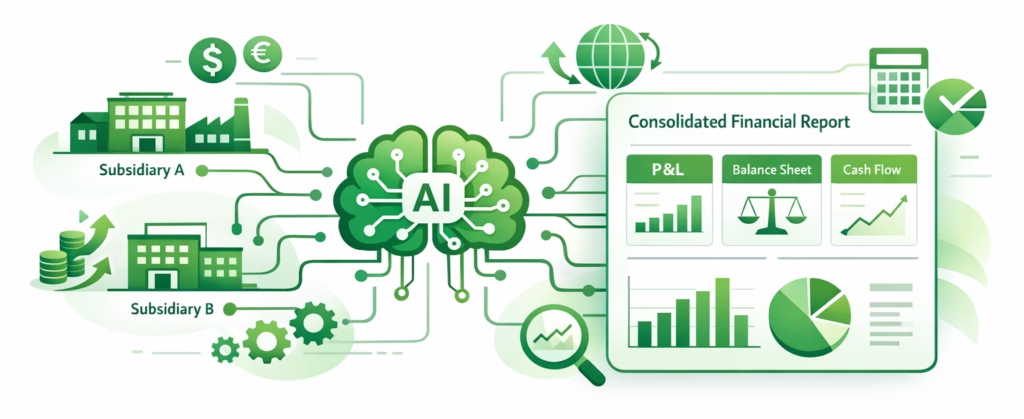
Artificial intelligence is rapidly reshaping many areas of finance, from fraud detection to forecasting. One area where its impact is becoming increasingly visible is financial consolidation and group reporting. As organisations grow and operate across multiple entities, currencies, and jurisdictions, the complexity of consolidation increases dramatically. Traditional processes — often built on spreadsheets and manual reconciliations — struggle to keep up with the speed and scale required by modern businesses.
AI introduces a new way of approaching consolidation. Instead of relying solely on manual validation and repetitive processes, intelligent systems can analyse patterns, detect anomalies, automate routine checks, and provide insights that would otherwise take finance teams hours or days to surface.
Importantly, AI does not replace accounting rules or the need for human judgment. Rather, it enhances the consolidation process by reducing manual effort, improving data quality, and accelerating reporting cycles. For finance teams responsible for multi-entity reporting, this shift represents an opportunity to move from operational tasks toward more analytical and strategic roles.
Automate NCI calculations across all your entities.
BrizoConsol handles non-controlling interest automatically — no manual adjustments required.
Why Financial Consolidation Is Traditionally Labour-Intensive
Financial consolidation requires combining financial data from multiple entities into a single set of group financial statements. This process typically involves collecting trial balances, translating foreign currencies, eliminating intercompany transactions, applying consolidation adjustments, and validating the results.
While the accounting principles behind these steps are well established, the operational process is often highly manual. Different subsidiaries may use different accounting systems, account structures, or reporting calendars. Data must be collected, mapped, validated, and reconciled before it can even be consolidated.
Intercompany transactions add another layer of complexity. Revenue recorded by one entity should match the corresponding expense recorded by another, but timing differences, currency effects, and inconsistent account mapping can create mismatches that require investigation. Because of these challenges, many finance teams spend a significant portion of their reporting cycle performing repetitive checks and manual reconciliations. AI technologies help reduce this burden by automating many of these validation and analysis tasks.
AI-Powered Account Mapping
One of the most practical and immediately valuable AI applications in consolidation is account mapping assistance. In a multi-entity group, each entity uses its own chart of accounts — different account names, different codes, different hierarchies. Mapping every entity account to the group’s common chart of accounts is a significant one-time setup task, and maintaining that mapping as entities add new accounts over time requires ongoing attention.
AI-assisted mapping analyses account names, account types, and historical mapping decisions to suggest where a new or unmapped account belongs in the group COA. Rather than requiring a human to start from a blank classification decision for every new account, the system presents a ranked suggestion with confidence level — the finance team reviews, confirms, or overrides.
AI account mapping in BrizoConsol A UK subsidiary adds a new account: “8420 — Contractor Fees — Product Development”. BrizoConsol’s AI mapping engine analyses the account name, account type (expense), and similar accounts previously classified by the finance team. It suggests mapping to the group COA line “External Contractor Costs — R&D” with high confidence, based on prior mappings of similar accounts containing “Contractor” and “Development” across other entities.
The finance team reviews the suggestion, confirms it, and the account is live in the group COA — without the manual classification exercise that would otherwise be required.
Over time, AI mapping improves as the classification history grows. Accounts that would have required manual judgment in the first year are often auto-classified with high confidence in subsequent years, as the system learns the group’s specific classification patterns.
AI-Powered Data Validation and Error Detection
Another immediate application of AI in financial consolidation is automated validation of financial data. When financial data flows from multiple entities into a consolidation platform, there are numerous opportunities for inconsistencies or errors to occur.
AI systems can analyse incoming data and compare it against historical patterns, expected relationships, and known accounting structures. If unusual values appear — sudden spikes in expenses, missing accounts, or unexpected account relationships — the system can flag them for review. This allows finance teams to identify potential issues earlier in the reporting process, rather than discovering them during the final stages of consolidation. Early detection reduces last-minute corrections and helps maintain the integrity of the reporting timeline.
Another advantage of AI-driven validation is consistency. Manual checks depend on individual experience and attention, whereas automated systems apply the same validation rules across all entities and reporting periods.
Intelligent Matching of Intercompany Transactions
Intercompany reconciliation is one of the most time-consuming aspects of group consolidation. Ideally, transactions recorded by one entity should match exactly with the corresponding entry recorded by the counterparty entity. In reality, mismatches frequently occur due to exchange rates, timing differences, rounding, or account classification inconsistencies.
AI-assisted matching applies pattern recognition and configurable tolerances to identify transaction pairs that are likely to represent the same underlying economic event, even when amounts differ slightly. Rather than requiring exact matches, the system recognises relationships between transactions sharing the same counterparty, similar timing, and amounts within a defined tolerance band.
Pattern-based intercompany matching Entity A records a management fee income of SGD 50,000 to Entity B in March. Entity B records a management fee expense of SGD 49,988 — a SGD 12 difference arising from a rounding difference in the exchange rate applied.
A purely exact-match system flags this as an unreconciled difference requiring investigation. An AI-assisted matcher recognises the same counterparty, same period, same transaction type, and amount difference within the defined tolerance — suggests an automatic match with a tolerance note. The finance team confirms. The mismatch that would otherwise consume 20 minutes of investigation time is resolved in seconds.
Finance teams can then focus their attention on genuine discrepancies — timing differences or classification errors that represent real data quality issues — rather than routine FX rounding and tolerance differences.
Automated Pattern Recognition in Financial Data
AI can analyse historical consolidation data to understand normal relationships between accounts, entities, and reporting periods. Once these patterns are established, deviations can be detected automatically. If a particular subsidiary consistently reports certain levels of revenue or expense, a sudden and unexplained change may trigger a review.
Pattern recognition is especially valuable in large groups where manual monitoring of every entity becomes impractical. Instead of reviewing every number individually, finance teams can rely on AI to highlight areas that require attention — transforming consolidation from a purely mechanical process into one that actively supports financial oversight and risk management.
Supporting Forecasting and Scenario Analysis
Although consolidation primarily focuses on historical reporting, many organisations increasingly use consolidated data to support planning and forecasting activities. Machine learning models can analyse historical group performance, identify drivers of revenue or cost changes, and generate projections based on past behaviour. When combined with consolidated financial data, these models provide a foundation for scenario analysis — evaluating how exchange rate movements, internal cost allocations, or market changes could affect group profitability.
Challenges and Considerations When Adopting AI
Data quality remains the most important prerequisite. AI models can only analyse the data they receive, so inconsistent account structures or incomplete transaction information limit their effectiveness. Garbage in, garbage out applies more acutely to AI than to manual processes — because AI processes at scale, data quality problems are amplified rather than caught and corrected one by one.
Transparency is equally important. Finance teams must be able to understand why a system flags certain transactions or suggests specific classifications. Modern AI implementations emphasise explainability, ensuring that automated suggestions can be reviewed, validated, and overridden by users. AI in consolidation should present its reasoning — not just its conclusions.
Finally, AI adoption should be incremental. The most successful implementations introduce AI gradually, starting with validation, anomaly detection, and mapping support — building confidence before extending AI assistance to more judgment-intensive tasks.
AI is beginning to reshape how finance teams approach consolidation and reporting. By automating repetitive tasks, identifying anomalies, and analysing financial patterns, AI allows finance professionals to focus on higher-value activities such as analysis, strategy, and decision support. The goal is not to replace accounting expertise — it is to provide tools that make complex reporting environments more manageable and less dependent on individual manual effort.
BrizoConsol incorporates AI assistance for account mapping and intercompany matching — reducing the manual effort at two of the most time-consuming steps in the consolidation process. Learn more or see it in action →