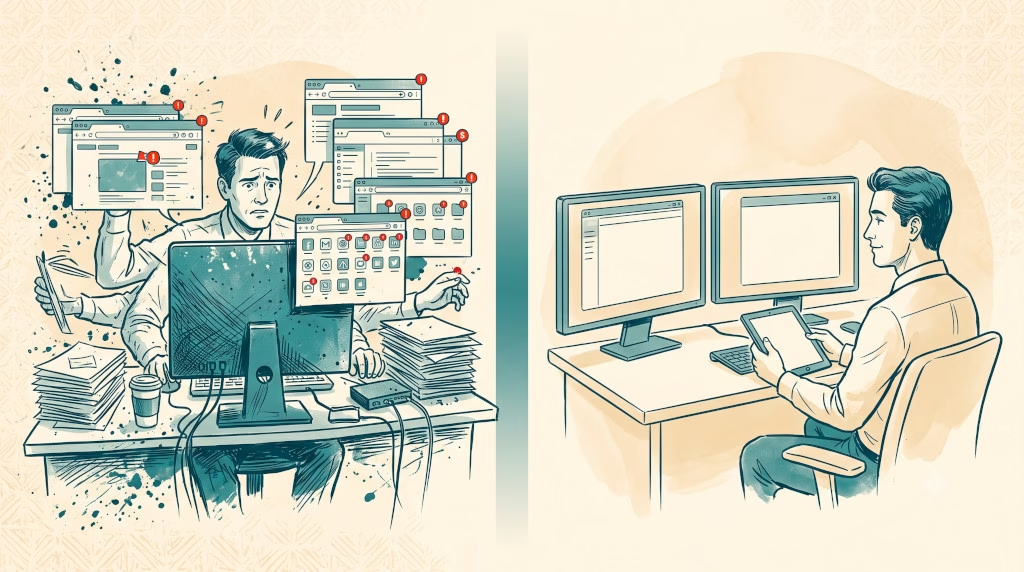
The average team is not suffering from a shortage of software. It is suffering from too much of it — and the overhead of managing the stack has quietly become one of the largest drains on productive time.
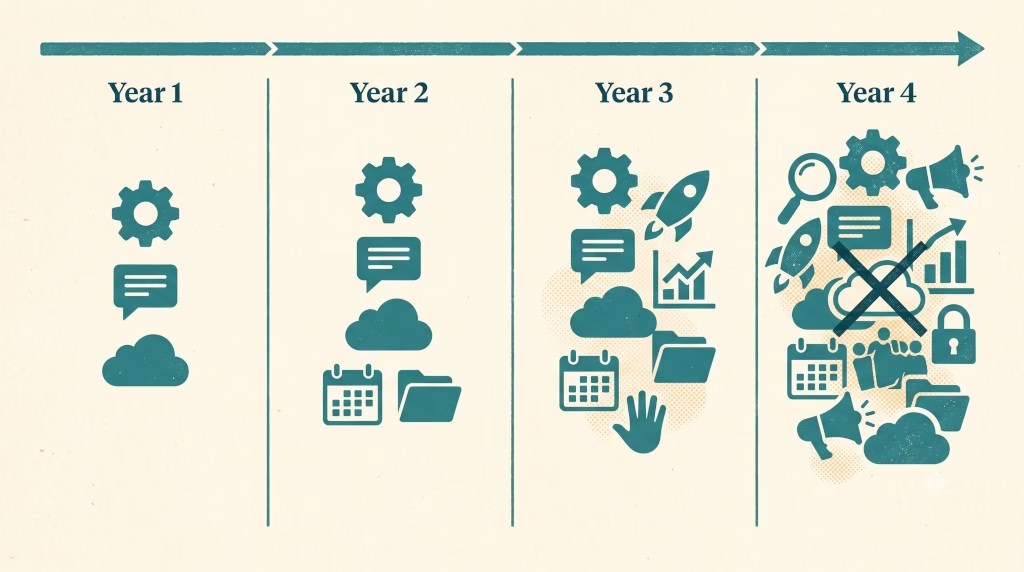
At some point in the last decade, acquiring software became a proxy for solving problems. A team struggling with client communication adopted a new messaging tool. A team struggling with project visibility adopted a new project management platform. A team struggling with data access adopted a new reporting layer. Each addition was a reasonable response to a real problem. The cumulative result was a stack of tools that nobody has fully mastered, several of which overlap in function, and all of which require maintenance, integration, and the periodic retraining of whoever joins the team next.
This is not a failure of judgment. It is the predictable outcome of a procurement culture that treats software as additive — where the response to a gap is always another tool, and where the cost of that addition is measured only in licence fees rather than in the ongoing cognitive and operational overhead it creates.
Stop building consolidations in spreadsheets.
BrizoConsol automates multi-entity consolidation — setup in minutes, reports the same day.
The teams that are working most effectively right now are not the ones with the most comprehensive tool stacks. They are the ones that have been most deliberate about keeping their stacks small — choosing fewer tools, understanding them more deeply, and extracting more value from each one.
Why Tool Sprawl Happens
Tools are adopted to solve symptoms rather than causes. When a team is not communicating effectively, the instinct is to add a communication tool rather than examine why communication is breaking down. The tool addresses the visible symptom without addressing the underlying cause. The symptom recurs in a different form, and another tool is considered.
Individual tools are evaluated in isolation. A new project management tool is evaluated on its own merits — does it handle dependencies well, does it have a good mobile interface, does it integrate with the calendar? The question of how it interacts with the three other tools already managing parts of the same workflow is rarely asked with the same rigour. The result is a stack where individual tools are each defensible but the stack as a whole is incoherent.
Removal is harder than addition. Adding a tool requires one decision: adopt it. Removing a tool requires identifying everything that depends on it, migrating any data or workflows that live inside it, communicating the change to everyone who uses it, and managing the transition period when institutional memory and new practice are in conflict. The asymmetry means that the stack ratchets upward — additions are easy, removals are hard, and the default is always to keep what is there and add what is needed.
Vendor incentives push toward expansion. Software vendors are not neutral advisors on tool stack composition. They have a direct interest in expanding the surface area of their product within your organisation — adding modules, expanding seat counts, introducing adjacent products that sit alongside the core. The path of least resistance in the relationship with any software vendor is a growing stack, not a disciplined one.
Every tool in a team’s stack has a maintenance cost that does not appear on the invoice. The licence is the visible expense. The cognitive overhead is the invisible one.
The True Cost of Too Many Tools
The financial cost of tool sprawl — redundant licences, overlapping capabilities, software that nobody uses but nobody cancels — is real but relatively tractable. The more significant cost is harder to measure and therefore easier to ignore.
Context switching between tools is one of the most consistently underestimated sources of productivity loss in modern knowledge work. Every time a team member moves from one application to another, there is a cognitive reset — a period of reorientation to the new interface, the new data model, the new set of conventions that govern how work is represented in that tool. In a workday that involves six different applications, this reset happens dozens of times. The cumulative cost is not trivial.
Fragmented information is a second cost. When different parts of a team’s workflow live in different tools, the complete picture of any project, client, or process requires synthesising information from multiple sources — a task that typically falls to the most senior person, who is already the most stretched. Important context is missed. Decisions are made on partial information.
Training and onboarding is a third. Every new team member faces a tool stack that has accumulated over years, each component with its own conventions and institutional knowledge. The time required to bring someone to functional competence across a ten-tool stack is substantially greater than the time required for a five-tool stack. In organisations where turnover is a factor, this cost recurs with each hire and compounds into a significant ongoing investment in knowledge transfer.
How to Audit Your Tool Stack
The first practical step toward working smarter with fewer tools is an honest audit — not of what your tools cost, but of what they do and whether they are the right tools for the job.
Start with a simple inventory: every tool the team uses with any regularity, and the primary function it serves. Do not start with the tool catalogue from your IT department or the list of active licences from finance. Start with what the team actually opens on a working day. The gap between these two lists is often revealing — tools that are paid for but not used, and workflows that are managed in ways that do not appear in the official stack.
For each tool in the inventory, ask two questions. First: what would stop working if this tool disappeared tomorrow? The answer identifies the core workflows that depend on it — the genuine value it delivers. Second: could any other tool in the current stack handle this with minimal adaptation? The answer identifies redundancy — places where two tools are doing the same job, or where one tool’s underused capability could replace another’s primary function.
The output of this audit is not a list of tools to cancel. It is a map of what the team’s actual workflows require — stripped of the accumulated additions, overlaps, and legacy adoptions that have accumulated over time. From that map, a considered consolidation becomes possible.
The Consolidation Principle
Consolidating a tool stack does not mean replacing ten tools with one. It means replacing ten tools with the minimum number that covers the team’s genuine workflow requirements without redundancy, without coverage gaps, and without creating new overhead in the form of complex integrations that require ongoing maintenance.
The principle guiding good consolidation is function, not category. The question is not “do we have too many project management tools?” It is “what does our team need in order to manage projects effectively, and what is the minimum set of tools that provides it?” The answer might be one tool, or three, or five — but it will be derived from the workflow requirement rather than from a count of tools by category.
Consolidation also requires a willingness to accept trade-offs. A more focused stack almost always means accepting that some tool in the new set does one particular thing slightly less well than the specialised tool it replaces. The relevant question is whether the overall reduction in overhead — cognitive, operational, financial — justifies that trade-off. In most cases, it does, because the overhead of managing a tool perfectly suited to one specific sub-task is often higher than the overhead of using a slightly less perfect tool that also handles five other tasks well.
What Fewer, Better Tools Actually Enables
Teams that successfully consolidate their tool stacks describe a consistent set of downstream benefits that go beyond the obvious cost savings.
Institutional knowledge becomes portable. When the team’s work lives in fewer places, the knowledge of how that work is managed is easier to transfer. New team members reach functional competence faster. Senior team members spend less time answering questions about which tool to use for which purpose. The stack becomes something that the whole team owns rather than something that only specific individuals can navigate fully.
Decisions improve. When the information relevant to a decision is distributed across fewer systems, assembling the complete picture takes less time and involves less risk of missing something important. The practice director who needs to review a client situation can do it in two steps rather than five. The accounting team preparing for a close can check the relevant positions in one place rather than reconciling data from three sources before the work even begins.
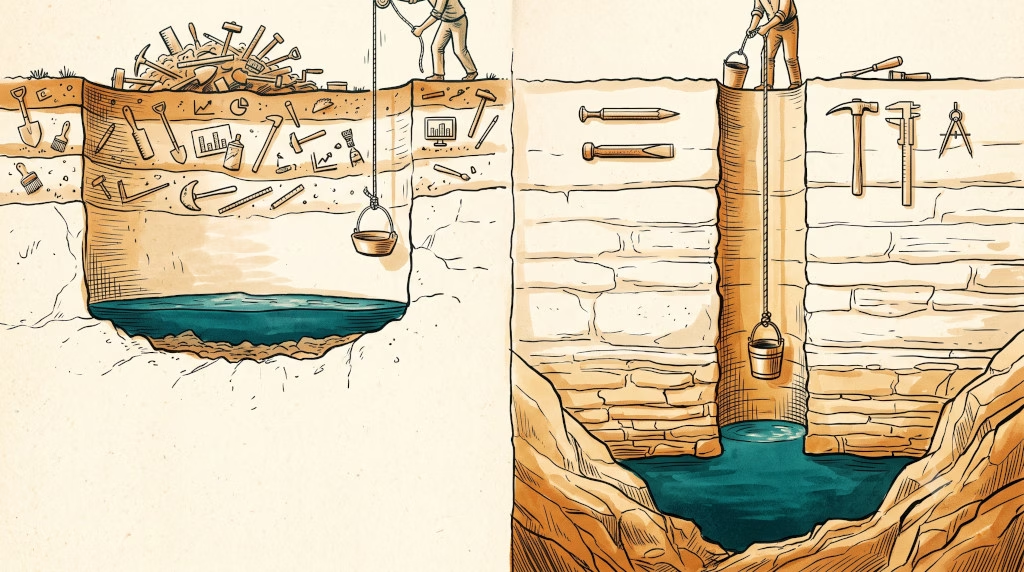
The tools that remain get used more deeply. One of the counterintuitive effects of tool sprawl is that individual tools are used shallowly — teams adopt tools, learn the basic workflows, and use a fraction of the available capability because there is never time to go further. With a consolidated stack, the tools that remain become more familiar and more fully utilised. Features that were never explored get discovered. Workflows that were manual get automated. The investment in each tool compounds over time rather than being spread thin across many.
What the Right Tool Looks Like
In a consolidated, deliberate stack, the right tool for any given workflow has a recognisable profile.
It covers the core workflow completely. The right tool does the primary job — not adequately, not mostly, but completely. A consolidation tool that requires a final formatting step in Excel has not completed the workflow. A pipeline tool that requires a manual export to produce the report the team actually uses has not completed the workflow. The right tool produces the output the team needs in the format they need it, without a workaround step at the end.
It is usable by the whole team, not just the power users. A tool that only the most experienced team members can use effectively is not a team tool — it is a dependency. The right tool can be picked up by a capable but non-specialist user and used for the core workflow in their first session.
It reduces context switches rather than adding them. The right tool should eliminate the need to visit other tools for information relevant to the same workflow, not create new reasons to switch. If adopting a new tool means spending more time moving between applications rather than less, the consolidation has moved in the wrong direction.
It improves with use rather than requiring periodic re-learning. The right tool builds familiarity over time rather than resetting it. The team’s relationship with the tool should get more productive as the months pass, not remain at the same level of friction it started with.
How BrizoSystem Products Fit Into a Consolidated Stack
BrizoSystem’s products are built around a single design principle that aligns directly with the consolidation approach: each product does one thing completely, for one audience, without requiring the user to integrate it with a complex surrounding stack to get the value out of it.
BrizoConsol replaces the combination of a consolidation module inside an enterprise ERP, a set of elimination spreadsheets maintained manually, and a formatting step in Excel at the end of each close. It does not require integration with those tools to function — it connects to the accounting systems already in use and produces the consolidated output directly. One tool replaces three workflow components.
BrizoMarket replaces the combination of a CRM export, a manual LinkedIn search routine, a spreadsheet tracking which companies are in which stage of market readiness, and a calendar reminder to review the pipeline every Friday. It monitors continuously and surfaces the relevant companies and contacts at the right moment, without the team needing to maintain the monitoring infrastructure. One tool replaces a multi-step manual process.
Working smarter with fewer tools is not a radical proposition. It is a recognition that the overhead of managing a tool stack has a cost, that cost scales with the size of the stack, and that the teams doing the best work are typically the ones who have kept their stack deliberately small and used each tool in it to its full potential. The tools exist to serve the work. When managing the tools becomes work in itself, the stack has grown past its useful size.