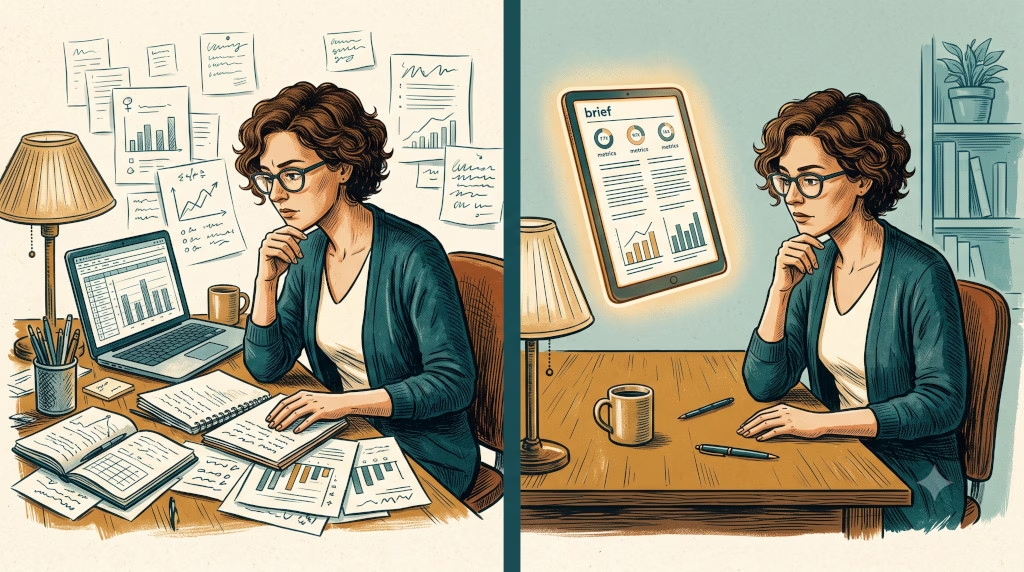
AI is not replacing the judgment of small business owners and their teams. It is changing what that judgment gets applied to — and that distinction matters more than most people realise.
Small businesses have always made decisions at a disadvantage. Not because the people running them are less capable than their counterparts at larger organisations — often they are more capable, by necessity — but because the resources that support good decision-making have historically scaled with size. The analyst who monitors the market. The finance team that produces weekly management accounts. The operations lead who tracks pipeline health. In a small business, all of these roles are typically held by the same one or two people who are also responsible for the work itself.
The result is a particular kind of decision-making — fast, experienced, pattern-dependent, and chronically under-informed. The small business owner knows their market deeply and their numbers approximately. They act on instinct calibrated by experience because there is rarely time to do otherwise. And they are often right — but not as often as they would be with better information, surfaced at the right moment, without the overhead of going to find it.
Stop building consolidations in spreadsheets.
BrizoConsol automates multi-entity consolidation — setup in minutes, reports the same day.
AI is changing this. Not by replacing the decision-maker, but by changing what they have available when they decide.
What AI Actually Changes About Decisions
The popular narrative around AI and business decisions tends toward one of two extremes: either AI will automate decisions entirely, removing humans from the loop, or AI is a productivity tool that speeds up existing processes without fundamentally changing them. Neither framing is accurate for the decisions that matter most in a small business context.
What AI changes, specifically and practically, is the quality and availability of the input to decisions that humans still make. The decision about which client to prioritise this week, which prospect to reach out to today, whether a particular intercompany balance is within normal range — these remain human decisions. What AI changes is whether the person making them has the relevant information structured, interpreted, and in front of them at the moment they need it, or whether they are making them from memory and instinct because gathering the information would take longer than acting on it.
This is a more modest claim than “AI replaces human judgment” — but it is also a more consequential one. The quality of a decision is not determined solely by the judgment applied to it. It is determined by the combination of judgment and information. Better information, consistently delivered at the right moment, compounds over time into a measurably better decision record. For small businesses, where every significant decision carries more weight than it would in a larger organisation with more room to absorb mistakes, that compounding matters.
AI does not make the decision. It changes the conditions under which the decision is made — and that changes the outcome.
The Three Shifts AI Is Producing in Small Business Decision-Making
The change AI is bringing to small business decisions is happening across three distinct dimensions, each of which produces a different kind of advantage.
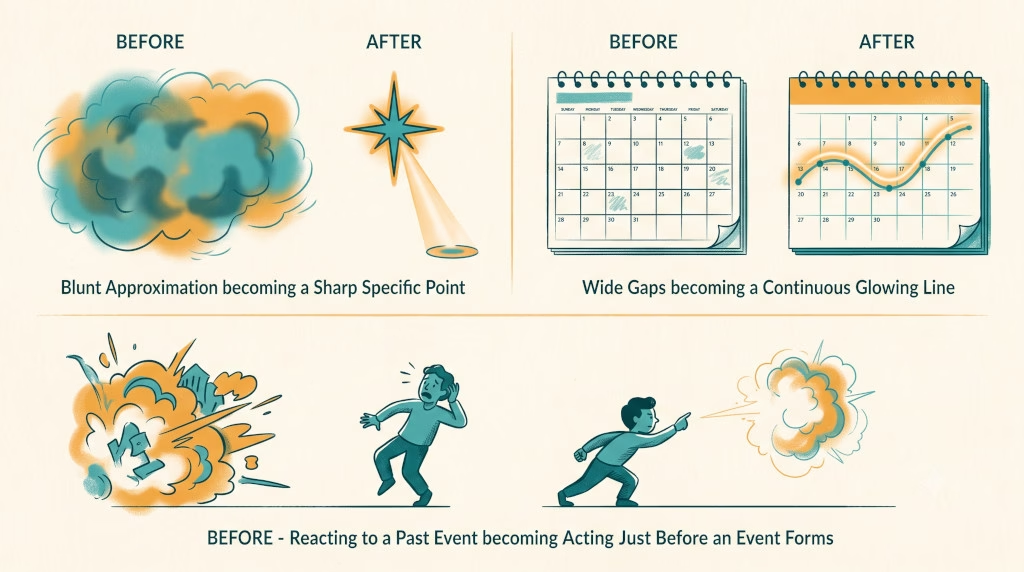
From approximate to specific. Small business decisions have historically been made against approximate information — the owner’s sense of how the pipeline is tracking, the accountant’s recollection of last quarter’s intercompany position, the practice director’s general feeling about which client relationships are healthy. AI enables decisions to be made against specific, current information instead. Not “I think the pipeline is roughly on track” but “three deals have had no activity in over two weeks and two of them close this month.” The specificity does not change the decision-maker’s expertise — it gives that expertise something precise to work with.
From periodic to continuous. In the absence of AI-driven monitoring, small businesses review their situation periodically — in the weekly management meeting, the monthly accounts, the quarterly strategy session. Between those reviews, conditions change but the decision-maker’s picture does not. AI-powered monitoring removes the periodicity. Conditions are tracked continuously, and the decision-maker is notified when something changes enough to warrant attention — not at the next scheduled review, but at the moment the change becomes significant.
From reactive to anticipatory. Perhaps the most significant shift is the change from decisions made in response to problems that have already materialised to decisions made in anticipation of conditions that are forming. A client relationship that is showing early warning signs is far cheaper to address than one that has already deteriorated. A sales opportunity identified at the moment a buying signal appears is more convertible than one identified after the prospect has already made a shortlist. AI-powered monitoring enables anticipatory decisions because it can identify patterns that precede significant events — before those events occur, not after.
What This Means in Accounting and Finance
For small accounting practices and the finance functions of small businesses, the AI-driven shift in decision-making has a specific and practical shape.
The decisions that define the quality of accounting work — which accounts require attention before close, which intercompany transactions are creating reconciliation exposure, whether a consolidation is tracking to produce clean output or is likely to surface problems under deadline pressure — have historically been made from a combination of experience and periodic review. A senior accountant who has run the same consolidation process for several years develops an instinct for where the problems typically appear. But that instinct is not the same as real-time visibility into whether those problems are currently forming.
AI changes this by monitoring the underlying data continuously and surfacing the specific conditions that the experienced accountant knows to look for — before they have had to look. The intercompany balance that has drifted. The elimination entry that is missing. The currency translation that will produce a misleading result if not addressed. These are flagged not at month-end, when there is limited time to resolve them, but as they arise, when there is still time to act without pressure.
The accountant’s expertise is not displaced by this. It is redirected. Instead of spending time discovering what needs to be done, the accountant spends time on the work that actually requires their professional judgment — the complex allocation, the non-standard elimination, the client conversation about an unusual group structure. AI handles the pattern recognition. The accountant handles the cases where pattern recognition is not enough.
What This Means in Business Development
For small businesses running lean business development functions — often a single person or a practice director doing business development alongside their other responsibilities — the AI shift is equally significant and perhaps more immediately felt.
Business development decisions in a small business context are made primarily from relationship knowledge and market instinct. The business development professional knows their pipeline, knows their key contacts, and has a general sense of which sectors are active and which are quiet. What they typically do not have is systematic visibility into the signals that indicate when a specific prospect is entering a buying window, when a dormant relationship has become warm again, or when a change at a target account creates a new opening that did not exist last week.
AI-powered market monitoring changes this by tracking those signals continuously across a defined target universe and surfacing them to the business development professional at the moment they become relevant. The result is not a different approach to business development — the relationship skills, the judgment about how to open a conversation, the ability to read a prospect — none of this changes. What changes is the trigger. Instead of reaching out based on a scheduled outreach cadence or a chance observation, the professional reaches out because the system has identified that now is a moment when outreach is more likely to land.
Where AI Falls Short — and Why That Matters
An honest account of AI’s impact on small business decision-making has to include the places where it falls short, because understanding the limits is as important as understanding the capability.
AI is effective at pattern recognition applied to structured data. It is much less effective at the contextual, relational, and qualitative dimensions of decisions that are not reducible to patterns in data. The decision about whether a client relationship can survive a difficult conversation. The judgment about whether a prospect’s hesitation reflects genuine concern or is a negotiating posture. The read on whether a junior team member is ready for a more senior role. These decisions require human judgment in a way that is not currently well-served by AI — and the risk of over-relying on AI in these domains is not trivial.
The second limitation is quality of input. AI-driven decision support is only as good as the data it has access to. A business whose client engagement data is scattered across email threads, phone notes, and an under-maintained CRM will not get the benefit of AI-powered relationship monitoring — the signal cannot be extracted from the noise. Realising the potential of AI in decision-making requires an investment in the data hygiene and system integration that makes the underlying data usable.
The third limitation is domain specificity. Generic AI tools produce generic intelligence. The value of AI in a specific operational context — accounting consolidations, professional services business development, SME financial management — depends on the AI being trained and tuned to that specific context. Domain-specific AI is more valuable than general-purpose AI for operational decisions, and choosing the right tool for the specific context matters more than adopting AI in the abstract.

What Good AI-Assisted Decision-Making Looks Like
The small businesses that will get the most from AI in their decision-making are not the ones that adopt the most AI tools — they are the ones that adopt the right AI tools for the specific decisions that most affect their outcomes, and integrate them in a way that genuinely changes how those decisions get made.
Good AI-assisted decision-making in a small business context has a recognisable shape. The decision-maker starts the day with a brief that has been prepared by the system — not a report to read, but a prioritised list of the decisions or actions that the system has identified as warranting attention today. The brief is short because the system has already filtered out what does not matter. The items on it are specific because the system has already performed the pattern recognition that identifies them as significant.
The decision-maker reviews the brief, applies their judgment to each item, and acts on the ones that warrant action. The system tracks the outcomes over time and, over repeated cycles, gets better at distinguishing the signals that the decision-maker consistently acts on from the ones they consistently ignore — narrowing the brief further and improving its precision.
How BrizoSystem Approaches This
BrizoSystem builds AI-integrated operational intelligence products for accounting practices and lean business teams in Singapore and the region. The AI in our products is not a general-purpose assistant layer — it is domain-specific intelligence trained for the specific decisions that our users make, in the specific contexts in which they make them.
In BrizoConsol, AI drives the monitoring and interpretation of consolidation data — flagging intercompany discrepancies, identifying elimination requirements, and surfacing adjustments before the close. The accountant makes the professional judgment calls. The AI handles the continuous monitoring that ensures those judgment calls are made against current, specific information rather than periodic approximations.
In BrizoMarket, AI drives the monitoring and interpretation of market signals — identifying buying triggers, flagging relationship changes, and surfacing the specific moments when outreach is most likely to produce a result. The business development professional makes the relationship and timing judgments. The AI handles the signal monitoring that ensures those judgments are applied at the right moment rather than at a randomly scheduled one.
In both cases, the goal is the same: to change the conditions under which decisions are made, so that the expertise of the person making them is applied to better information, more consistently, with less time spent gathering it. That is what AI, used correctly and in the right context, actually does for small businesses. And it is enough to matter.