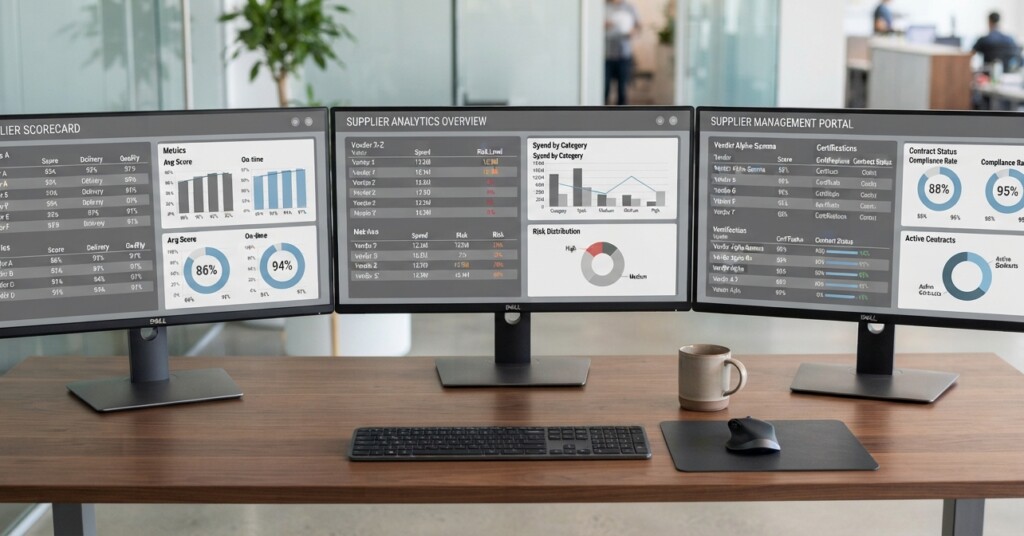
If your business runs more than one software system — an ERP, an accounting platform, a procurement tool, a CRM — there is a reasonable chance that the same supplier exists in several of them under slightly different names, different codes, or with conflicting contact details. This is one of the most common and least glamorous problems in business data management, and it causes real operational damage: duplicated payments, failed reconciliations, incorrect spend reports, and hours of manual correction every month.
Master data conflicts around suppliers are not a sign that your team is careless. They are an almost inevitable outcome of business growth, system acquisitions, and the practical reality that different departments set up records independently. The purchasing team adds a supplier in the procurement system. The accounts payable team creates the same entity in the accounting software. Neither knows the other has done it, and neither is using the same naming convention. Within months, ‘Johnson Electrical Supplies Ltd’ in one system is ‘Johnson Elec Supplies’ in another and ‘JES Ltd’ in a third.
This article walks through why master data conflicts happen, what they cost businesses in practice, and how to build a sustainable approach to resolving and preventing them.
Stop building consolidations in spreadsheets.
BrizoConsol automates multi-entity consolidation — setup in minutes, reports the same day.
Why Supplier Master Data Becomes Inconsistent Across Systems
The root causes of supplier master data conflicts are almost always structural rather than human error. When businesses grow, they add systems to solve specific problems — a dedicated inventory platform, a new finance tool, an e-commerce back-end. Each system has its own supplier or vendor module, and each was set up at a different point in time by people with different priorities.
Common structural causes include: no single system designated as the master record for supplier data; no shared supplier ID or code enforced across platforms; manual re-entry of supplier details when onboarding in a new system; and mergers or acquisitions that bring in entirely separate supplier databases. The result is a scattered landscape of partially overlapping, partially contradictory supplier records.

Master data management (MDM) is the practice of defining, maintaining, and governing the core data entities a business depends on — customers, suppliers, products, employees — so that every system works from a single, authoritative source of truth. For suppliers specifically, this means agreeing on which system holds the ‘golden record’ and how all other systems align to it.
The Real Business Cost of Duplicate and Conflicting Supplier Records
Before investing time in fixing supplier master data, it helps to understand what the problem is actually costing. The costs are rarely captured in a single report, which is part of why the problem persists — nobody sees the total damage in one place.
| Problem Type | Example | Business Impact |
|---|---|---|
| Duplicate payments | Invoice paid twice because supplier exists under two codes | Direct financial loss, recovery time, supplier relationship strain |
| Failed reconciliation | Transactions in accounting do not match procurement records | Month-end delays, audit risk, manual correction hours |
| Incorrect spend reporting | Spend split across duplicate records understates true supplier exposure | Poor negotiating position, missed volume discounts |
| VAT and compliance errors | Different VAT numbers on duplicate records for the same entity | Tax filing errors, regulatory risk |
| Onboarding confusion | New staff cannot identify the correct supplier record to use | Process delays, further data degradation |
| Integration failures | Data sync between systems breaks due to mismatched supplier IDs | Operational downtime, manual workarounds |
For a business managing several hundred active suppliers across two or three systems, it is not unusual for 10–20% of supplier records to have some form of conflict or duplication. At that scale, the reconciliation burden alone can represent a significant portion of a finance team’s monthly workload.
Identifying and Auditing Your Supplier Master Data
Before you can fix the problem, you need a clear picture of its scope. A supplier master data audit does not need to be a lengthy project — a focused extract and comparison exercise can surface the main issues within a few days.
Start by exporting your supplier lists from each system. At minimum, include: supplier name, any system-assigned ID, registered company number (if captured), VAT number, primary contact email, and payment terms. Then run a comparison to find records that look like they refer to the same real-world entity but differ in one or more fields.
Fuzzy matching tools — either built into data preparation software or available through spreadsheet formulas — can flag likely duplicates based on name similarity. Registered company numbers and VAT numbers are the most reliable matching keys because they are unique identifiers. If your systems capture these consistently, matching becomes much more accurate. If they do not, that itself is a gap worth fixing.
Do not rely on supplier name alone as a matching key. Trading names, abbreviations, name changes after acquisitions, and simple data entry variation will cause both false matches (two different suppliers with similar names) and missed matches (the same supplier entered differently). Always validate matches using at least one additional field — company registration number, VAT number, or verified bank account details.
Building a Golden Record for Each Supplier
Once you have identified your conflicts, the next step is to decide what the correct, authoritative version of each supplier record should contain. This is called the ‘golden record’ — the single trusted version that all systems should align to.
For each supplier, the golden record should include: the legal registered name of the entity, the company registration number, the VAT registration number, the registered address, the primary trading address (if different), bank payment details, agreed payment terms, the category or categories of goods and services supplied, and a master supplier code that will be used consistently across all systems.
The golden record needs to live somewhere — either in a dedicated MDM system, or in a nominated ‘system of record’ such as your ERP or accounting platform. The key is that there is a designated authoritative source, and all other systems either pull data from it or are periodically reconciled against it.

Governance: Who Owns Supplier Master Data and How Changes Are Made
Technical fixes alone will not keep supplier master data clean over time. Without clear ownership and process, the same conflicts will reappear. This is where data governance comes in — not as a formal compliance exercise, but as practical clarity about who is responsible for what.
For supplier master data, governance typically needs to cover three things: who can create new supplier records, who can amend existing records (particularly payment details), and what process exists for reviewing and resolving conflicts when they are spotted.
Many businesses assign supplier master data ownership to the finance or accounts payable function, since they are most exposed to the downstream consequences of bad data. Procurement teams are often involved in the initial supplier setup process. What matters is that the roles are explicitly agreed and documented — not that a particular department ‘wins’ the ownership question.
One practical governance measure worth implementing immediately: require a company registration number or VAT number to be entered before a new supplier record can be saved. This single validation step significantly reduces the risk of duplicates and makes future matching much easier. If your systems allow it, enforce uniqueness on these fields so the same number cannot be entered twice.
Using Automation to Detect and Prevent Future Conflicts
Once your supplier master data is in reasonable shape, automation can help keep it that way. Rather than relying on periodic manual audits, well-configured integration and validation rules can flag potential conflicts as they arise.
If your systems are connected through an integration layer or data pipeline, you can build matching logic that checks incoming supplier records against the master list before they are written to any system. If a new supplier record arrives with a VAT number that already exists in the master, the process can hold it for review rather than creating a duplicate.
Scheduled reconciliation jobs — running nightly or weekly — can compare supplier records across systems and surface discrepancies in a report or notification. This creates an ongoing visibility layer rather than a problem that only gets noticed when something goes wrong downstream.
- Define your golden record fields and choose a system of record for supplier master data.
- Export supplier lists from all connected systems and run a matching exercise using registration and VAT numbers as primary keys.
- Resolve identified duplicates by merging records and updating all systems to use the agreed master supplier code.
- Implement validation rules in each system to enforce required fields (registration number, VAT number) on new supplier creation.
- Set up automated reconciliation between systems to detect new conflicts as they arise.
- Assign clear ownership for supplier master data and document the process for creating and amending records.
- Review the master supplier list quarterly to catch any drift and keep the data current.
Practical Considerations When Multiple Departments Use Different Systems
One of the harder aspects of supplier master data management is that different departments often have legitimate reasons for maintaining their own view of a supplier. Procurement may need category and performance data that the accounting system does not hold. The finance team needs payment terms and bank details that the procurement platform does not manage. A CRM might hold relationship and contact history that neither finance nor procurement tracks.
The solution is not to force all supplier data into one system — it is to agree on which fields are ‘master’ fields that must stay consistent across all systems, and which fields are system-specific and can vary. Master fields (legal name, registration number, VAT number, payment terms) should only be updateable in the system of record, and changes should propagate to other systems. System-specific fields (contact notes in a CRM, delivery preferences in a warehouse system) can be managed locally without affecting the master.
Bank account details for supplier payments deserve special attention. This field is a frequent target for fraud — specifically, ‘mandate fraud’ where someone impersonates a supplier and requests a payment detail change. Any change to bank account information on a supplier record should require a separate verification process and should be logged with a timestamp and the identity of the person who made the change. Never update payment details based on an email request alone.
When a Supplier Genuinely Appears in Multiple Legal Forms
Not every case where the same supplier appears differently is an error. Some suppliers genuinely trade through multiple legal entities — for example, a parent company and a subsidiary, or a supplier who operates through different registered entities in different countries. These need to be handled carefully to avoid merging records that should remain distinct.
The best approach is to maintain separate supplier records for separate legal entities, but link them with a ‘parent group’ or ‘supplier group’ field that allows you to roll up spend reporting across the group. This gives you accurate legal and payment records for each entity while still enabling the kind of consolidated supplier spend analysis that informs commercial negotiations.
Getting supplier master data right is not a one-time project — it is an ongoing discipline. But the investment pays off in cleaner month-end processes, more reliable spend reporting, fewer payment errors, and significantly less time spent on manual correction and reconciliation. For businesses running multiple systems, the question is not whether to address it, but when and how.
Need Help Connecting and Reconciling Data Across Your Business Systems?
BrizoSystem works with businesses managing data across multiple platforms — helping teams build cleaner data foundations, reduce manual reconciliation, and get more reliable reporting from the systems they already use.