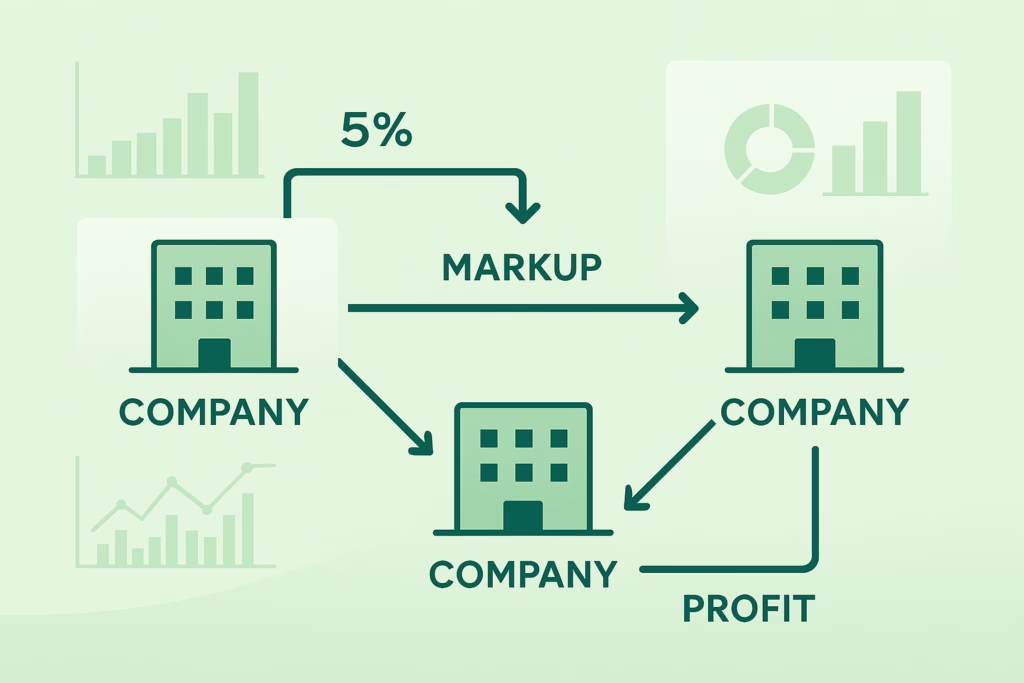
Intercompany markups serve legitimate purposes: they support entity-level performance measurement, satisfy transfer pricing compliance requirements, and create accountability for cost across the group. But they introduce a specific distortion in group margin reporting that is often underappreciated — not just because unrealised profit needs to be eliminated (which is covered separately), but because the markups themselves change what entity-level gross margins mean, and what the group’s true gross margin actually is.
This post focuses on the margin analysis dimension: how to read entity-level margins when intercompany sales are present, how to calculate the group’s real gross margin after eliminations, and how to present both views in management reporting without creating confusion.
How Markups Distort Entity-Level Gross Margins
A manufacturing entity that sells 40% of its output to a sister distribution entity at cost plus 30% will show a blended gross margin that mixes its real external market performance with its intercompany pricing policy. The two components are structurally different:
Automate NCI calculations across all your entities.
BrizoConsol handles non-controlling interest automatically — no manual adjustments required.
- External sales margin: reflects the entity’s actual competitiveness in the open market — pricing power, cost efficiency, product mix
- Intercompany sales margin: reflects a policy decision (the transfer pricing policy), not a market outcome
Entity-level margin distortion — worked example Manufacturing Entity — period results:
External sales: $400,000 revenue / $300,000 cost → 25% gross margin
Intercompany sales to Distribution Entity: $260,000 revenue / $200,000 cost → 23.1% gross margin (cost + 30%)
Wait — if cost is $200,000 and price is $200,000 × 1.30 = $260,000, the gross margin = $60,000 / $260,000 = 23.1%.
But the blended reported gross margin = ($400k + $260k revenue) − ($300k + $200k cost) / ($400k + $260k) = $160k / $660k = 24.2%
The 24.2% blended margin is neither the entity’s true external market performance (25%) nor the transfer price margin (23.1%) — it’s a weighted mix. If the intercompany proportion grows, the blended margin declines even if external performance improves.
For finance teams evaluating Manufacturing Entity’s performance, the intercompany sales volume and the transfer pricing rate are policy variables — they should be visible and separated from external market performance. An entity manager who is measured on blended gross margin has an incentive to maximise external sales (higher margin) but is being partially evaluated on a transfer pricing rate they didn’t set.
The Group Gross Margin — What It Should Be
After intercompany eliminations, the group’s gross margin reflects only external revenue and the original cost of goods at group level. The markup that one entity charged another disappears — the group’s gross profit is the external selling price minus the manufacturing entity’s cost, not minus the distribution entity’s intercompany purchase price.
Group margin calculation — all goods sold externally Manufacturing Entity sells to Distribution Entity at $260,000 (cost $200,000, markup $60,000).
Distribution Entity sells all goods to external customers for $340,000.
Entity-level margins:
Manufacturing: $60,000 / $260,000 = 23.1%
Distribution: ($340,000 − $260,000) / $340,000 = $80,000 / $340,000 = 23.5%
Group margin (after eliminating intercompany sale):
Revenue: $340,000 (external only)
Cost: $200,000 (Manufacturing Entity’s original cost)
Group gross profit: $140,000
Group gross margin: 41.2%
The $60,000 markup and the $80,000 distribution margin both flow to the group — together they equal the $140,000 group gross profit. The group margin is higher than either entity’s margin because each entity’s margin is measured against its own revenue line, which includes the markup from below.
💡 What happens when goods are not all sold externally: If Distribution Entity still holds 40% of the goods in closing inventory, the $60,000 intercompany markup is only 60% realised ($36,000). The remaining $24,000 is eliminated from group COGS and from inventory. Group gross margin still calculates on the realised external sales — the eliminated amount defers to the next period when inventory is sold.
The Markup Matrix
In groups with multiple entities that sell to each other at varying markup rates, calculating unrealised profit consistently requires a documented and maintained markup matrix: a schedule that maps each selling entity to each buying entity, identifies the applicable markup rate, and records the basis for the rate (transfer pricing study, cost-plus formula, fixed policy).
Markup matrix — simplified extract
| Selling entity | Buying entity | Transaction type | Markup rate | Basis |
|---|---|---|---|---|
| AU Manufacturing | UK Distribution | Finished goods | Cost + 25% | TP study 2024 |
| AU Manufacturing | SG Distribution | Finished goods | Cost + 20% | TP study 2024 |
| SG IT Hub | All entities | IT services | Cost + 10% | Management policy |
| UK R&D Centre | AU Manufacturing | IP licence | Revenue 5% | TP study 2024 |
The markup matrix serves two purposes: it is the source data for unrealised profit calculations (applied to unsold inventory proportions each period), and it provides the audit trail for why specific markup rates were used. Where transfer pricing policies change — following a transfer pricing study review, a restructuring, or regulatory pressure — the matrix records when the rate changed and what it was in prior periods.
Transfer Pricing vs Management Accounting — The Alignment Problem
Transfer pricing policies are set primarily for tax compliance: the rate must be arm’s length under the OECD guidelines to satisfy the tax authorities in each jurisdiction. Management accounting policies are set for performance measurement: the rate should create the right incentives and reflect how the group wants entities to be evaluated.
These two objectives are not always aligned. A transfer price set to minimise tax in a high-tax jurisdiction may move profit to the manufacturing entity that makes the group look like it earns its margins in manufacturing (even if the commercial value is actually created in distribution, marketing, or R&D). If entity managers are evaluated against those transfer-price-based margins, the performance signals can be misleading.
The most common practical resolution: maintain a dual margin view in management reporting. The entity-level statutory margin (including transfer pricing) feeds the consolidation and satisfies the tax treatment. A separate management contribution analysis uses a notional cost-plus rate to show what each entity contributed after standardising for the transfer pricing effect. The two views are reconciled, with the difference representing the tax-driven transfer pricing adjustment.
WIP and Partially Manufactured Intercompany Goods
Where one entity sells to another a product that is not yet finished — for example, a component that the buying entity further manufactures before selling externally — the markup calculation must be proportionate to the stage of completion at the point of transfer.
If the buying entity has further processed the goods (adding its own material and labour cost) and the combined product sits in its inventory, the unrealised profit to eliminate is only the markup on the selling entity’s component — not the full cost of goods in the buying entity’s inventory. The buying entity’s own value-add is not intercompany profit; it’s genuine group cost.
🚩 Common error: Applying the markup percentage to the buying entity’s full inventory balance rather than just the intercompany-sourced component of that balance. If the buying entity adds $80 of its own cost to a $130 intercompany component (cost $100, markup $30), the inventory balance is $210. The unrealised profit is $30 (the markup on the $100 component) — not $30/$210 applied to the full inventory balance.
BrizoConsol supports configurable intercompany markup rates by entity pair and transaction type — calculating the unrealised profit elimination based on the documented markup matrix and the closing inventory proportion, with entity-level and group-level margin reporting available from the same consolidated data. Learn more or see it in action →