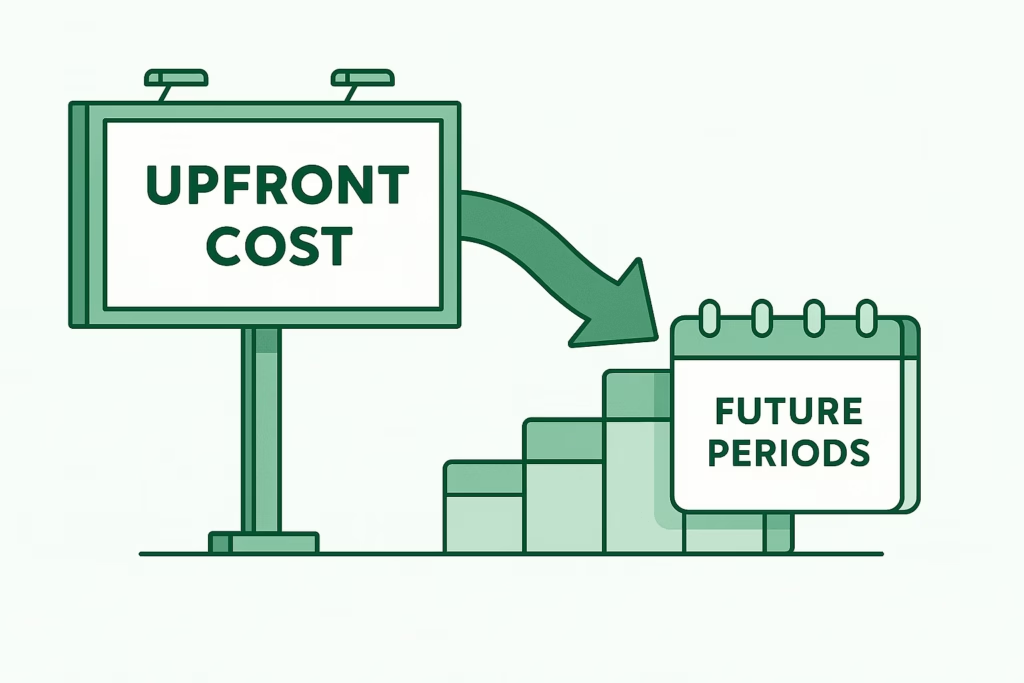
Deferred revenue expenditure refers to large, non-recurring costs incurred in one period that are expected to benefit the business across multiple future periods — and which, on that basis, are carried on the balance sheet and amortised over the benefit period rather than expensed entirely in the year they are incurred. The concept is widely recognised in Indian GAAP (Ind AS pre-convergence), some other local accounting frameworks, and traditional accounting education.
Under IFRS, however, the concept as broadly applied is largely not permitted. IFRS requires that any balance sheet asset must meet the definition of an asset under the Conceptual Framework — a resource controlled by the entity from which future economic benefits are expected to flow. Many costs traditionally deferred as “revenue expenditure” do not meet this test. This post covers what deferred revenue expenditure is, what IFRS allows and doesn’t allow, and what groups need to do when subsidiaries carry deferred expenditure under local GAAP.
The Traditional Concept
The deferred revenue expenditure concept applies the matching principle broadly: if a cost generates benefits across multiple years, matching it against those years’ revenues is more informative than recognising it entirely in the period of cash outflow. Common examples cited under traditional frameworks include:
Stop building consolidations in spreadsheets.
BrizoConsol automates multi-entity consolidation — setup in minutes, reports the same day.
- Heavy advertising or brand-building campaigns expected to drive sales over several years
- Business launch or establishment costs for a new branch or division
- Restructuring costs whose benefits extend across future periods
- Research and development expenditure not yet meeting capitalisation criteria
- Voluntary retirement scheme costs paid upfront with future labour cost savings
In each case, the argument is that the expense is “too large and too future-benefit-generating” to be absorbed in one year’s P&L.
The IFRS Position — What Is and Isn’t Permitted
IFRS applies the asset definition more strictly. An item can only be recognised on the balance sheet if the entity controls a resource from which future economic benefits are expected to flow and the cost can be reliably measured. Meeting this test for costs like advertising is problematic: the entity does not control whether customers will respond to an advertising campaign, and the future economic benefits — if any — cannot be reliably separated from the general goodwill of the business.
🚩 Items that cannot be deferred under IFRS:
Advertising and brand-building costs: IAS 38.69 explicitly states that expenditure on advertising activities shall be recognised as an expense when incurred. The entity does not control the future benefits, and internally generated brands cannot be recognised as intangible assets.
Establishment and launch costs: Costs of opening a new branch, launching a new product line, or relocating operations are expensed as incurred. No asset arises because these costs do not create a separable, controllable resource.
Training costs: Even where training clearly benefits future periods, the entity cannot control the trained employee’s continued service — the employee may leave. Training costs are expensed as incurred.
Research costs: Expenditure during the research phase must be expensed (IAS 38.54). Only development phase costs meeting all six specific criteria can be capitalised.
What Is Permitted Under IFRS
Three categories of spending that might historically have been treated as deferred revenue expenditure do have permitted IFRS treatments — but the mechanism is specific, not the broad “spread it because it benefits future years” approach:
Development costs meeting IAS 38 criteria
Where all six IAS 38 development phase criteria are met simultaneously — technical feasibility, intention to complete, ability to use or sell, probable future economic benefits, adequate resources, ability to reliably measure expenditure — development costs are capitalised as an intangible asset and amortised over the asset’s useful life. This is capitalisation as an intangible asset under a specific standard, not deferred revenue expenditure in the traditional sense.
Example A software company incurs $900,000 developing a new product in its development phase (all six IAS 38 criteria confirmed by the team). The expected useful life is 3 years.
Capitalise $900,000 as intangible asset. Annual amortisation: $300,000. This is permitted and correct under IAS 38 — not because the cost “benefits future years” broadly, but because the specific recognition criteria are met.
Prepaid expenses
Payments made in advance for services or benefits not yet received — prepaid insurance, prepaid rent, prepaid maintenance contracts — are recognised as assets (prepayments) and expensed as the service or benefit is consumed. This is standard accruals-based accounting, not deferred revenue expenditure. The asset exists because the entity has a right to receive future services, which is a controllable economic resource.
Debt issuance costs
Costs of raising debt (arrangement fees, legal fees, underwriting costs) are presented as a direct deduction from the carrying amount of the related financial liability under IFRS 9 — a contra liability, not a deferred asset. They are amortised using the effective interest method over the life of the debt. This is sometimes described as “deferred” but it is structurally a contra liability, not an asset on the balance sheet.
The IFRS vs Local GAAP Comparison
| Item | IFRS treatment | Common local GAAP treatment |
|---|---|---|
| Advertising campaign | Expense immediately (IAS 38.69) | May be deferred and amortised over 3–5 years |
| Business launch / establishment costs | Expense immediately | Often deferred as pre-operative expenses |
| Development costs (criteria met) | Capitalise as intangible asset (IAS 38) | Capitalise or defer — treatment varies |
| Research costs | Expense immediately (IAS 38.54) | Sometimes deferred pending project outcome |
| Debt issuance costs | Contra liability, EIR amortisation (IFRS 9) | Deferred asset, straight-line amortisation |
| Voluntary retirement scheme costs | Pension/employee benefit accounting (IAS 19) | Often deferred and amortised |
Consolidation Implications for Groups with Local GAAP Subsidiaries
For IFRS-reporting groups that consolidate subsidiaries filing statutory accounts under local GAAP (Indian GAAP, local GAAP in other developing markets, or pre-IFRS frameworks), deferred revenue expenditure in the subsidiary’s accounts may need to be reversed as a consolidation adjustment.
Where a subsidiary has carried forward advertising costs, launch costs, or establishment costs as deferred assets under its local GAAP, those amounts do not meet the IFRS asset definition. The consolidation adjustment reverses the deferred balance:
Consolidation adjustment — reversing non-qualifying deferred expenditure
| Account | Debit | Credit |
|---|---|---|
| Retained Earnings / P&L (expense recognised) | $X | |
| Deferred Revenue Expenditure (asset reversed) | $X |
This adjustment must be tracked as a consolidation-level entry — it does not change the subsidiary’s own statutory accounts. The deferred balance and the adjustment amount should be documented in the consolidation working papers and reviewed each period as the subsidiary amortises or utilises the deferred balance.
💡 Deferred tax consequence: Reversing a deferred expenditure asset at consolidation creates a temporary difference — the asset is zero for IFRS consolidation purposes but still present in the subsidiary’s local GAAP books (and its tax base). Depending on the jurisdiction, this may create a deferred tax asset or require recalculation of the subsidiary’s tax position in the consolidation.
For groups consolidating subsidiaries under multiple local GAAP frameworks, BrizoConsol supports consolidation-level adjustments — including reversals of non-qualifying deferred items — with a full audit trail and period-to-period tracking separate from each entity’s statutory accounts. Learn more or see it in action →