
The next generation of business software will not be larger, more connected, or more configurable. It will be smaller, faster, and smarter — built to serve the operator rather than the organisation chart.
There is a term gaining quiet momentum in product and strategy circles: lightweight operational intelligence. It does not yet have a canonical definition, a dominant vendor, or an established analyst category. What it has is a clear direction — a convergence of ideas that have been building independently across product thinking, AI development, and the lived frustrations of operators who have been sold complexity when they needed clarity.
The term brings together three concepts that matter individually and are more powerful in combination. Lightweight means built for the operator, not the organisation — deployable without implementation projects, usable without training programmes, maintainable without dedicated administrators. Operational means embedded in the flow of actual work, not sitting beside it as an analytical layer that requires a deliberate visit. Intelligence means producing conclusions, not data — surfacing what matters and what to do, not what exists.
Stop building consolidations in spreadsheets.
BrizoConsol automates multi-entity consolidation — setup in minutes, reports the same day.
Together, these three ideas describe a category of software that does not yet fully exist but is being assembled from parts that do. Understanding where it is going is useful for anyone building software, buying it, or trying to create competitive advantage in markets where operational speed is a differentiator.
How We Got Here
The trajectory of business software over the past three decades has followed a consistent pattern: more capability, more integration, more data, more configuration. Each cycle produced tools that were objectively more powerful than their predecessors and objectively harder to use at the individual level.
Enterprise resource planning systems consolidated disparate business functions into single platforms and created administrative complexity that required dedicated management. Business intelligence tools gave organisations the ability to query their own data and created an analytics function whose job was to make the data accessible to everyone else. SaaS platforms reduced the infrastructure burden of deploying enterprise software and shifted the complexity from installation to configuration and integration.
Each of these was a genuine advance. Each also increased the gap between what the software could theoretically do and what a single operator — the accountant, the account manager, the practice director — could extract from it on a given Tuesday afternoon without dropping everything else.
Lightweight operational intelligence platforms are the correction. Not a rejection of the capability that accumulated over thirty years of enterprise software development, but a redistribution of where the work of applying that capability happens. The operator should not have to do it. The platform should.
The history of enterprise software is a history of adding capability. The next chapter is about deciding who bears the cost of using it.
What Lightweight Operational Intelligence Looks Like Today
The category does not yet have clear edges, but its centre of gravity is visible in the products that are already pointing toward it.
In finance and accounting, it looks like consolidation tools that monitor intercompany positions throughout the period rather than waiting for month-end, that automate elimination entries based on observed transactions rather than requiring manual construction, and that surface anomalies and required adjustments before the close rather than during it. The accounting expertise is embedded in the product. The accountant applies judgment to conclusions the product has already reached, rather than constructing those conclusions from raw data.
In business development, it looks like signal platforms that monitor market conditions continuously and surface the specific companies, contacts, and moments that warrant outreach — not as a feed to review but as a prioritised brief to act on. The market knowledge is embedded in the platform. The sales professional applies relationship skill and timing judgment to opportunities the platform has already identified.
In client relationship management for professional services, it looks like systems that monitor engagement signals across a client portfolio and flag relationship risk before it becomes client loss — not after a difficult conversation has already happened. The pattern recognition is embedded in the system. The partner applies their experience of the client relationship to a situation the system has already diagnosed.
In each case, the common structure is the same: domain expertise and interpretive work absorbed into the product, so that the operator’s contribution is judgment and action rather than data gathering and analysis.
The Architecture That Makes It Possible
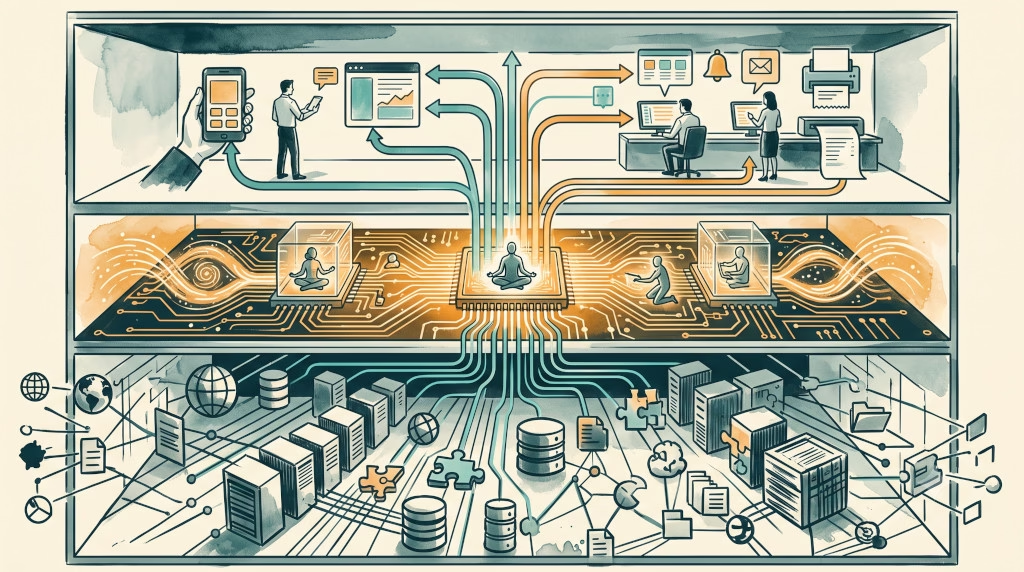
Lightweight operational intelligence platforms are becoming viable now because three architectural shifts have converged at the same moment.
AI as an embedded layer, not an add-on. The use of AI in previous generations of business software was largely additive — a recommendation engine bolted onto a CRM, a predictive model attached to a reporting tool. Lightweight operational intelligence platforms are different: AI is the mechanism by which domain expertise is encoded and applied, not a feature added after the core product was built. The interpretive layer that produces conclusions from data is, in these products, an AI layer — one that can be trained on domain-specific patterns, updated continuously as new data arrives, and personalised to the specific context of the organisation using it.
API-first integration as the default. The integration overhead that once forced businesses toward monolithic platforms — because connecting separate best-of-breed tools was prohibitively complex — has largely been resolved by the maturation of API ecosystems and integration middleware. A lightweight operational intelligence platform does not need to replace the accounting system, the CRM, or the document management tool. It sits above them, drawing data from each through standard integrations, and producing intelligence that is relevant to the operator regardless of which underlying systems are involved.
Delivery mechanisms that meet operators where they are. Early business software delivered output through dedicated application interfaces that required the user to visit the software. Lightweight operational intelligence can deliver conclusions through email digests, messaging platform integrations, mobile notifications, and embedded widgets inside existing tools — without requiring the operator to add another application to their daily rotation. The intelligence finds the operator rather than the operator finding the intelligence.
The Five Characteristics of Next-Generation Platforms
Looking ahead, the platforms that will define this category over the next five years will be distinguished by five characteristics that current products are only partially realising.
Domain depth over breadth. The platforms that win will not be the ones that cover the most categories. They will be the ones that understand their chosen domain at a level that produces reliable, correct, actionable intelligence — not plausible-sounding conclusions that require expert verification before they can be trusted. Domain depth is the moat that horizontal platforms cannot easily replicate.
Conclusions over data. The output of next-generation platforms will shift further from data presentation toward conclusion delivery. Not “here is the intercompany balance across your entities” but “entity A owes entity B an amount that has not been eliminated — here is the journal entry.” Not “here are the companies in your target segment” but “this company entered your ideal customer profile two weeks ago, here is why they are worth contacting now, and here is who in your network can make an introduction.”
Ambient operation. Next-generation platforms will operate primarily in the background — monitoring, processing, interpreting — and surface conclusions to the operator at the moment they become relevant, rather than requiring a deliberate visit. The experience of using the platform will increasingly resemble receiving a well-briefed update from a capable colleague rather than querying a database.
Outcome accountability. The platforms that earn long-term retention will be those that can demonstrate outcome impact — not feature usage, not login frequency, but demonstrable improvement in the quality and speed of decisions made by the operators using them. Outcome accountability is hard to build and hard to fake, which is why it will separate the platforms that create genuine value from those that merely appear to.
Composability without complexity. Operators need platforms that connect to their existing systems without requiring integration projects. Next-generation platforms will offer pre-built connectors for the most common data sources in their domain, configuration through conversation rather than through settings screens, and the ability to add context in minutes rather than days.
Why This Is a Moment for New Entrants
Category shifts in enterprise software have historically favoured incumbents — they have the distribution, the installed base, and the integration depth to absorb new capabilities and defend their position even when their architecture is not well-suited to the new paradigm.
Lightweight operational intelligence is different, for a reason that is structural rather than cyclical: incumbents cannot easily build it without undermining their existing business model.
The revenue model of most enterprise software vendors is built on complexity. Implementation services, support contracts, professional services engagements, configuration consulting — these are meaningful revenue streams that exist precisely because the software requires expert management. A platform that eliminates the need for those services is not a product addition for an incumbent. It is a threat to their economics.
This creates a genuine opening for new entrants who are not defending an existing revenue model — who can build operator-first, domain-deep, intelligence-native products without the constraint of needing those products to generate the professional services revenue that currently subsidises incumbent growth.

The Organisations That Win Early
The firms that benefit most from lightweight operational intelligence platforms in the near term share a common profile: they are operating in complex domains with limited internal capacity to manage that complexity, they are making decisions that are time-sensitive enough that delayed intelligence has a measurable cost, and they have been historically underserved by enterprise platforms that were priced and architected for organisations larger than they are.
Small and mid-size accounting firms fit this profile precisely. The workflows they manage — group consolidations, multi-entity reporting, intercompany reconciliations — are technically demanding, consequential, and time-constrained. The internal capacity to manage complex software is limited. The enterprise alternatives are priced for the large end of the market. Lightweight operational intelligence built for this specific context is not a feature addition to their existing toolset. It is a structural upgrade to how they work.
Where BrizoSystem Is Positioned
BrizoSystem is building lightweight operational intelligence platforms for the professional services and lean business teams of Singapore and the region. The products are narrow by design — each one owns a specific domain deeply enough to produce intelligence that operators can act on without verification, at a scale and cost structure that the firms we serve can actually adopt.
BrizoConsol is operational intelligence for the consolidation and group reporting workflow. BrizoMarket is operational intelligence for business development and market signal monitoring. Both are built on the same architectural premise: domain expertise embedded in the product, intelligence delivered to the operator, complexity absorbed by the platform rather than passed to the user.
The category we are building in does not yet have a name that every buyer recognises. That is normal for a category that is still forming. What is not normal — and what makes this moment genuinely interesting — is the speed at which the underlying components have come together. The AI capability, the integration infrastructure, the delivery mechanisms, and the operator expectation that software should come to them rather than the reverse — all of these arrived within the same short window.
The platforms built to take advantage of that window, built correctly and for the right customer, will define the category. We intend to be among them.