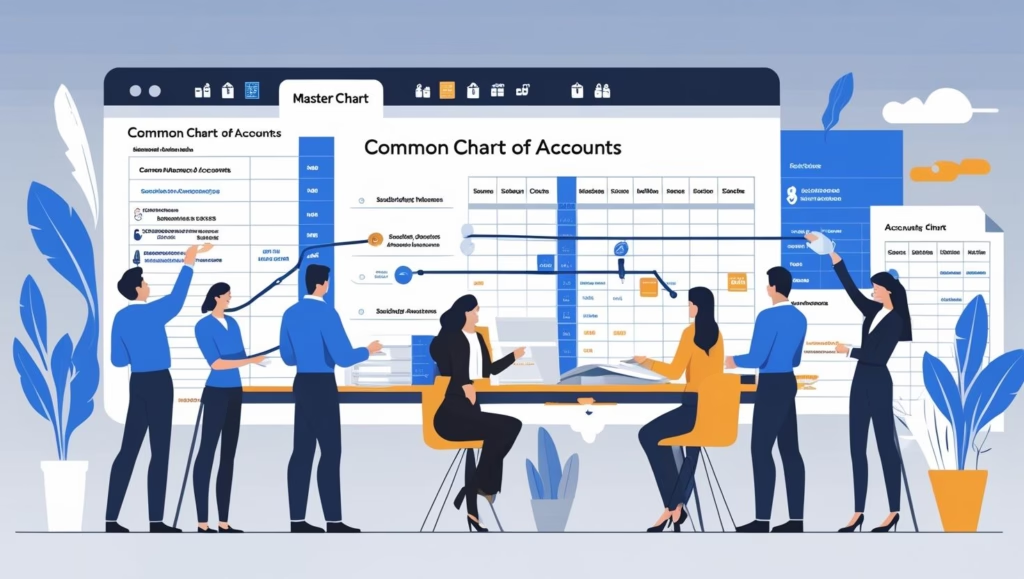
Every entity in a group has its own chart of accounts — the list of accounts used to record transactions in its accounting software. These accounts reflect local accounting practices, local compliance requirements, and how each entity’s finance team thinks about its own business. Two subsidiaries in the same industry, owned by the same parent, will often have completely different account structures. That’s normal. The problem arises when you try to consolidate them.
Without a common structure for the group, consolidation is an exercise in manual reconciliation: matching accounts across entities by name (which differ), by classification (which may differ), and by granularity (which definitely differs). A Common Chart of Accounts (CCOA) is the solution — not by forcing entities to change their own account structures, but by creating a mapping layer that translates each entity’s accounts into a consistent group structure.
The Three Types of COA Inconsistency
COA inconsistency across a group typically manifests in three forms, each with different consolidation consequences.
Automate NCI calculations across all your entities.
BrizoConsol handles non-controlling interest automatically — no manual adjustments required.
Naming inconsistency
The same economic concept described differently across entities. “External Advisory Costs” in one entity, “Consulting Fees” in another, “Professional Services — External” in a third. Each account records the same type of expenditure — payments to external advisors and consultants — but would aggregate to three different lines in a naive consolidation. A CCOA maps all three to a single group line.
Granularity inconsistency
One entity has a detailed revenue breakdown across five accounts by product line; another records all revenue to a single account. For the consolidated P&L, both need to contribute to the same group revenue lines — but the detailed entity can populate five group lines while the simple entity can only populate one. The CCOA handles this through many-to-one mapping: multiple entity accounts map to one group account, or one entity account maps to one group account that aggregates alongside more detailed contributions from other entities.
Classification inconsistency
The same transaction classified differently between entities. Software subscriptions recorded as IT Costs in one entity, Operating Expenses in another, and Admin Overheads in a third. The transaction is identical in nature; the classification reflects each finance team’s judgment about where it belongs in their entity’s P&L. In the group, it should appear consistently — which requires the CCOA to define the correct group classification and override whatever classification each entity applied locally.
The CCOA as a Mapping Layer
The critical concept is that a CCOA does not replace entity charts of accounts. Entities continue using their own COA in their own accounting software — for local bookkeeping, local compliance, BAS, GST, payroll, and whatever else their system handles. The CCOA exists at the consolidation level, as a mapping that translates each entity account into a group account when trial balance data is pulled into the consolidation.
How the mapping works
| Entity | Entity Account | Maps to CCOA Line |
|---|---|---|
| AU Pty Ltd (Xero) | 4000 – Revenue | Group: Revenue – Products |
| AU Pty Ltd (Xero) | 4100 – Consulting Revenue | Group: Revenue – Services |
| UK Ltd (MYOB) | Turnover – Products | Group: Revenue – Products |
| UK Ltd (MYOB) | Turnover – Services | Group: Revenue – Services |
| SG Pte Ltd (QuickBooks) | Sales | Group: Revenue – Products |
| SG Pte Ltd (QuickBooks) | Service Fees | Group: Revenue – Services |
The mapping is many-to-one at the group level — multiple entity accounts can map to the same CCOA line. It is not one-to-many — a single entity account cannot be split across two CCOA lines without additional configuration. This constraint matters when designing the CCOA: group lines should be defined at a level of granularity that can be consistently populated across all entities, including those with less detailed account structures.
Designing a Good CCOA
A CCOA designed well at the outset saves significant maintenance work over time. A few principles that matter in practice:
Reflect how the group thinks about its business, not how one entity does. The easiest approach is to copy one subsidiary’s COA as the group standard. The risk is that it reflects one entity’s operational context rather than the group’s reporting needs. If the group measures performance by product line, the CCOA should have product-line revenue categories — even if one entity records all revenue to a single account.
Set granularity at the lowest common denominator, with room to expand. If three entities can distinguish domestic from export revenue but one cannot, consider whether domestic/export is a meaningful group distinction or whether it creates a mapping problem (one entity always contributing to only one of the two lines). Design for what all entities can consistently supply, with entity-specific detail available through drill-down rather than separate CCOA lines.
Tag intercompany accounts explicitly. The CCOA should identify which accounts are used for intercompany transactions — intercompany sales, intercompany receivables and payables, intercompany loans, management fee income and expense. This tagging enables the consolidation system to automatically identify candidates for elimination rather than requiring manual identification of intercompany accounts each period.
Design for growth. New entities will be added. New business lines will be launched. The CCOA structure should accommodate both without requiring a rebuild. New CCOA lines can be added for new account types; new entity accounts are mapped to existing CCOA lines where possible, or trigger a new CCOA line where necessary. Stability in the CCOA structure is important for trend reporting — changing classifications between periods makes period-over-period comparisons unreliable.
The statutory and management CCOAs can differ. The CCOA used for statutory consolidated financial statements (IFRS presentation) may differ from the CCOA used for internal management reporting. Management reporting often needs more granularity (cost by department, revenue by channel) than statutory reporting. It’s legitimate to maintain two mappings — one for compliance output, one for management reporting — from the same entity account structure.
CCOA Maintenance — The Discipline That Makes It Work
A CCOA built carefully at implementation degrades unless it’s actively maintained. The most common failure mode: an entity adds a new account to its accounting software mid-year, the CCOA mapping is not updated, and the new account either flows into an incorrect group line or fails to flow through at all.
🚩 The silent unmapped account problem: An unmapped account doesn’t generate an error — the consolidation runs successfully. The account’s balance simply doesn’t appear in the consolidated P&L or balance sheet. The balance sheet may still balance (the unmapped amount is absorbed into retained earnings or a catch-all line), making the error invisible until someone investigates why a cost category looks unusually low. This is one of the most common sources of silent error in group consolidation.
Three practices that prevent the mapping from drifting:
- Require notification before new accounts are added: Entity finance teams should notify the group before adding any new account code, so the group COA can be updated in advance of the next submission.
- Run an unmapped account check before each consolidation: Any trial balance account with no CCOA mapping should be flagged as a blocker before the consolidation runs — not discovered after the close when the output is being reviewed.
- Audit the catch-all line regularly: Most CCOAs include an “Other” or catch-all line for accounts that don’t fit neatly elsewhere. A growing balance in the catch-all is a signal that mapping maintenance is falling behind.
Entity COA vs CCOA — What Each Is For
| Entity COA | Group CCOA | |
|---|---|---|
| Lives in | Entity’s accounting software (Xero, MYOB, QuickBooks, etc.) | Consolidation platform |
| Purpose | Local bookkeeping, tax, statutory filing, payroll | Group consolidated reporting, management reporting, KPI calculation |
| Controlled by | Entity finance team | Group finance team |
| Changes | When entity’s operational needs change | When group reporting requirements change |
| Audience | Entity management, local auditors, tax authority | Group board, investors, lenders, group management |
The CCOA doesn’t need to match the entity COA structure — and often shouldn’t. It needs to provide the group with the information it requires for its own reporting, translated consistently from whatever structure each entity uses locally.
BrizoConsol’s CCOA is configured once in the consolidation platform — each entity account is mapped via AI-assisted suggestions with human review, unmapped accounts are flagged before each consolidation run, and both local COA and group CCOA views are available in reports. Learn more or see it in action →