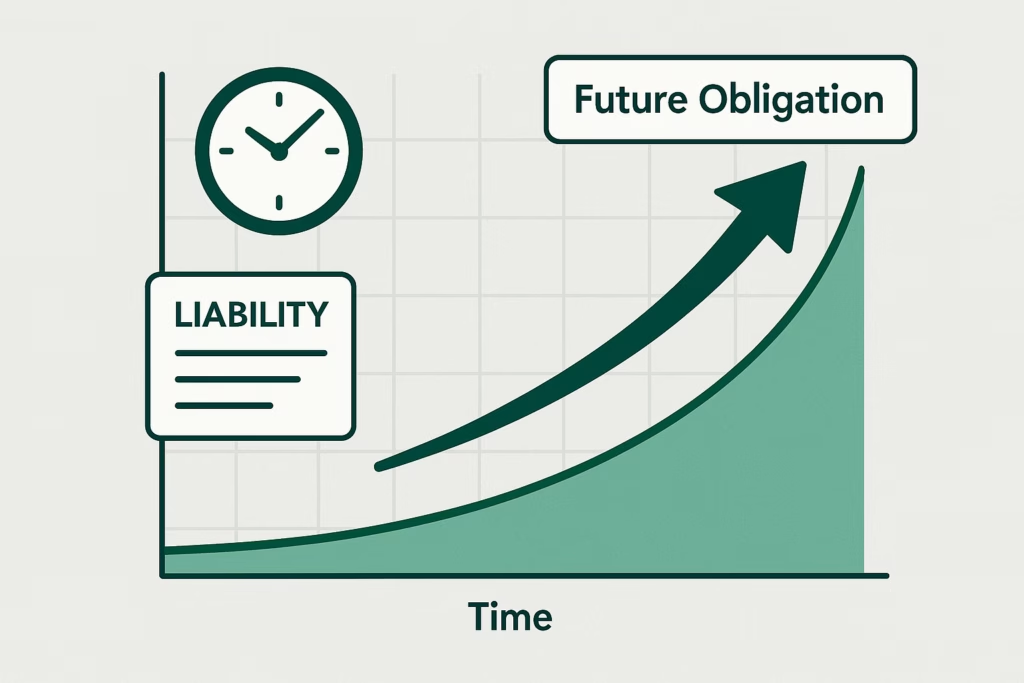
Accretion expense is the periodic increase in the carrying amount of a discounted long-term liability as it approaches its settlement date. It arises because obligations that will be settled in the future are initially recorded at their present value — a figure lower than the actual amount that will ultimately be paid. As time passes, the discount unwinds and the liability grows toward its undiscounted value. That growth is accretion expense.
The most common context is asset retirement obligations (AROs) — legal obligations to restore or decommission a physical asset at the end of its useful life. Oil and gas companies must restore drill sites. Mining companies must rehabilitate land. Utilities must decommission power plants. The obligation exists from day one, but the cash outflow is years away — so the liability is recorded at present value, and accretion expense is charged each year as the payment date approaches.
Initial Recognition — The ARO and the Offsetting Asset
When an ARO is first recognised, two entries are made simultaneously: the liability is recorded at present value, and an equal amount is capitalised as an “asset retirement cost” — an addition to the carrying value of the related asset. The asset retirement cost is then depreciated over the useful life of the asset, separately from the accretion that unwinds the liability.
Stop building consolidations in spreadsheets.
BrizoConsol automates multi-entity consolidation — setup in minutes, reports the same day.
Initial recognition — ARO at present value
| Account | Debit | Credit |
|---|---|---|
| Property, Plant & Equipment (asset retirement cost component) | $613,900 | |
| Asset Retirement Obligation (liability) | $613,900 |
This means the company has two related charges over the life of the asset:
- Depreciation of the $613,900 ARO cost component, charged to P&L over the asset’s useful life (alongside depreciation of the underlying asset)
- Accretion expense on the $613,900 ARO liability, growing the liability toward $1,000,000 over 10 years
How Accretion Works — A Full 10-Year Example
Scenario Estimated future decommissioning cost: $1,000,000 in 10 years
Discount rate: 5% per annum
Present value at inception: $1,000,000 / (1.05)^10 = $613,913
| Year | Opening Liability | Accretion (5%) | Closing Liability |
|---|---|---|---|
| 1 | 613,913 | 30,696 | 644,609 |
| 2 | 644,609 | 32,230 | 676,839 |
| 3 | 676,839 | 33,842 | 710,681 |
| 4 | 710,681 | 35,534 | 746,215 |
| 5 | 746,215 | 37,311 | 783,526 |
| 6 | 783,526 | 39,176 | 822,702 |
| 7 | 822,702 | 41,135 | 863,837 |
| 8 | 863,837 | 43,192 | 907,029 |
| 9 | 907,029 | 45,351 | 952,380 |
| 10 | 952,380 | 47,620 | 1,000,000 |
The accretion expense grows each year because it is calculated as a fixed percentage of a growing liability. By year 10, the liability equals the undiscounted obligation — the discount has been fully unwound.
Annual accretion entry (Year 1 example: $30,696)
| Account | Debit | Credit |
|---|---|---|
| Accretion Expense (P&L — finance costs or separate line) | $30,696 | |
| Asset Retirement Obligation (liability) | $30,696 |
Key Characteristics
- Non-cash: Accretion expense increases the liability but involves no cash outflow. It is added back in the operating section of the cash flow statement when reconciling net income to operating cash flows.
- Finance cost: Accretion is economically equivalent to interest on a liability — it is the cost of time. It is typically presented in the income statement within finance costs or as a separate line item, not within operating expenses.
- Grows over time: Because accretion is calculated on the growing liability balance, the expense increases each year — even if the discount rate is unchanged.
- Common in capital-intensive industries: Oil and gas, mining, utilities, and construction are the most frequent users, but any entity with a long-dated restoration or decommissioning obligation will have accretion expense.
Changes in Estimates — What Happens When Costs Change
The estimated cost of the future obligation is periodically reassessed. Under IFRS (IFRIC 1), when the estimated future cost changes:
- The ARO liability is remeasured to the new present value (using the current discount rate for a new obligation, or the original risk-free rate for existing obligations under some circumstances)
- The corresponding adjustment is made to the carrying amount of the related asset, not to profit or loss
- If the asset is already fully depreciated, the adjustment goes directly to profit or loss
Example — change in estimate at Year 3 At the end of Year 3, the company revises its estimated future cost from $1,000,000 to $1,200,000 (due to expected increase in remediation costs). Current discount rate: 5%.
New PV of liability = $1,200,000 / (1.05)^7 = $852,184
Current ARO liability: $710,681 (from Year 3 closing balance above)
Increase in liability: $852,184 − $710,681 = $141,503
Entry: Dr PP&E (ARO cost component) $141,503 / Cr Asset Retirement Obligation $141,503
The asset’s increased carrying value is then depreciated over the remaining useful life (7 years). Accretion going forward is calculated on the revised $852,184 balance.
IFRS vs US GAAP Differences
| IFRS (IAS 37 / IFRIC 1) | US GAAP (ASC 410) | |
|---|---|---|
| Discount rate | Pre-tax rate reflecting current market assessments and liability-specific risk; remeasured when market rates change | Credit-adjusted risk-free rate at initial recognition; locked in for changes in timing, new rate for revisions in estimated cash flows |
| Scope | Legal and constructive obligations | Legal obligations only |
| Changes in liability from market rate movements | Adjusts the asset (and therefore future depreciation) | Rate is locked; remeasurement only on change in estimated cash flows or timing |
| Income statement classification | Finance costs (unwinding of discount) | Accretion expense (often within operating or finance costs) |
The discount rate difference is the most practically significant. Under IFRS, if market interest rates rise, the liability is remeasured at the higher rate — which reduces the present value of the liability (smaller number) and generates a credit adjustment to the related asset. Under US GAAP, the original locked-in rate continues to apply for the original estimate, and only changes in estimated cash flows use a new rate.
Accretion in Group Consolidation
In a group with multiple entities that hold decommissioning or restoration obligations — common in energy, mining, and infrastructure groups — the consolidated balance sheet aggregates all ARO liabilities from across the group. Key consolidation considerations:
- Consistent discount rates: Where the group accounting policy specifies a particular approach to discount rate selection (e.g., a single group-wide risk-free rate), entity-level AROs that were calculated using different rates may need to be adjusted at consolidation.
- NCI impact: Where a subsidiary with an ARO is partially owned, the ARO liability contributes to the subsidiary’s net assets — and therefore affects the NCI’s share of equity. Changes in the ARO estimate that adjust the asset also affect net assets and NCI equity.
- Accounting policy alignment: IFRS groups consolidating US GAAP subsidiaries that have AROs need to assess whether the US GAAP discount rate and scope (legal obligations only) produces a materially different liability from the IFRS calculation, and adjust accordingly.
For groups managing decommissioning and restoration liabilities across multiple entities, BrizoConsol provides the consolidated balance sheet view and entity-level drill-down needed to track ARO balances, accretion movements, and the related asset adjustments period to period. Learn more or see it in action →