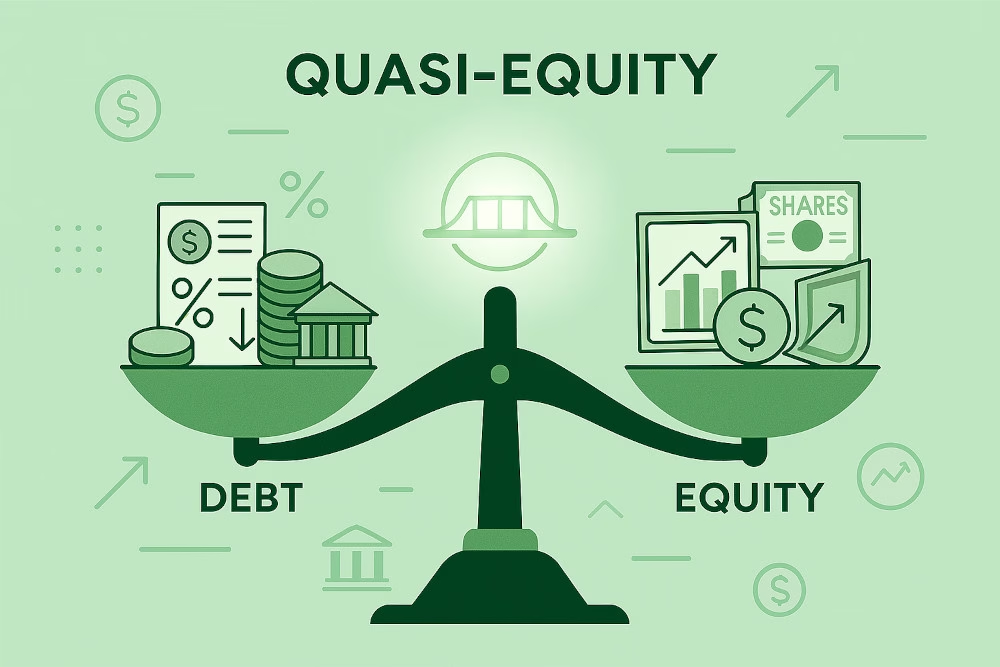
Quasi-equity is a broad term for financial instruments that sit between debt and equity in a company’s capital structure. Like debt, they often involve repayment obligations or priority rights over pure equity holders. Like equity, they may give investors participation in the company’s upside, and they absorb losses before senior creditors. The precise features vary significantly between instrument types — which is why the accounting treatment and the consolidation implications require careful assessment in each case.
Understanding quasi-equity matters for group finance teams because these instruments appear frequently in multi-entity structures, affect leverage ratios and capital structure reporting, and their classification under IFRS determines how they appear in the consolidated balance sheet.
Why Quasi-Equity Is Used
Quasi-equity instruments typically emerge when the interests of the company, its founders, and its investors do not align neatly with either traditional bank debt or straightforward equity investment.
Stop building consolidations in spreadsheets.
BrizoConsol automates multi-entity consolidation — setup in minutes, reports the same day.
From the company’s perspective: the business needs growth capital but either cannot access bank lending (insufficient collateral, early-stage risk profile) or does not want to issue equity at current valuations (founder dilution, control considerations). Quasi-equity provides capital with more flexible repayment terms than senior debt and without the immediate dilution of a share issuance.
From the investor’s perspective: pure equity in an early or mid-stage company carries high risk with no downside protection. Quasi-equity instruments typically provide some priority in repayment — subordinated to bank debt but senior to equity — while preserving upside participation through performance-linked returns, warrants, or conversion rights.
From the bank’s perspective: quasi-equity often counts as near-equity in leverage assessments, reducing perceived lending risk even though it does not change the company’s legal ownership structure.
Common Quasi-Equity Instruments
Convertible Notes and Loans
A convertible note starts as debt — the company borrows money and pays interest — but includes a right for the lender to convert the outstanding balance into equity at a future event: typically a funding round, an IPO, or maturity. Conversion terms usually include a valuation cap (the maximum price at which conversion can occur) and a discount rate (the percentage below the next round’s price at which the note converts).
Convertible notes are common in venture-backed businesses as bridge financing between funding rounds, and in acquisition structures where the seller takes back a portion of the consideration as a convertible instrument.
Revenue-Based Financing
Revenue-based financing structures repayment as a percentage of the company’s monthly or quarterly revenue rather than fixed instalments, with a total repayment cap (e.g., 1.5x the amount borrowed). The company repays faster when revenue is high and slower when revenue is low — suited to businesses with variable or seasonal cash flows. There is no equity conversion mechanism; repayment is contractual, making this instrument more debt-like than other quasi-equity forms.
Mezzanine Financing
Mezzanine debt is subordinated debt — ranked below senior bank debt in repayment priority — that typically includes an equity kicker: warrants or other rights giving the mezzanine lender participation in the company’s equity value. It is common in leveraged buyouts, where it bridges the gap between senior debt and the private equity sponsor’s equity. The equity kicker aligns the mezzanine lender’s returns with the success of the business, compensating for higher default risk in the subordinated position.
Preferred Equity
Preferred equity sits within the equity layer but carries priority features: liquidation preferences (preferred holders are paid before ordinary shareholders in a sale or wind-up), fixed or cumulative dividends, and sometimes anti-dilution protections. It is the standard instrument in venture capital and private equity investment. Despite the word “equity,” the accounting classification depends on the specific terms of the instrument — not its name.
Accounting Classification Under IFRS — Liability or Equity?
The most important accounting question for any quasi-equity instrument is whether it should be classified as a financial liability or as equity. Under IAS 32, the determining factor is whether the instrument contains a contractual obligation to deliver cash or another financial asset. If it does — regardless of how the instrument is labelled or structured — it is a financial liability.
| Instrument | Typical IFRS Classification | Key Determining Factor |
|---|---|---|
| Convertible note | Split: liability component + equity component | Debt repayment = liability; fixed-for-fixed conversion option = equity |
| Revenue-based financing | Financial liability | Contractual payment obligation exists regardless of revenue variability |
| Mezzanine debt with warrants | Liability (debt) + equity (warrants) | Debt obligation = liability; warrants (fixed shares for fixed amount) = equity |
| Mandatorily redeemable preferred equity | Financial liability | Mandatory redemption = obligation to deliver cash = liability |
| Non-redeemable participating preferred equity | Equity | No contractual repayment obligation despite priority features |
Convertible Notes: Split Accounting
Convertible notes under IAS 32 require split accounting — separating the instrument into its liability component and equity component at initial recognition. The liability component is the present value of the contractual cash flows (interest and principal) discounted at the market rate for equivalent non-convertible debt. The equity component is the residual: total proceeds minus the liability component.
Split accounting — simplified example A company issues a $1,000,000 convertible note at 3% annual interest, converting at maturity (3 years). Market rate for equivalent non-convertible debt: 8%.
PV of interest ($30,000/year at 8% for 3 years) = $77,300
PV of principal ($1,000,000 at 8% for 3 years) = $793,800
Liability component = $871,100
Equity component (conversion option) = $128,900
Balance sheet at issuance: $871,100 in financial liabilities; $128,900 in equity reserves.
The liability component accretes toward the face value using the effective interest method — interest expense each period is higher than the cash coupon, with the difference increasing the carrying value toward $1,000,000 at maturity.
Consolidation Implications for Groups
Where quasi-equity instruments exist within a group structure, the consolidation treatment depends on whether the instrument is between group entities or between a group entity and an external party.
Intercompany quasi-equity: An instrument between the parent and a subsidiary must be eliminated on consolidation. A convertible note classified as a liability in the subsidiary and as an investment in the parent eliminates both legs. The equity component in the subsidiary’s accounts is also eliminated against the parent’s investment in subsidiary.
External quasi-equity in a subsidiary: An external convertible note or preferred equity in a subsidiary requires an IFRS 10 control assessment. If conversion would give the noteholder significant ownership — or potentially control — the potential voting rights that arise on conversion must be considered in determining whether the noteholder controls the subsidiary, even before conversion has occurred.
Impact on group leverage ratios: Quasi-equity instruments classified as liabilities contribute to group net debt — affecting debt-to-EBITDA and interest coverage calculations that lenders monitor under facility covenants. Management commentary on the group’s capital structure should address material quasi-equity positions and their classification basis, particularly where lenders may treat the instruments differently from IFRS in their own covenant calculations.
Lender treatment vs IFRS treatment: Some lenders treat mezzanine debt or subordinated convertible instruments as equity-like in their leverage assessments, even though IFRS classifies them as financial liabilities. Credit facility covenants may define leverage with specific carve-outs for subordinated instruments. Always confirm how quasi-equity in the group structure will be treated under the specific covenant definitions — the IFRS balance sheet classification and the covenant classification can differ materially.
For groups managing complex capital structures with quasi-equity instruments in subsidiaries, BrizoConsol supports the entity-level and consolidated reporting needed to correctly classify and disclose these instruments across the group. Learn more or see it in action →