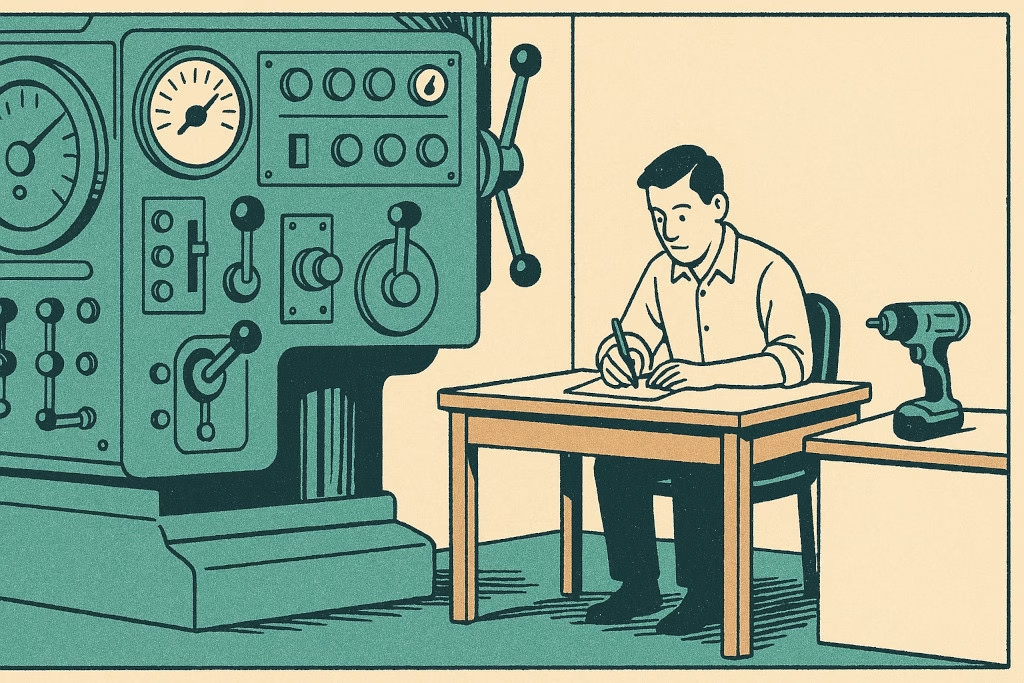
Enterprise software was not built for small teams. The cost goes far beyond the subscription fee — and most businesses only realise it after they have already paid it.
Somewhere in the history of most small businesses, there is a software decision that seemed sensible at the time. The enterprise suite offered everything — finance, HR, CRM, operations, reporting — under one roof. A single vendor. A single login. A single contract that felt like it was solving a sprawl problem before the sprawl had even begun.
Six months later, the finance team was using two modules. The rest sat untouched. The implementation consultant had moved on. The internal champion who pushed for the purchase had become the only person who could navigate the system. And the annual renewal was approaching.
Stop building consolidations in spreadsheets.
BrizoConsol automates multi-entity consolidation — setup in minutes, reports the same day.
This story is not unique. It is the predictable outcome of a fundamental mismatch — between what enterprise software is designed to do and what small businesses actually need it to do.
What Enterprise Software Was Actually Built For
Enterprise software is not bad software. In the right context — large organisations with dedicated IT departments, specialist administrators, and complex multi-departmental workflows — it performs exactly as intended. The breadth is a feature. The configurability is a feature. The ability to support five hundred concurrent users across twelve countries is a feature.
But none of those features serve a business with fifteen employees and a two-person finance team. For that business, the breadth is overhead. The configurability is a project. The multi-country infrastructure is an abstraction that adds nothing to the task of closing the books each month.
Enterprise software is architected around the assumption that the organisation deploying it has the internal capacity to shape the tool around its workflows. Implementation teams. System administrators. Change management programmes. Ongoing training budgets. Small businesses have none of this. They have the software, and whoever agreed to take ownership of it during procurement.
The hidden cost of enterprise software for small businesses is not the licence fee. It is the permanent overhead of maintaining a system that was never designed for your scale.
The True Cost Is Not on the Invoice
When a small business evaluates enterprise software, the number that gets scrutinised is the subscription cost. That number is real, but it is rarely the largest cost the business will bear.
Implementation takes longer than scoped. The internal time investment — pulling the right people away from their actual work to configure, test, and validate a system — adds up to weeks across a quarter. Training is ongoing because the system is complex enough that knowledge does not transfer naturally through use. Every new hire needs a structured introduction to a tool that a more intuitive product would not require.
And then there is the cost of partial adoption. Most small businesses using enterprise software use a fraction of what they are paying for. The modules they do not use are not free — they are part of the contract, part of the implementation scope, part of the administrative surface area that someone has to manage even when nothing is happening inside them.
The result is a recurring gap between what the software costs and what it returns. That gap is not a negotiation failure. It is structural — the product was priced and built for a customer with different economics than yours.

What Lightweight SaaS Gets Right
Lightweight SaaS — purpose-built tools designed for specific workflows rather than entire organisational ecosystems — operates on a different set of assumptions. It assumes the user is not an administrator. It assumes onboarding should be measured in hours, not months. It assumes the business using it does not have a dedicated person whose job is to maintain the integration.
These assumptions produce different design decisions at every level of the product. The interface is narrower because the scope is narrower. The configuration options are fewer because the defaults are more opinionated. The documentation is shorter because the product does not need to explain itself at length.
For a small business, this translates directly into time. Time to first value — the point at which the software is doing something useful — is measured in days rather than months. The learning curve is shallow enough that knowledge transfers naturally between team members without formal training. And when something goes wrong, the surface area is small enough that diagnosing and fixing the problem does not require a support ticket that takes three business days to close.
Lightweight SaaS is not a compromise. It is a product designed for a different customer with different requirements — and for small businesses, those requirements are better matched by purpose-built tools than by enterprise platforms scaled down.
The Integration Argument Does Not Hold Up
The most common objection to lightweight SaaS for small businesses is the integration concern. Enterprise suites, the argument goes, eliminate the problem of connecting separate tools — everything lives in one system, so nothing needs to talk to anything else.
In practice, this argument rarely survives contact with reality. Enterprise suites are integrated within their own ecosystem, but that ecosystem is rarely complete. Most small businesses using an enterprise suite for finance still use a separate tool for email, a separate tool for project management, and a separate tool for customer communication. The suite did not eliminate integration — it just moved the integration boundary.
Meanwhile, the lightweight SaaS ecosystem has matured significantly. Modern purpose-built tools are designed to connect with each other through standard APIs and integration platforms. A small accounting firm running a dedicated consolidation tool, a CRM, and a document management system can have those three products communicating reliably without an IT department. The integration overhead that once justified the enterprise suite has largely dissolved.
When Specialisation Beats Generalisation
There is a deeper argument for lightweight SaaS that goes beyond cost and complexity: specialised tools are simply better at the specific thing they do.
An enterprise suite’s financial reporting module is designed to serve the reporting needs of organisations ranging from fifty to fifty thousand employees across multiple industries. It must be general enough to accommodate all of them. That generality is a constraint on depth — the module cannot be optimised for the specific reporting requirements of a Singapore accounting firm managing IFRS consolidations for a portfolio of SME clients, because it was not built with that customer in mind.
A purpose-built consolidation tool, by contrast, can be designed entirely around that workflow. Every default, every interface decision, every automated process can reflect the specific way that type of work actually gets done. The result is not just a simpler product — it is a more capable one, within the domain it was built for.
For small businesses with specific, well-defined needs, this specialisation advantage compounds over time. The tool gets better at the specific job faster than any general-purpose suite can, because its entire development resource is focused on that one problem.
How to Identify the Right Tool for Your Scale
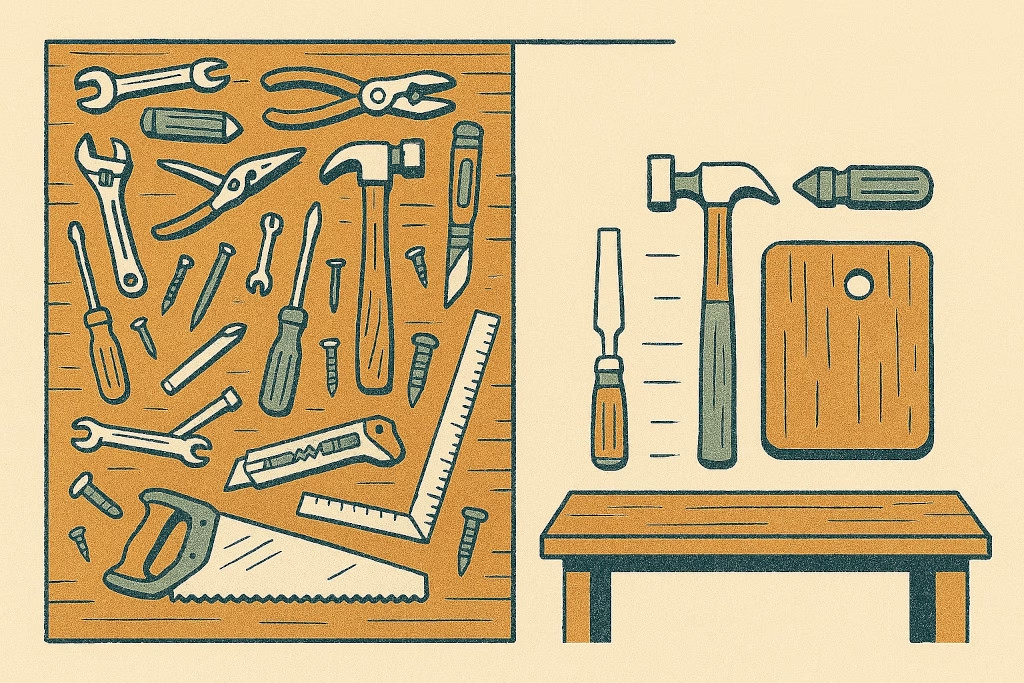
The practical question for any small business evaluating software is not “does this tool do everything we might ever need?” It is “does this tool do the specific thing we need, reliably, without requiring us to become experts in the tool itself?”
A useful test: can a capable member of your team complete the core task the software is intended to support within their first session, without consulting documentation or contacting support? If the answer is no, the onboarding cost has already exceeded what a lightweight alternative would charge you to solve the same problem.
A second test: when you describe the software to a new hire in their first week, can you do it in one sentence? If the explanation requires caveats, module names, and a distinction between what the tool does and what it does not do, the tool is carrying more complexity than your business needs.
The right software for a small business is not the most powerful software available. It is the most focused software available — the one that solves the specific problem you have, completely, with the least surface area that requires your ongoing attention to manage.
What This Means for Accounting and Finance Teams
Nowhere is the mismatch between enterprise software and small business needs more visible than in accounting and financial reporting. The major enterprise finance suites — NetSuite, SAP, Oracle — are genuinely excellent at what they do. They are also priced, implemented, and maintained at a scale that most small businesses and accounting practices cannot support.
The gap this creates is real and persistent. Small accounting firms managing group structures for SME clients need consolidation capability — multi-entity reporting, intercompany eliminations, currency translation, IFRS-compliant output — but they do not need the full architecture of an enterprise ERP to get it. They need a tool that does consolidation well, connects to the accounting systems their clients are already using, and produces output that is ready to present without a formatting step in Excel.
That is a solvable problem at a fraction of the enterprise cost. The market for lightweight, purpose-built consolidation software exists precisely because the enterprise suite is the wrong answer for most of the firms that need this capability.
What BrizoSystem Was Built to Solve
BrizoSystem builds purpose-built software for small accounting firms and lean business teams in Singapore and the region. The products are narrow by design — each one does a specific job, for a specific type of user, without the overhead of a platform that was built to serve everyone.
BrizoConsol handles multi-entity consolidation and group reporting for accounting firms whose clients have outgrown single-entity accounting but whose practices have not outgrown the need to work efficiently. It connects to the accounting systems already in use, automates the eliminations and adjustments that currently happen manually in spreadsheets, and produces compliant consolidated output without a consultant, an implementation project, or a six-month onboarding programme.
Lightweight does not mean limited. It means focused. And for small businesses, focus is worth more than breadth.