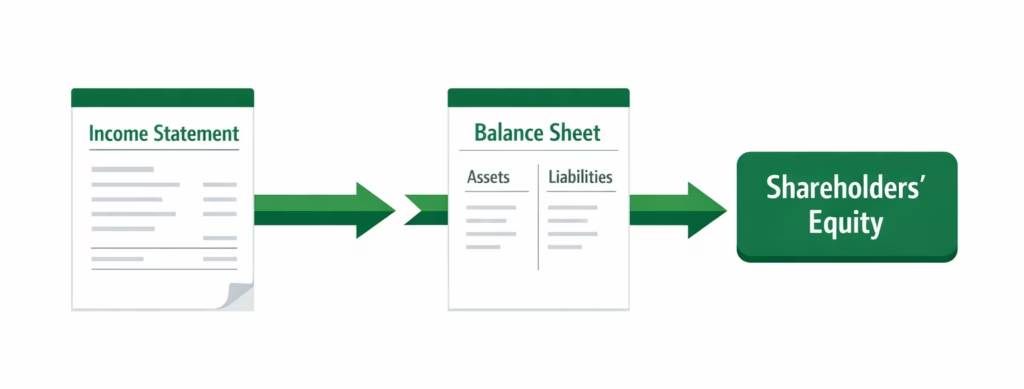
Clean surplus accounting describes a property of financial statements in which all changes in equity — other than transactions with owners — pass through the income statement. Under clean surplus, reported profit is the complete and sole explanation of how equity grew or shrank during the period, aside from capital contributions and distributions to owners. This makes the income statement and balance sheet perfectly linked: if you know beginning equity, net income, and owner transactions, you can derive ending equity exactly.
The Clean Surplus Relation
The clean surplus relation is expressed as:
BVt = BVt-1 + NIt − Dt
Stop building consolidations in spreadsheets.
BrizoConsol automates multi-entity consolidation — setup in minutes, reports the same day.
Where BV is book value of equity, NI is net income, and D is net dividends paid to owners (or minus capital raised). Under clean surplus, this identity holds exactly — no equity change is unaccounted for by the income statement.
Clean surplus in practice Opening equity: $1,000,000
Net income for the period: $150,000
Dividends paid: $50,000
No share issues or buybacks
Closing equity: $1,000,000 + $150,000 − $50,000 = $1,100,000
The $100,000 increase in equity is fully explained by net income less dividends. No unexplained equity movement exists.
Dirty Surplus — Where Modern IFRS Breaks the Clean Relation
Modern accounting standards permit — and in some cases require — items to bypass the income statement and be recorded directly in equity through Other Comprehensive Income (OCI). These “dirty surplus” items mean that reported net income does not capture all non-owner equity changes. The income statement is no longer a complete record of value creation and destruction.
Under both IFRS and US GAAP, the most significant OCI items include:
| OCI item | Standard | Why it bypasses P&L |
|---|---|---|
| Currency translation adjustment (CTA) | IAS 21 | Translation differences from foreign subsidiaries are placed in OCI; recycled to P&L on disposal of the foreign operation |
| Asset revaluation surplus | IAS 16 / IAS 38 | Upward revaluations of PP&E and intangibles go to OCI (cannot be reversed through P&L) |
| Actuarial gains/losses on defined benefit pensions | IAS 19 | Remeasurement of pension obligations goes to OCI and is never recycled to P&L |
| Fair value changes on FVOCI investments | IFRS 9 | Equity instruments designated as FVOCI have fair value changes in OCI; not recycled to P&L on sale |
| Effective portion of cash flow hedges | IFRS 9 | Hedge effectiveness gains/losses deferred in OCI until the hedged item affects P&L |
The consequence: a company whose FVOCI investments increased in value by $400,000, whose pension scheme generated $200,000 of favourable actuarial remeasurement, and whose foreign subsidiaries generated $300,000 of CTA may report net income of $500,000 — but total equity increased by $1,400,000. The $900,000 difference represents real economic value changes that the income statement completely omits.
Total Comprehensive Income — The Clean Surplus Substitute
The concept of total comprehensive income (TCI) — net income plus all OCI items — approximates the clean surplus relation in modern financial reporting. TCI captures all non-owner equity changes in a single measure:
TCI = Net Income + Other Comprehensive Income
For analysts who want to restore the clean surplus property for valuation purposes, TCI is the relevant income measure — not reported net income. Using net income for valuation when significant OCI items are present understates or overstates the true economic earnings depending on the direction of OCI.
💡 The residual income valuation model — developed by Ohlson (1995) — depends explicitly on the clean surplus relation. The model values equity as book value plus the present value of expected “abnormal earnings” (earnings above the equity charge). For the model to work correctly, either TCI must be used as the earnings measure, or OCI items must be explicitly incorporated into the analyst’s forecast. Using reported net income without adjusting for significant OCI items systematically misstates the model’s inputs.
The Statement of Changes in Equity — The Transparency Tool
Because modern standards allow dirty surplus items, the Statement of Changes in Equity (SOCE) is required to bridge the gap. The SOCE shows, for each component of equity, the opening balance, all movements during the period (including OCI), owner transactions, and the closing balance. It is the formal reconciliation of equity that restores transparency when the income statement alone is incomplete.
For auditors, the SOCE is the document that confirms the balance sheet and income statement are mathematically consistent. For analysts, it is the source document for identifying what OCI items are present, how large they are, and whether they are recycling items (which will eventually appear in P&L) or permanent equity items (which won’t).
SOCE equity roll-forward with OCI Opening equity: $1,000,000
Net income: $150,000
OCI — CTA: ($80,000) — foreign subsidiaries weakened against presentation currency
OCI — pension remeasurement: $30,000
Total comprehensive income: $100,000
Dividends paid: ($50,000)
Closing equity: $1,050,000
If only net income was presented: opening $1,000,000 + net income $150,000 − dividends $50,000 = $1,100,000 — overstated by $50,000 versus actual closing equity of $1,050,000. The SOCE explains the gap.
Clean Surplus and Group Consolidation
In a multi-entity group, OCI items exist at both the entity level and the consolidation level. The most significant consolidation-level OCI item is the currency translation adjustment — the difference arising from translating foreign subsidiaries’ net assets at closing rates while their equity accumulated at historical rates. This CTA is not generated in any individual entity’s books; it arises in the consolidation process and is recorded directly in consolidated equity.
Understanding this is important for the equity roll-forward in the consolidated SOCE. The CTA line in the consolidated equity table needs to show:
- Opening CTA balance (carried from prior period)
- Movement in the period from translation of foreign subsidiaries
- CTA recycled to P&L on any subsidiary disposals
- Closing CTA balance
And for partially-owned subsidiaries, the CTA must be split between the parent’s share and the NCI’s share — the minority shareholders also have an economic exposure to the translation difference on their proportionate share of the subsidiary’s net assets.
For groups managing OCI items — particularly CTA — across multiple foreign entities, BrizoConsol calculates and tracks the currency translation adjustment automatically as a separate equity component, with the period movement and cumulative balance available for the consolidated Statement of Changes in Equity. Learn more or see it in action →