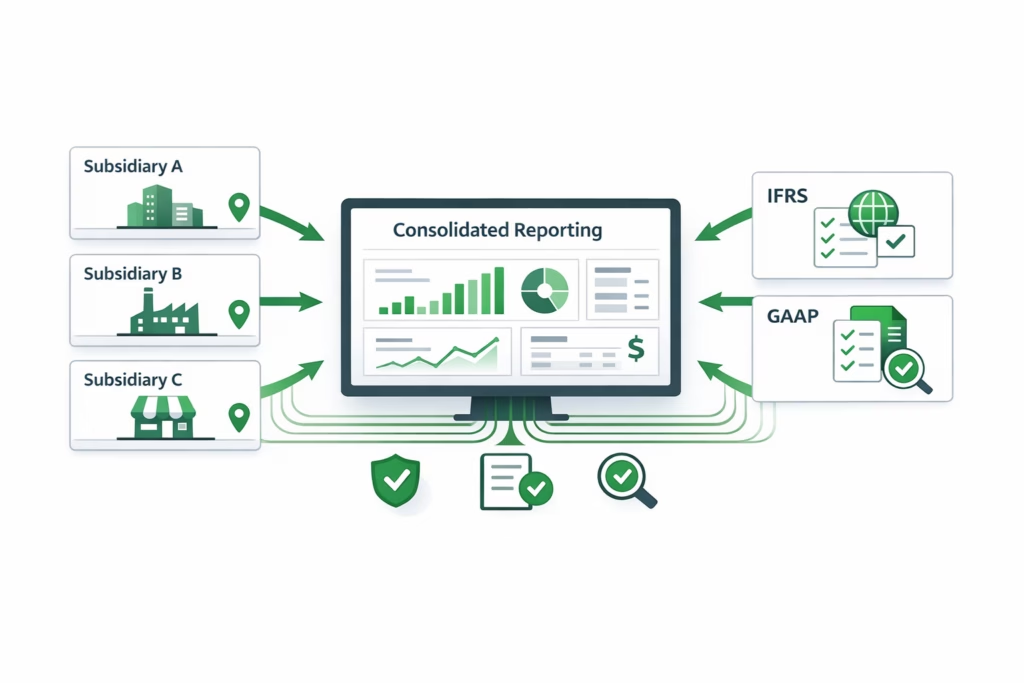
IFRS and US GAAP compliance in a single-entity context is primarily a question of accounting judgment and correct transaction recording — largely handled within the entity’s accounting software. Compliance in a group context is a different challenge. Most of the IFRS standards that create the most compliance pressure for multi-entity groups — IFRS 10 (Consolidation), IFRS 3 (Business Combinations), IFRS 16 (Leases), IAS 21 (Foreign Currency) — generate requirements that arise not in the entity’s general ledger but in the consolidation process that sits above it.
Understanding where software helps with this — and where it doesn’t — shapes how finance teams should think about their compliance infrastructure.
The Compliance Gap Between Entity and Group
An entity whose own books are correctly maintained under local GAAP or IFRS can still produce a consolidated result that is non-compliant with the group’s reporting standard. The compliance gap arises from the steps between:
Stop building consolidations in spreadsheets.
BrizoConsol automates multi-entity consolidation — setup in minutes, reports the same day.
- Policy differences: IFRS 10.B87 requires all entities in a group to apply uniform accounting policies. A subsidiary reporting under local GAAP with an accounting policy that differs from the group standard must be adjusted before its results enter the consolidation. These adjustments live at the consolidation level — not in the subsidiary’s books.
- Intercompany elimination: IFRS 10 and ASC 810 both require elimination of intercompany transactions. Whether the elimination is complete and correctly allocated between the parent and NCI is a consolidation-level compliance question.
- Acquisition accounting: IFRS 3 requires PPA intangibles and fair value adjustments at acquisition that don’t exist in the subsidiary’s own statutory accounts. The PPA amortisation and depreciation are consolidation adjustments that must be applied consistently every period from the acquisition date.
- Foreign currency translation: IAS 21 requires specific rate application (closing rate for balance sheet, average rate for P&L, historical rates for equity). The currency translation adjustment belongs in OCI, not P&L. Compliance with IAS 21 in a group context requires a centralised rate management process — not just rates applied by each entity individually.
Where Software Makes a Specific Compliance Difference
Policy alignment at the consolidation level
Where entities report under local GAAP or under IFRS policies that differ from the group standard, the adjustment needs to be posted in the consolidation — not in the entity’s own books. Software that supports a dedicated consolidation adjustment layer (separate from entity data) makes this workflow structured and repeatable. The same adjustment — for example, reversing a LIFO inventory provision that isn’t permitted under IFRS — is applied every period without requiring a separate entry in each entity’s local system or a manual step in a spreadsheet.
Policy alignment — IFRS consolidation of a US GAAP entity A US subsidiary reports under US GAAP, using LIFO inventory. LIFO inventory is prohibited under IAS 2 (IFRS). The LIFO reserve at period end is $180,000.
Consolidation adjustment: Dr Inventory $180,000 / Cr Retained Earnings $180,000 (net of deferred tax)
This adjustment exists only at the consolidation level. It is applied consistently every period and updated as the LIFO reserve changes. With software, it is stored and applied automatically; without it, it’s a manual step that must be identified and applied correctly at every close.
Consistent rate application for IAS 21 compliance
IAS 21 compliance requires that all entities use the same closing rate for balance sheet items and the same average rate for P&L items in a given period. If different entities apply different rates — because each pulls from its own bank’s feed — the resulting intercompany mismatches and residual differences in the consolidation are not genuine FX movements; they are rate inconsistency noise. Publishing a single group rate table and enforcing its use across all entities is the process that ensures IAS 21 rate compliance at scale. Software applies the published rate centrally; the alternative is manual enforcement by emailing rate tables and checking each entity’s submission.
Parallel reporting — IFRS and US GAAP simultaneously
Some groups must report under two standards: IFRS for statutory consolidation in the home jurisdiction and US GAAP for SEC-filing subsidiaries, US investors, or debt covenants. The most efficient architecture is a single consolidation data set with separate adjustment layers applied for each standard — not two separate consolidation models.
| Adjustment type | IFRS treatment | US GAAP treatment | Where the difference is handled |
|---|---|---|---|
| Goodwill amortisation | No amortisation (impairment only) | Private companies can elect 10-year amortisation (ASU 2014-02) | Consolidation adjustment layer |
| Development costs | Capitalise if IAS 38 criteria met | Generally expensed (ASC 730) | Reversal in GAAP adjustment layer |
| Inventory method | FIFO or weighted average (LIFO prohibited) | LIFO permitted | LIFO reserve adjustment in IFRS layer |
| Revenue recognition | IFRS 15 | ASC 606 (largely converged) | Residual differences in specific industries |
Audit trail as compliance evidence
IFRS and US GAAP compliance is not only about producing compliant numbers — it’s about demonstrating how those numbers were derived. Auditors reviewing a group consolidation will trace elimination entries to source transactions, verify rate tables, confirm policy adjustments are consistent with documented group accounting policies, and check that PPA amortisation has been correctly applied from the acquisition date. Each of these verification steps requires documented evidence. Software that maintains a structured audit trail — where every elimination entry, rate applied, and consolidation adjustment is dated, attributed, and linked to the source data — provides this evidence as a byproduct of the close process, not as a separate documentation exercise.
What Software Doesn’t Do
Software doesn’t make accounting judgments. It applies the rules you have configured and the adjustments you have posted — consistently and at scale. If the accounting judgment is wrong (for example, if a lease has been incorrectly classified as an operating lease, or if a provision that should meet IAS 37 criteria has been omitted), the software will apply consistent treatment to a wrong starting position.
IFRS and GAAP compliance still require professional judgment about recognition, measurement, and disclosure. The role of software is to make the consistent application of those judgments across a multi-entity group technically feasible without proportionally increasing manual work.
BrizoConsol supports multi-standard group reporting — with configurable consolidation adjustment layers for IFRS and US GAAP differences, centralised rate tables, policy adjustment journals, and a full audit trail from source data to consolidated output. Learn more or see it in action →