As companies expand across borders, financial reporting complexity increases rapidly. One of the most common challenges faced by finance teams in multi-entity groups is the need to report under multiple accounting standards — often simultaneously.
Local entities prepare their accounts under local GAAP, while group-level stakeholders may require reporting under IFRS, US GAAP, or UK GAAP. Traditionally, managing this complexity has meant duplicated spreadsheets, parallel adjustments, and manual reconciliations that are difficult to maintain and even harder to audit.
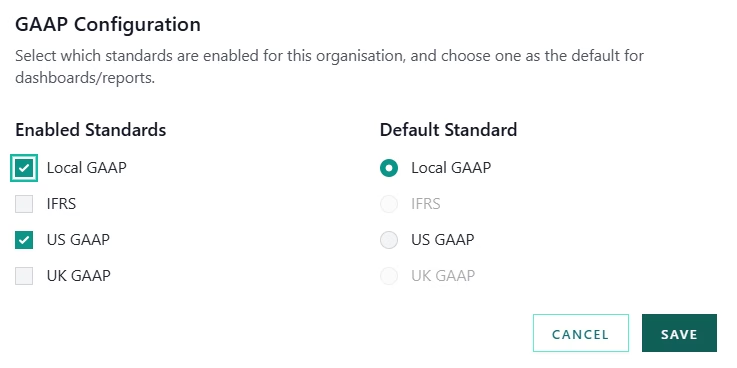
BrizoConsol now allows users to explicitly define which accounting standards are required at the reporting level — bringing clarity, control, and flexibility to multi-standard group reporting.
Stop building consolidations in spreadsheets.
BrizoConsol automates multi-entity consolidation — setup in minutes, reports the same day.
The Challenge of Multi-Standard Reporting
In most organisations, local finance teams prepare statutory financials according to their local accounting standards. This is both necessary and appropriate for compliance purposes. However, group reporting requirements rarely stop there.
Parent companies, investors, lenders, or regulators may require consolidated reporting under IFRS, management reporting under US GAAP, or local statutory reporting under country-specific GAAP — sometimes all three. Without structured support, finance teams are forced to maintain multiple versions of the same numbers, with adjustments tracked outside the system in spreadsheets.
The result is fragmented reporting, increased manual effort, and growing audit risk. The more standards required, the worse the problem compounds.
What Changes Between Standards — and Why It Matters
The adjustments required to move from local GAAP to IFRS or US GAAP are not trivial. Some affect revenue recognition, some affect asset valuation, and some affect how equity is presented. Understanding what changes — and ensuring those changes are applied consistently and only where relevant — is the core challenge of multi-standard reporting.
Common adjustments finance teams manage at the consolidation layer:
| Area | IFRS treatment | US GAAP treatment | Common local GAAP divergence |
|---|---|---|---|
| Inventory method | FIFO or weighted average; LIFO prohibited (IAS 2) | LIFO permitted | Some jurisdictions permit LIFO |
| Development costs | Capitalise if IAS 38 criteria met | Generally expensed (ASC 730) | Often expensed; some jurisdictions defer |
| Goodwill | No amortisation; annual impairment test | Private company election: 10-year amortisation | Some local GAAPs amortise goodwill |
| Lease liabilities | On-balance-sheet for most leases (IFRS 16) | On-balance-sheet (ASC 842) | Older local GAAPs may still treat operating leases as off-balance-sheet |
| Revenue recognition | IFRS 15 — five-step model | ASC 606 — largely converged with IFRS 15 | Varies significantly by jurisdiction |
Each of these differences requires a specific adjustment at the consolidation layer. That adjustment applies only to the relevant reporting standard — it should not flow into the local GAAP view, and it should not be applied to a standard where the treatment is already the same.
Practical example — Singapore group with US private equity investor A Singapore-based group prepares statutory accounts under Singapore FRS (local GAAP). A US private equity investor requires US GAAP reporting for their fund reporting. A Singapore subsidiary uses LIFO for inventory (permitted under local GAAP).
At the consolidation layer:
— Local GAAP view: no adjustment required
— US GAAP view: the LIFO reserve ($180,000) is reversed — LIFO is not permitted under US GAAP; inventory is restated to FIFO basis
— IFRS view: same LIFO reversal applies (IAS 2 prohibits LIFO)
The adjustment is tagged to “US GAAP” and “IFRS” in BrizoConsol — it applies to both standard views but not to the local GAAP statutory view. One entry, correctly scoped, no duplication.
Defining Accounting Standards at the Reporting Level
In BrizoConsol, users can explicitly specify which accounting standards are required for their group reporting. By default, local GAAP is enabled to reflect the original accounting records coming from source systems. Users can then choose to enable additional standards — IFRS, US GAAP, UK GAAP — as parallel reporting views without duplicating source data.
This approach acknowledges a critical reality: accounting entries belong in the general ledger, while standard-specific adjustments belong in the reporting and consolidation layer. BrizoConsol keeps these two layers structurally separate.
Flagging Journals and Elimination Entries by Accounting Standard
Not all journals or eliminations apply to every accounting framework. A development cost capitalisation journal is relevant for IFRS but not for US GAAP. A LIFO reversal is relevant for IFRS and US GAAP but not for a local GAAP view that permits LIFO.
In BrizoConsol, journal entries and elimination entries can be flagged to indicate which accounting standard they apply to — local GAAP only, IFRS, US GAAP, UK GAAP, or any combination. This ensures that adjustments are applied only where relevant, avoiding accidental over-adjustment or misstatement in any given standard view.
It also creates a clear, auditable distinction between local statutory figures and group-level accounting standard adjustments — which is precisely what auditors need when reviewing multi-standard consolidated accounts.
Viewing Reports by Accounting Standard
Once accounting standards are enabled and adjustments are correctly flagged, finance teams can view consolidated reports under different accounting standards using the same underlying dataset. The local GAAP view, the IFRS view, and the US GAAP view all draw from the same entity trial balances — with different adjustment layers applied on top.
This means finance teams can:
- Review consolidated results under local GAAP for statutory filing purposes
- Switch instantly to an IFRS view for group consolidation
- Generate a US GAAP view for investor or lender reporting
- See exactly which adjustments drive the differences between any two views
Instead of maintaining separate report files or parallel spreadsheet models for each standard, BrizoConsol provides a controlled, transparent reporting environment where standard-specific views are generated consistently from a single source.
💡 For auditors: The ability to show which specific journal entries apply to which standard — with a full audit trail — significantly reduces the time auditors spend tracing multi-standard differences. Instead of reconciling between two separate sets of workpapers, auditors can see the bridge between standards directly in the system.
A Reporting-Led Approach to Accounting Standards
This feature does not replace local accounting systems or override statutory accounting. Instead, it provides a structured reporting layer that reflects how modern finance teams actually work — local GAAP as the foundation, with additional accounting standards layered transparently on top. Each layer is clearly defined, clearly applied, and clearly reported.
As reporting requirements become more complex — driven by cross-border expansion, international investors, and multi-jurisdiction debt facilities — the ability to manage multiple standards within a single consolidation environment is no longer optional. It is the difference between a finance team that spends close week reconciling parallel spreadsheets and one that can deliver the right numbers for every audience from the same platform.
See how BrizoConsol handles multi-standard group reporting — IFRS, US GAAP, UK GAAP, and local GAAP in a single consolidation environment. Learn more or see it in action →