
At the heart of accounting lies one simple but powerful idea:
everything a business owns is funded either by borrowing or by the owners themselves.
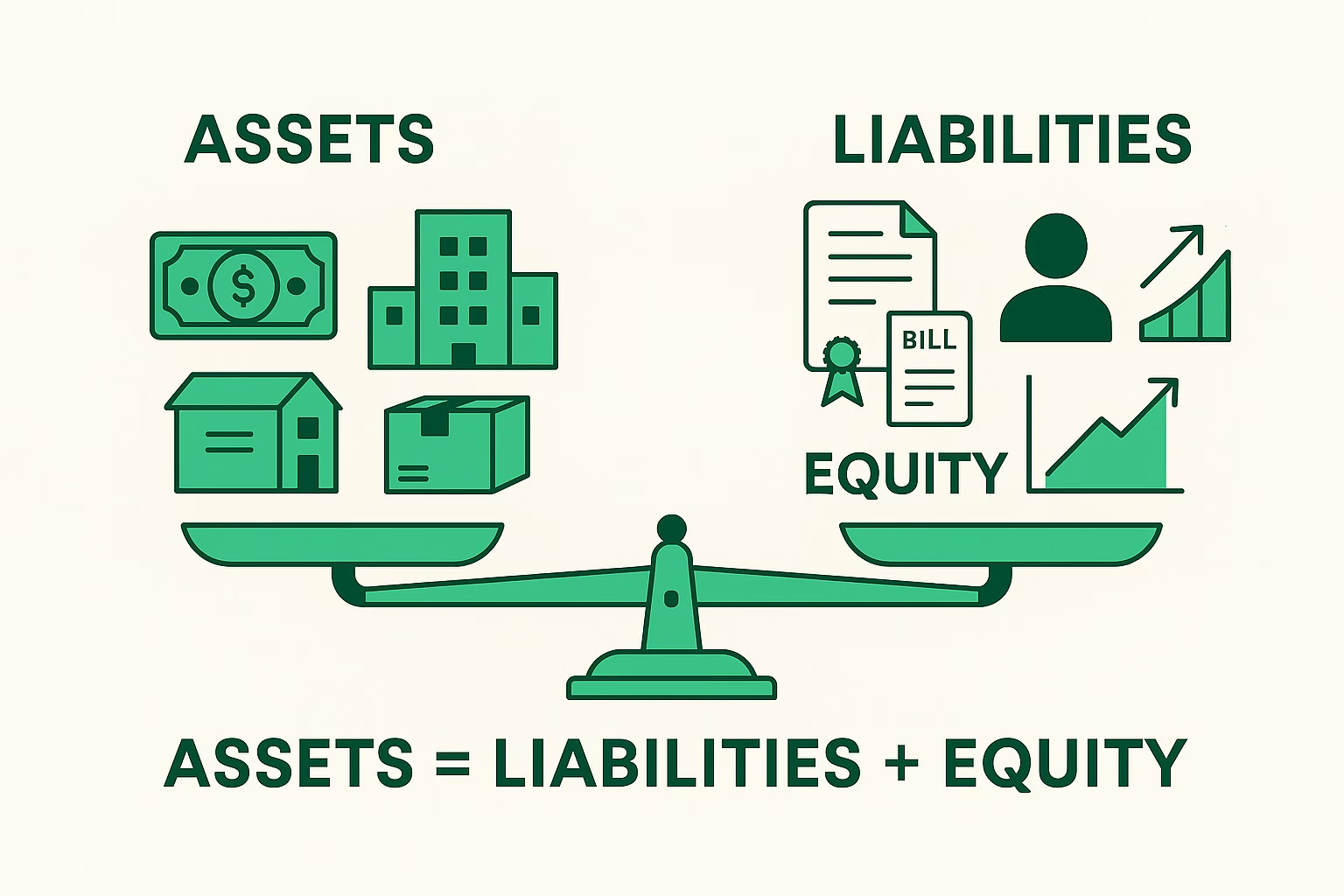
This idea is captured in the Assets–Liabilities–Equity Equation, the foundation of double-entry accounting and the balance sheet.
Assets = Liabilities + Equity
No matter how complex a business becomes, this equation must always remain in balance.
🔍 What Does the Equation Mean?
Assets
Assets are resources the business controls and expects to generate future economic benefits from.
Examples include:
- Cash and bank balances
- Accounts receivable
- Inventory
- Property, plant, and equipment
- Intangible assets like software or patents
Assets show what the company owns or controls.
Liabilities
Liabilities are obligations the company owes to others — amounts that must be settled in the future.
Examples include:
- Loans and borrowings
- Accounts payable
- Accrued expenses
- Deferred revenue
- Asset retirement obligations
Liabilities represent claims by external parties on the company’s assets.
Equity
Equity represents the owners’ residual interest in the business after all liabilities are settled.
It includes:
- Share capital
- Retained earnings
- Reserves
- Accumulated profits or losses
Equity shows what belongs to the owners.
⚖️ Why the Equation Always Balances
Every business transaction affects at least two accounts.
Example:
- If a company buys equipment using cash:
- One asset (equipment) increases
- Another asset (cash) decreases
Example:
- If a company takes a bank loan:
- Assets (cash) increase
- Liabilities (loan) increase
Because each transaction has a dual effect, the equation always stays in balance.
📊 Real-World Example
Suppose a business has:
- Assets of $1,000,000
- Liabilities of $400,000
Using the equation:
Equity = Assets − Liabilities
Equity = $1,000,000 − $400,000 = $600,000
This means the owners’ claim on the business is $600,000.
🧮 Expanded View
Equity itself can be expanded further:
Equity = Capital + Retained Earnings
And retained earnings can be broken down into:
Retained Earnings = Opening Balance + Profit − Dividends
This shows how daily business operations flow back into the core accounting equation.
📈 Why This Equation Matters
1. Foundation of Financial Statements
The balance sheet is built directly from this equation.
2. Financial Health Indicator
A business with high liabilities relative to assets may be over-leveraged.
3. Decision-Making Tool
Managers, investors, and lenders rely on this equation to assess risk and value.
4. Error Detection
If the equation doesn’t balance, there’s an accounting error.
🧠 Simple Analogy
Think of a house:
- The house is the asset
- The mortgage is the liability
- The homeowner’s stake is the equity
No matter how you look at it, the value of the house equals the mortgage plus the owner’s share.
🪙 Key Takeaway
The Assets–Liabilities–Equity Equation is the backbone of accounting.
It explains where a company’s resources come from and who has a claim on them.
Once this equation is understood, all other accounting concepts — from journal entries to financial analysis — start to make sense.