For groups with multiple subsidiaries, a consolidated cash flow statement (CFS) is one of the most complex documents in the reporting pack — and one of the most consequential. Get it wrong and liquidity looks better than it is, audit queries multiply, and management decisions get made on flawed data.
The most common mistake is treating consolidation as a simple addition: sum up the entity-level cash flows and call it done. This approach misses intercompany eliminations, ignores FX mismatches, and creates inconsistencies between the CFS and the underlying balance sheet and P&L.
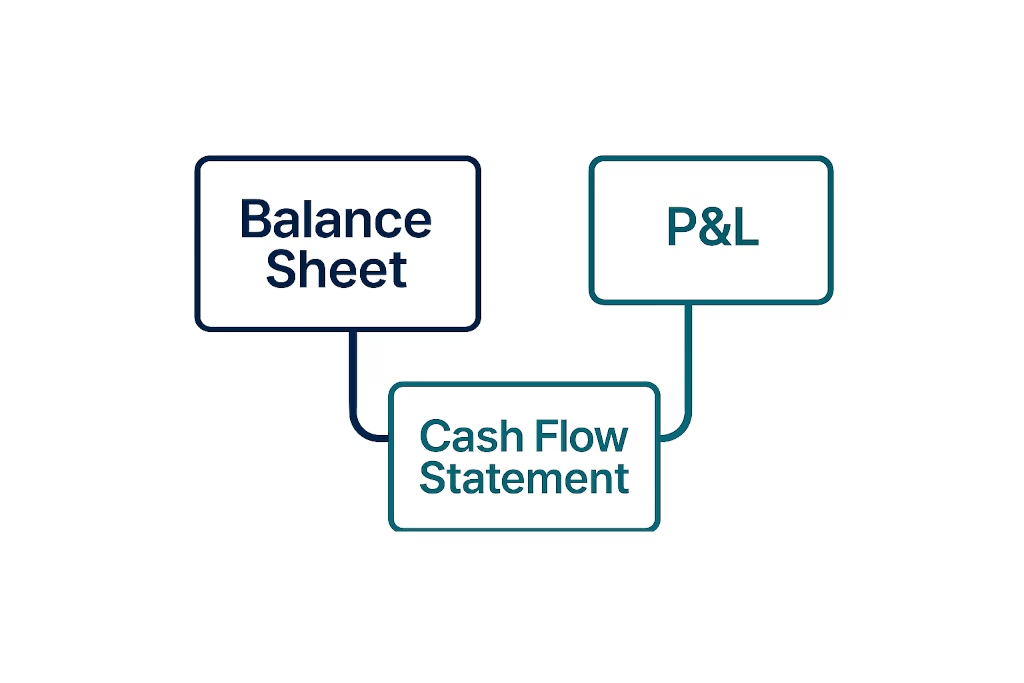
The right approach — used by group controllers at well-run multinationals — is to derive the consolidated CFS from the consolidated balance sheet (BS) and profit & loss (P&L) after all eliminations are complete.
Automate NCI calculations across all your entities.
BrizoConsol handles non-controlling interest automatically — no manual adjustments required.
This guide walks through every step, the technical traps to avoid, and how finance teams can build a CFS that is accurate, auditable, and defensible.
Why the Consolidated Cash Flow Statement Is Different
A standalone entity cash flow statement is relatively straightforward. A consolidated cash flow statement is not — because the group is not simply the sum of its parts.
When subsidiaries transact with each other, those transactions appear in both entities’ records: as income and expense, as asset and liability, as cash in and cash out. None of those intra-group flows represent real economic activity with the outside world. They must all be removed before the group CFS reflects true external cash generation.
Under IAS 7 (Statement of Cash Flows) groups must present a single consolidated statement showing only cash flows between the group and external parties. Achieving this requires a disciplined, step-by-step process — not a spreadsheet sum.
Step 1: Gather Subsidiary Financials
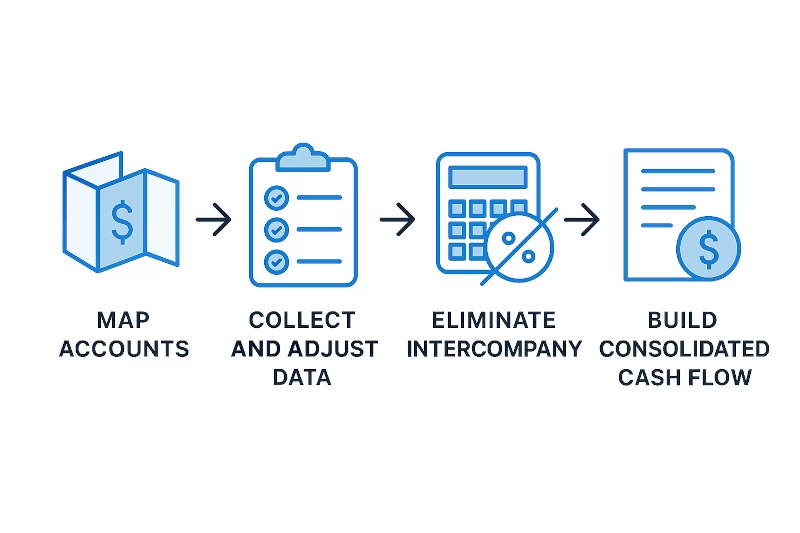
Begin by collecting the balance sheet, P&L, and trial balance from each entity. The critical discipline: do not treat entity-level cash flow statements as your starting point.
Instead, ensure that the BS and P&L from each entity are aligned and standardised before consolidation begins. Common misalignments include:
- Different chart of accounts structures across entities
- Inconsistent classification of items (e.g. interest received shown as operating vs. investing)
- Different fiscal year-end dates requiring adjustment periods
- Missing intercompany transaction flags
By standardising BS and P&L data first, you establish a single, consistent foundation. The CFS is then derived from that foundation — not assembled from incompatible pieces.
Step 2: Map Accounts and Counterparties
Create a mapping table that aligns every subsidiary account to the group’s chart of accounts, and flags any account with an intercompany counterparty. This is the foundation of your elimination workings.
| Subsidiary Account | Group Account | Intercompany Counterparty |
|---|---|---|
| A: Intercompany Loan to Sub B | Loans Receivable | Subsidiary B |
| B: Intercompany Loan from Sub A | Loans Payable | Subsidiary A |
| C: Management Fee Receivable | Other Receivables | Parent Entity |
| C: Dividend Payable to Parent | Dividends Payable | Parent Entity |
| A: Sales to Sub B | Intercompany Revenue | Subsidiary B |
A complete, verified intercompany map makes Step 4 eliminations systematic rather than ad hoc. Every mismatched pair identified here is a potential overstatement in the consolidated CFS if left unadjusted.
Step 3: Convert to Reporting Currency
For multinational groups, all subsidiary financials must be translated into the parent’s reporting currency before consolidation. Under IAS 21 the translation rules are:
- P&L items — translated at the average exchange rate for the period
- Balance sheet items — translated at the closing exchange rate at period end
- Equity movements — translated at historical rates (rate at date of original transaction)
- FX translation differences — recognised in Other Comprehensive Income (OCI), not in P&L
These differences matter for the CFS. If a subsidiary’s opening and closing cash balances are translated at different rates, an FX translation effect will arise that must be shown separately in the CFS as “effect of exchange rate changes on cash and cash equivalents” — not buried in operating or investing activities.t.
Step 4: Eliminate Intercompany Transactions
This is where most errors occur. Every transaction between group entities — loans, management fees, dividends, intercompany sales, internal royalties — must be eliminated in full. None of these flows represent cash movement with an external party.
Example 1 — Intercompany Management Fee
Subsidiary A pays $1,000,000 to Subsidiary B for management services. At entity level: A records an operating cash outflow; B records an operating cash inflow. At group level: both must be removed entirely.
| Account | Dr ($) | Cr ($) |
|---|---|---|
| Management Fee Revenue (Sub B) | 1,000,000 | |
| Management Fee Expense (Sub A) | 1,000,000 |
Effect on consolidated CFS: both the $1M outflow and the $1M inflow are eliminated. Net group CFS impact: $0. Without this elimination, operating cash flows are overstated by $1,000,000 in both directions.
Example 2 — Intercompany Dividend
The Parent receives a $500,000 dividend from Subsidiary A.
| Account | Dr ($) | Cr ($) |
|---|---|---|
| Dividend Income (Parent) | 500,000 | |
| Dividend Paid (Sub A) | 500,000 |
Without elimination, the group CFS would show $500,000 of investing inflows (Parent) and $500,000 of financing outflows (Sub A) — both fictitious at group level. For a full treatment, see: Understanding Intercompany Dividend Elimination in Financial Consolidation.
Step 5: Build the Consolidated Balance Sheet and P&L
Once all intercompany eliminations are complete, prepare the consolidated BS and P&L. These are the primary financial statements — the backbone of group reporting — and they must be fully reconciled and signed off before you proceed to the CFS.
Key checks at this stage:
- All intercompany balances net to zero
- Goodwill and non-controlling interest are correctly calculated and presented
- FX translation reserves are correctly reflected in equity
- Retained earnings tie to opening balance plus consolidated net income minus dividends paid to external shareholders
The consolidated BS and P&L are not merely inputs to the CFS — they are its source of truth. Any error at this stage flows directly into the cash flow statement.
Step 6: Why Consolidated Cash Flow Should Be Derived from BS and P&L
This is the step most finance teams get wrong. Rather than consolidating entity-level cash flow statements, calculate the group CFS by analysing movements in the consolidated BS and P&L.
| Risk of Aggregating Entity CFS | Why It Fails |
|---|---|
| Inconsistent classification | Subsidiaries may use direct vs. indirect methods; classifications differ across entities |
| Missed eliminations | Intercompany flows eliminated from BS/P&L may be missed in entity-level CFS |
| FX distortion | Translation differences obscure true cash movements if not standardised |
| Audit trail breakdown | Auditors validate CFS against BS/P&L — aggregated entity CFS cannot tie back cleanly |
Worked Example — Indirect Method Reconciliation
| Item | $000s |
|---|---|
| Consolidated Net Income (from P&L) | 50,000 |
| Add: Depreciation & Amortisation | 3,200 |
| Add: Impairment charges | 800 |
| Less: Increase in Trade Receivables (from BS) | (5,000) |
| Less: Decrease in Trade Payables (from BS) | (1,500) |
| Add: Increase in Accrued Liabilities | 2,200 |
| Less: Unrealised FX Gain | (700) |
| Net Cash from Operating Activities | 49,000 |
Every line traces directly to a consolidated BS or P&L movement. No entity-level CFS is involved. The result is a statement any auditor can follow from source data to final number.
Step 7: Aggregate and Format the Consolidated CFS
With all movements calculated, classify them into the three sections required under IAS 7:
Operating Activities — Net income adjusted for non-cash items (depreciation, impairments, amortisation) and working capital movements (receivables, payables, inventory). This section shows cash generated by the group’s core business operations.
Investing Activities — Capital expenditure, acquisitions and disposals of subsidiaries, loans made to or repaid by third parties, and interest received (where classified as investing under group policy). This section shows how the group is deploying capital.
Financing Activities — Debt raised and repaid, dividends paid to external shareholders (and to non-controlling interests, disclosed separately), equity issuances and buy-backs. This section shows how the group is funded.
Final check: The movement between opening and closing cash and cash equivalents must equal the sum of the three sections, plus the effect of exchange rate changes on cash. If it does not tie, there is an error — most commonly a missed elimination or an FX translation issue.
Common Challenges in Preparing a Consolidated Cash Flow Statement
1. Inconsistent Reporting Methods
Some subsidiaries use the direct method (listing actual cash receipts and payments); others use the indirect method (adjusting net income for non-cash items). Aggregating these produces an inconsistent group report. The fix: by deriving the group CFS from consolidated BS and P&L, the entity-level method becomes irrelevant — the group always applies a consistent indirect calculation.
2. Different Accounting Policy Elections
One entity classifies interest received as operating; another classifies it as investing. Dividends paid appear under financing in one entity and operating in another. Without a mandated group accounting policy, the consolidated CFS misclassifies cash flows. Group finance must define and enforce classification rules before entities submit.
3. Currency Translation Mismatches
Applying the wrong exchange rate creates irreconcilable differences in the CFS. Common mistakes: using closing rates for P&L items (should be average), or failing to separate the FX translation effect on cash from underlying cash movements. IAS 21 is unambiguous — misapplication is a factual error, not a judgement call.
4. Intercompany Timing Differences
Subsidiary A records a payment to Subsidiary B in March. Subsidiary B records the receipt in April. At consolidation, the balances don’t match and elimination leaves a residual — overstating or understating consolidated cash. The fix is a mandatory pre-consolidation intercompany reconciliation: every intercompany pair must agree before elimination runs.
5. Manual, Spreadsheet-Driven Processes
Excel is the default tool for most consolidations. As the group grows, spreadsheet complexity compounds. A single formula error cascades through the entire CFS with no obvious signal. Consolidation-specific tools eliminate this risk by enforcing structure and providing automated validation at each stage.
6. Audit Reconciliation Pressure
Auditors validate the CFS against BS and P&L movements. If the CFS does not tie — and it often does not when built from aggregated entity statements — the finance team spends days preparing bridge analyses and explanations. Teams that derive the CFS from consolidated BS and P&L arrive at audit with a statement already reconciled to source.
Best Practices for Reliable Consolidated Cash Flow Statements
1. Always Derive CFS from Consolidated BS and P&L
Make this a non-negotiable process rule. The consolidated BS and P&L are signed off first; the CFS follows from them. This single discipline eliminates most reconciliation problems before they start.
2. Standardise Accounting Policies Group-Wide
Define a group accounting policy manual specifying exactly how every class of cash flow is classified. Distribute it to all subsidiary finance teams and enforce it during the review of entity submissions. For context on why consistent policy matters across entities, see: Why Do We Eliminate Intercompany Transactions?
3. Complete Intercompany Reconciliation Before Elimination
Require all intercompany pairs to confirm and agree their balances before the consolidation period closes. Unresolved differences at elimination create errors that are significantly harder to trace after the fact. See: The Complete Guide to Intercompany Eliminations in Consolidation.
4. Automate Intercompany Elimination Rules
Elimination entries should not depend on someone remembering to post them. Set up systematic rules — in your ERP or consolidation tool — that automatically offset matched intercompany pairs every period. For the full set of balance sheet elimination entries, see: Common Elimination Entries for the Balance Sheet.
5. Maintain a Unified Chart of Accounts
All entities should map to a single group chart of accounts. Local statutory variations are acceptable, but a clear mapping from every local account to the group equivalent must exist. Without this, account-level movements cannot be analysed or compared across the group.
6. Apply FX Translation Rules Consistently
Average rates for P&L. Closing rates for BS. Historical rates for equity transactions — every period, without exception. Present the effect of exchange rate changes on cash as a separate line in the CFS, not netted against operating, investing, or financing activities. Audit this line against the FX translation reserve movement in OCI.
7. Build Validation Into the Close Cycle
Do not wait until the CFS is finalised to check for errors. Validate as you go: confirm entity cash balances against bank statements before consolidation; verify intercompany balances match across entities before elimination runs; check FX translation impact after conversion. Catching errors in Steps 3 and 4 takes minutes; catching them in Step 7 takes days.
8. Document Every Assumption
Record the exchange rates applied, the elimination journals posted, the mapping rules used, and any judgement calls made. This documentation is your audit trail. It also protects your team when the same question comes back twelve months later.
How BrizoSystem Automates Consolidated Cash Flow Reporting
For most finance teams, the biggest barrier to a clean consolidated CFS is process: too many spreadsheets, too many manual steps, and no single source of truth.
BrizoSystem is built specifically for multi-entity consolidation and addresses every challenge described in this guide:
| Challenge | How BrizoSystem Handles It |
|---|---|
| Inconsistent entity submissions | Standardised submission templates enforce uniform classification at source |
| Intercompany mismatches | Automated intercompany matching flags timing differences before consolidation |
| FX translation | Applies group-defined rates (average/closing/historical) across all entities automatically |
| CFS derivation | Derives the group CFS directly from consolidated BS & P&L movements |
| Audit trail | Every elimination, rate applied, and adjustment is logged and traceable |
| Manual Excel processes | Replaces spreadsheets with a controlled, versioned consolidation environment |
Finance teams using BrizoSystem typically cut their consolidation close cycle by 30–50% — and go into audit with a fully traceable, reconciled CFS rather than a collection of spreadsheets.
See how BrizoSystem handles consolidated cash flow reporting →
Conclusion
A consolidated cash flow statement built by summing entity-level reports is a liability — it’s inconsistent, difficult to audit, and prone to errors that compound at every close cycle.
The disciplined approach is straightforward: standardise policies across entities, complete intercompany eliminations at the BS and P&L level, and derive the CFS from those consolidated primary statements. Done correctly, the CFS becomes a reliable tool for liquidity planning, covenant management, and board-level decision-making — not just a compliance box to tick.
The teams that close fastest and audit cleanest are those that have systematised this process, replaced manual spreadsheet chains with structured consolidation tools, and built validation steps into the close cycle itself — not bolted them on at the end.
Ready to see what a structured consolidation process looks like in practice?