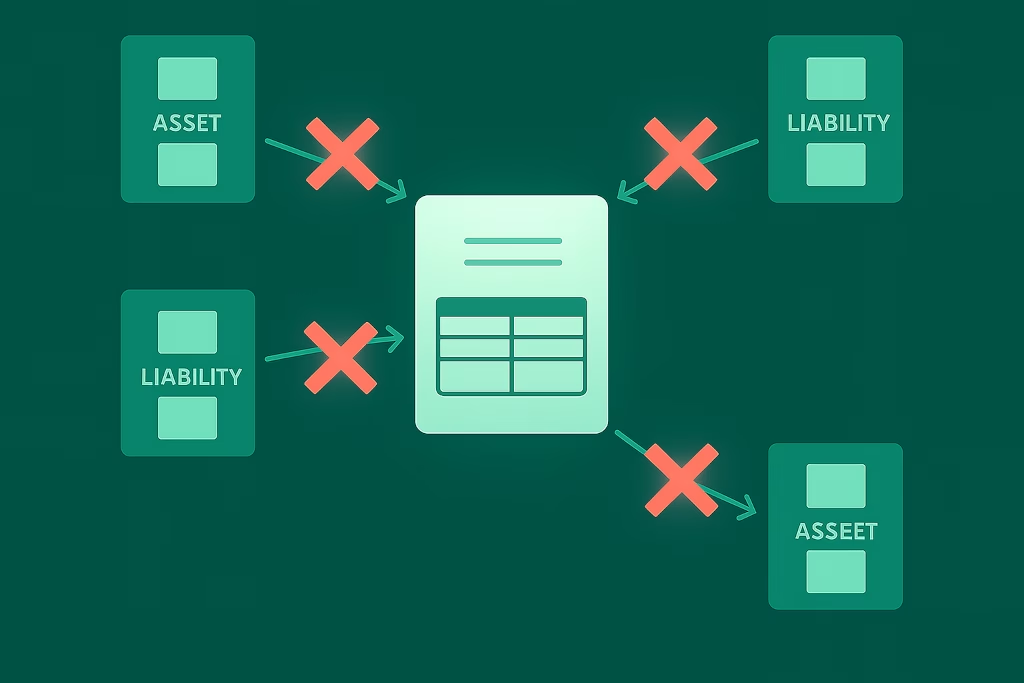
When preparing consolidated financial statements, one of the most critical — and most error-prone — parts of the process is eliminating intercompany balances from the group balance sheet. Without these eliminations, the consolidated balance sheet will overstate assets, liabilities, and equity by including amounts that exist only because two entities within the same group have transacted with each other.
This guide covers the 10 most common balance sheet elimination entries, each with a description, worked example, and journal entry. It focuses specifically on balance sheet eliminations — if you’re also looking for income statement eliminations such as intercompany sales, management fees, and interest, those are covered separately in our step-by-step elimination guide.
1. Intercompany Loans and Advances Elimination
When one group entity lends funds to another, both sides record the balance — a loan receivable for the lender and a loan payable for the borrower. At consolidation, these offset each other and must be eliminated to prevent the group’s total assets and liabilities from being overstated.
Automate NCI calculations across all your entities.
BrizoConsol handles non-controlling interest automatically — no manual adjustments required.
Example: Company A lends $100,000 to Company B.
| Account | Debit | Credit |
|---|---|---|
| Intercompany Loan Payable (Company B) | $100,000 | |
| Intercompany Loan Receivable (Company A) | $100,000 |
Any interest accrued on the loan also needs to be eliminated from the income statement — interest income for Company A and interest expense for Company B cancel out at group level.
2. Intercompany Trade Balances (Accounts Receivable/Payable) Elimination
Ongoing trading between group entities generates receivable and payable balances that have no economic substance from the group’s perspective. These must be eliminated so the consolidated balance sheet reflects only amounts owed to or from external third parties.
Example: Company A sells goods to Company B for $50,000, still unpaid at period end.
| Account | Debit | Credit |
|---|---|---|
| Accounts Payable — Intercompany (Company B) | $50,000 | |
| Accounts Receivable — Intercompany (Company A) | $50,000 |
Timing mismatches — where one entity has recorded the transaction and the other hasn’t — are common here and must be resolved before the elimination can be posted cleanly.
3. Unrealized Profit in Inventory (Inventory and Retained Earnings Adjustment)
When one group entity sells inventory to another at a profit, and that inventory hasn’t yet been sold to an external customer by period end, the profit is unrealised. It must be eliminated because the group cannot recognise income until it has been earned from outside the group.
Example: Company A sells inventory to Company B for $30,000. Company A’s cost was $25,000, giving an intercompany profit of $5,000. All inventory remains unsold at period end.
Current period elimination (profit arose this period):
| Account | Debit | Credit |
|---|---|---|
| Cost of Sales | $5,000 | |
| Inventory (Company B) | $5,000 |
Prior period elimination (profit arose in a previous period and inventory is still held):
| Account | Debit | Credit |
|---|---|---|
| Retained Earnings (opening) | $5,000 | |
| Inventory (Company B) | $5,000 |
Note: The current period entry debits Cost of Sales, not Retained Earnings. The Retained Earnings approach is only used when the unrealised profit originated in a prior reporting period and carried forward. Applying the wrong entry is a common mistake that misstates both the income statement and opening equity.
BrizoConsol tracks intercompany inventory movements and applies the correct elimination entry based on the period in which the profit originated — removing the need to manually determine which approach applies each close cycle.
4. Unrealized Profit in Fixed Asset Transfers (Asset and Equity Adjustment)
If one entity sells a fixed asset to another group entity at a gain, that gain is unrealised at group level. The receiving entity will also depreciate the asset at the inflated transfer price — so both the gain and the excess depreciation must be adjusted.
Example: Company A sells a machine to Company B for $60,000. Company A’s book value was $50,000, giving an unrealised gain of $10,000. Company B depreciates the machine over 5 years.
Elimination of the unrealised gain:
| Account | Debit | Credit |
|---|---|---|
| Retained Earnings | $10,000 | |
| Fixed Assets (Company B) | $10,000 |
Adjustment for excess depreciation charged (Year 1: $10,000 ÷ 5 = $2,000):
| Account | Debit | Credit |
|---|---|---|
| Accumulated Depreciation (Company B) | $2,000 | |
| Retained Earnings | $2,000 |
Both entries are required each year until the asset is fully depreciated or sold externally.
5. Intercompany Dividend Payable and Receivable Elimination
When a subsidiary declares a dividend to its parent that remains unpaid at period end, both a payable and a receivable exist on the respective balance sheets. These must be eliminated to avoid overstating both assets and liabilities.
Example: Company A declares a $20,000 dividend to Company B, unpaid at reporting date.
| Account | Debit | Credit |
|---|---|---|
| Dividend Payable (Company A) | $20,000 | |
| Dividend Receivable (Company B) | $20,000 |
The corresponding Dividend Income in Company B’s income statement must also be eliminated separately. For a full walkthrough of dividend elimination — including partial ownership and timing differences — see our intercompany dividend elimination guide.
6. Intercompany Investments vs. Equity Elimination
When a parent acquires a subsidiary, the parent records the cost of investment on its balance sheet. At consolidation, this investment is eliminated against the subsidiary’s equity. Where the acquisition cost exceeds the book value of net assets acquired, the difference is recognised as goodwill.
Scenario A — Investment equals book value (no goodwill):
Company A owns 100% of Company B. Investment cost = $200,000. Company B’s share capital and retained earnings = $200,000.
| Account | Debit | Credit |
|---|---|---|
| Share Capital (Company B) | $150,000 | |
| Retained Earnings (Company B) | $50,000 | |
| Investment in Subsidiary (Company A) | $200,000 |
Scenario B — Investment exceeds book value (goodwill arises):
Company A pays $250,000 for 100% of Company B, whose net assets are $200,000. Goodwill = $50,000.
| Account | Debit | Credit |
|---|---|---|
| Share Capital (Company B) | $150,000 | |
| Retained Earnings (Company B) | $50,000 | |
| Goodwill | $50,000 | |
| Investment in Subsidiary (Company A) | $250,000 |
Scenario C — Partial ownership (80%), NCI recognised:
Company A pays $160,000 for 80% of Company B (net assets $200,000). NCI at acquisition = 20% × $200,000 = $40,000.
| Account | Debit | Credit |
|---|---|---|
| Share Capital (Company B) | $150,000 | |
| Retained Earnings (Company B) | $50,000 | |
| Investment in Subsidiary (Company A) | $160,000 | |
| Non-Controlling Interest | $40,000 |
The goodwill and NCI calculations must be revisited at each reporting date for impairment and post-acquisition profit movements. In practice, this is one of the most complex balance sheet eliminations to manage manually across a large group.
7. Intercompany Accrued Expenses and Liabilities Elimination
When one group entity accrues an expense for services provided by another group entity, both an accrued expense and accrued income exist internally. These must be eliminated as they represent the same internal obligation viewed from two sides.
Example: Company A accrues $15,000 for IT services provided by Company B, not yet invoiced.
| Account | Debit | Credit |
|---|---|---|
| Accrued Expense (Company A) | $15,000 | |
| Accrued Income (Company B) | $15,000 |
8. Intercompany Deposits (Prepaid/Deferred Income) Elimination
Deposits or advance payments between group entities create prepaid assets for the payer and deferred income for the recipient. At group level these are internal and must be eliminated.
Example: Company A pays a $10,000 deposit to Company B for future services.
| Account | Debit | Credit |
|---|---|---|
| Deferred Income (Company B) | $10,000 | |
| Prepaid Expenses (Company A) | $10,000 |
9. Currency Translation Adjustment for Intercompany Balances
When group entities operate in different functional currencies, the same intercompany balance will be recorded at different amounts on each side due to exchange rate movements. These differences don’t represent a real economic gain or loss — they’re a consolidation artefact that must be captured in the Currency Translation Reserve (part of Other Comprehensive Income), not left as unexplained variances.
Example: Company A (USD reporting) has a $50,000 intercompany loan receivable from Company B (EUR functional). By reporting date, exchange rate movements have created a $1,000 difference between the two sides.
| Account | Debit | Credit |
|---|---|---|
| Currency Translation Reserve (OCI) | $1,000 | |
| Intercompany Loan Receivable (Company A) | $1,000 |
The direction of the entry depends on whether the rate has moved favourably or unfavourably. Groups with multiple currency pairs across many entities should treat CTA differences as a standing reconciliation item at each close — not a one-off adjustment.
BrizoConsol handles currency conversion and CTA calculations within the consolidation workflow, so FX differences are captured and allocated automatically rather than being chased manually at month end.
10. Offsetting Intercompany Guarantees or Contingent Liabilities
Where one group entity has provided a guarantee for another’s external obligations, both sides may have disclosure notes — a contingent liability for the guarantor and a contingent asset for the beneficiary. At consolidation, these internal exposures are eliminated from the group’s disclosures because from the outside, the group as a whole is simply the borrower.
Important: In most cases, intercompany guarantees are eliminated from notes and disclosures only — not through a journal entry. A journal entry is only required if the guarantee has been formally recognised as a financial liability on the guarantor’s balance sheet (e.g. under IFRS 9 or IAS 37). If it’s treated as a contingent liability that hasn’t been recognised, no elimination entry is posted — just the disclosure is removed from the consolidated notes.
If the guarantee has been formally recognised as a liability:
| Account | Debit | Credit |
|---|---|---|
| Guarantee Liability (Company A) | $100,000 | |
| Guarantee Asset / Receivable (Company B) | $100,000 |
If it has not been recognised — which is the more common treatment — remove the reference from the consolidated notes disclosures only, with no journal entry required.
Getting Balance Sheet Eliminations Right
Balance sheet eliminations are not optional adjustments — they are the foundation of a consolidated statement that accurately reflects the group’s real assets, liabilities, and equity. Each of the 10 entries above removes an internal balance that would otherwise make the group appear larger, more leveraged, or more profitable than it actually is.
In practice, the complexity compounds quickly. Partial ownership, prior-period unrealised profits, multi-currency positions, and acquisition accounting all require careful treatment that goes well beyond a simple debit and credit. For finance teams managing this manually across multiple entities, the risk of error — and the time cost of fixing it — grows with every subsidiary added to the group.
BrizoConsol automates intercompany matching, applies elimination entries consistently across every reporting period, and gives finance teams full audit-trail visibility into every adjustment — so balance sheet eliminations are faster, cleaner, and ready for review on day one of the close.
👉 See how BrizoConsol handles balance sheet eliminations → or See It in Action and walk through your own group structure with our team.