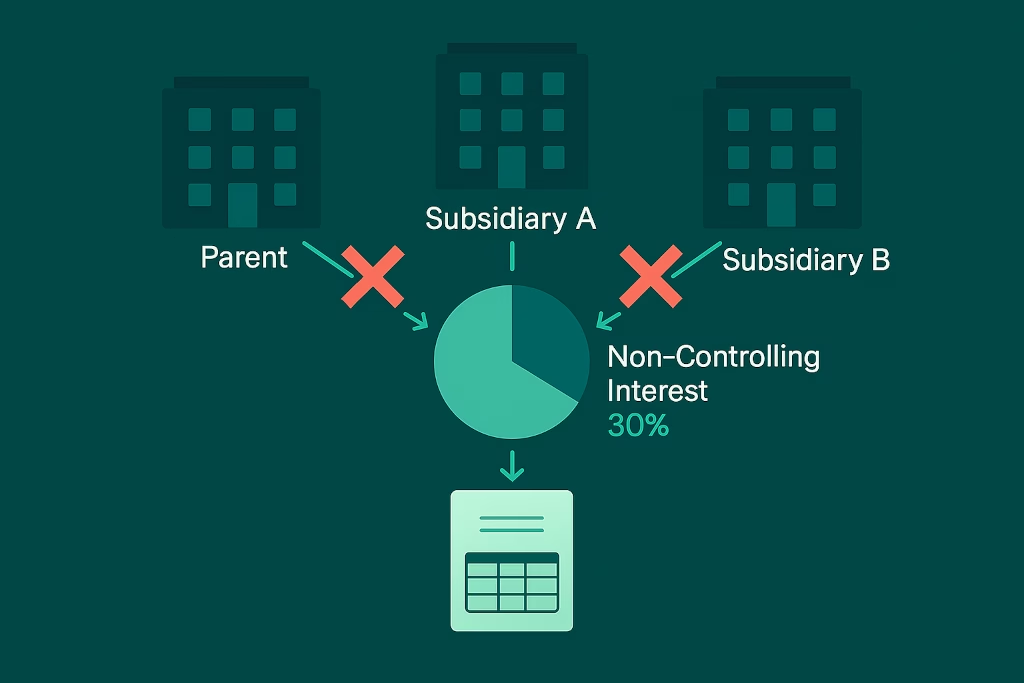
When a group grows beyond two entities, financial consolidation becomes significantly more complex. Each additional company brings more intercompany flows — and every one of them needs to be identified, matched, and eliminated before the consolidated financial statements can present an accurate picture of the group.
This guide walks through the four most common elimination entry types in a three-entity group, with worked journal entries for each. It also covers unrealised profit — one of the most frequently missed adjustments in multi-company consolidations.
For the foundational explanation of why intercompany eliminations are required, see our complete guide to intercompany eliminations.
Automate NCI calculations across all your entities.
BrizoConsol handles non-controlling interest automatically — no manual adjustments required.
The Group Structure Used in This Guide
Throughout this post we’ll use the following group:
- Parent Co — owns 100% of Subsidiary A and 100% of Subsidiary B
- Subsidiary A — manufacturing entity, sells goods internally and externally
- Subsidiary B — distribution entity, purchases goods from Subsidiary A and sells externally
All entities report in USD. At period end the following intercompany activities have occurred:
| Transaction | Entities Involved | Amount |
|---|---|---|
| Goods sold internally | Subsidiary A → Subsidiary B | $50,000 |
| Intercompany loan | Parent Co → Subsidiary A | $200,000 |
| Dividend declared | Subsidiary B → Parent Co | $30,000 |
| Outstanding payable/receivable | Subsidiary A ↔ Subsidiary B | $15,000 |
Each requires its own elimination entry at consolidation.
1. Intercompany Sales and Purchases — Including Unrealised Profit
Subsidiary A sells goods to Subsidiary B for $50,000. Subsidiary A’s cost was $30,000, giving an intercompany margin of $20,000. At period end, Subsidiary B still holds all of this inventory unsold externally.
Entity-level entries:
Subsidiary A’s books:
| Account | Debit | Credit |
|---|---|---|
| Accounts Receivable (Subsidiary B) | $50,000 | |
| Sales Revenue | $50,000 | |
| Cost of Goods Sold | $30,000 | |
| Inventory | $30,000 |
Subsidiary B’s books:
| Account | Debit | Credit |
|---|---|---|
| Inventory | $50,000 | |
| Accounts Payable (Subsidiary A) | $50,000 |
Consolidation elimination — Step 1: Remove the intercompany sale:
| Account | Debit | Credit |
|---|---|---|
| Sales Revenue | $50,000 | |
| Cost of Goods Sold | $50,000 |
Consolidation elimination — Step 2: Remove the unrealised profit in inventory:
The $20,000 margin earned by Subsidiary A is unrealised at group level — the goods haven’t been sold to an external customer yet. Leaving it in would overstate both group profit and inventory value.
| Account | Debit | Credit |
|---|---|---|
| Cost of Sales | $20,000 | |
| Inventory (Subsidiary B) | $20,000 |
Both steps are required. Step 1 alone removes the revenue and cost of the sale — but leaves the $20,000 profit sitting inside Subsidiary B’s inflated inventory balance. Step 2 corrects this. Once Subsidiary B sells the goods externally, the unrealised profit reverses and is recognised at group level.
2. Intercompany Loans and Interest
Parent Co has lent $200,000 to Subsidiary A at an annual interest rate of 6% ($12,000/year). Both the loan balance and the interest must be eliminated.
Entity-level positions at period end:
- Parent Co: Loan Receivable $200,000 + Accrued Interest Receivable $12,000
- Subsidiary A: Loan Payable $200,000 + Accrued Interest Payable $12,000
Consolidation elimination — loan principal:
| Account | Debit | Credit |
|---|---|---|
| Intercompany Loan Payable (Subsidiary A) | $200,000 | |
| Intercompany Loan Receivable (Parent Co) | $200,000 |
Consolidation elimination — interest:
| Account | Debit | Credit |
|---|---|---|
| Interest Income (Parent Co) | $12,000 | |
| Interest Expense (Subsidiary A) | $12,000 |
Consolidation elimination — accrued interest balances:
| Account | Debit | Credit |
|---|---|---|
| Accrued Interest Payable (Subsidiary A) | $12,000 | |
| Accrued Interest Receivable (Parent Co) | $12,000 |
After elimination, the consolidated balance sheet shows no internal loan, and the consolidated P&L shows no interest earned or charged internally. Only the group’s external financing costs remain.
For a deeper dive into intercompany loan eliminations — including FX treatment and quasi-equity classification — see our intercompany loans and interest guide.
3. Intercompany Dividends
Subsidiary B has declared a $30,000 dividend to Parent Co. The dividend has been declared but not yet paid at period end.
Entity-level positions:
- Subsidiary B: Dividend Payable $30,000 (deducted from retained earnings)
- Parent Co: Dividend Receivable $30,000 + Dividend Income $30,000
Consolidation elimination — income statement leg:
| Account | Debit | Credit |
|---|---|---|
| Dividend Income (Parent Co) | $30,000 | |
| Retained Earnings (Subsidiary B) | $30,000 |
Consolidation elimination — balance sheet leg (unpaid at period end):
| Account | Debit | Credit |
|---|---|---|
| Dividend Payable (Subsidiary B) | $30,000 | |
| Dividend Receivable (Parent Co) | $30,000 |
If the dividend had already been paid in cash, the balance sheet leg would not be required — the cash would have simply moved between entities within the group and would wash out when consolidated. The income statement leg is always required regardless of payment status.
For partial ownership scenarios where NCI dividends must be handled separately, see our intercompany dividend elimination guide.
4. Intercompany Receivables and Payables
Subsidiary A has an outstanding balance of $15,000 owed by Subsidiary B for a separate service charge, still unpaid at period end.
Entity-level positions:
- Subsidiary A: Accounts Receivable — Intercompany $15,000
- Subsidiary B: Accounts Payable — Intercompany $15,000
Consolidation elimination:
| Account | Debit | Credit |
|---|---|---|
| Accounts Payable — Intercompany (Subsidiary B) | $15,000 | |
| Accounts Receivable — Intercompany (Subsidiary A) | $15,000 |
After elimination, neither balance appears in the consolidated balance sheet. The group does not owe money to itself, and the consolidated net asset position is unaffected.
How Complexity Scales With More Entities
With three entities, this guide required nine separate elimination entries. Add a fourth entity — say, an overseas holding company — and the number of potential intercompany flows increases exponentially. Every pair of entities that transacts with each other adds another set of eliminations to manage.
In larger groups the key challenges are:
Tiered structures: When Subsidiary A owns Subsidiary C (which is owned by Parent Co through Subsidiary A), eliminations must happen at the correct level of the hierarchy — sub-group first, then at group level. Getting the sequence wrong either misses the elimination or doubles it.
Subsidiary-to-subsidiary transactions: In this guide, Subsidiary A transacted with both Parent Co and Subsidiary B. In larger groups, subsidiaries transact with each other without the parent involved at all — these are just as real and just as mandatory to eliminate, but easier to miss in a manual process.
Timing mismatches across entities: When three or more entities are involved, the chance of one entity recording a transaction in a different period from its counterparty multiplies. A rigorous intercompany confirmation process — where all parties confirm balances before the consolidation run — is essential.
Currency differences: Each additional foreign entity introduces FX translation differences that can create residual variances on intercompany balances, even after elimination entries are posted.
How BrizoConsol Handles Multi-Company Eliminations
Managing elimination entries manually across three or more entities — with intercompany flows in multiple directions, unrealised profits to track, and tiered structures to sequence correctly — is where spreadsheet-based consolidation breaks down most visibly.
BrizoConsol is built specifically for this:
Multi-entity hierarchy management: Define your group structure once — parent, subsidiaries, sub-groups, ownership percentages. BrizoConsol applies the correct elimination logic at each level automatically.
Automatic intercompany matching: Transactions between any two entities in the group are matched based on counterparty, amount, and date — regardless of whether they involve the parent or are purely subsidiary-to-subsidiary flows.
Unrealised profit tracking: BrizoConsol tracks intercompany margins on inventory and asset transfers, applies the correct elimination entry (current period or prior period), and reverses them automatically when goods are sold externally.
Tiered elimination sequencing: For groups with multiple consolidation levels, BrizoConsol applies eliminations at the correct point in the hierarchy — sub-group before group — without requiring finance teams to manually sequence the consolidation run.
Scalable to any group size: Whether your group has three entities or thirty, the elimination logic is defined once and applied consistently at every period close.
Conclusion: Getting Every Elimination Right Across Every Entity
In a multi-company group, the accuracy of consolidated financial statements depends on every intercompany flow being identified, matched, and eliminated — not just the obvious ones between parent and subsidiary, but also subsidiary-to-subsidiary transactions, unrealised profits in inventory, and accrued balances outstanding at period end.
Missing even one leg of one elimination distorts the group’s revenue, assets, or equity — and the impact compounds as the group grows.
BrizoSystem gives finance teams the tools to manage this at scale — with automated matching, hierarchy-aware elimination logic, and full audit trails across every entity in the group.
👉 See how BrizoConsol handles multi-company consolidations → or See It in Action and walk through your own group structure with our team.